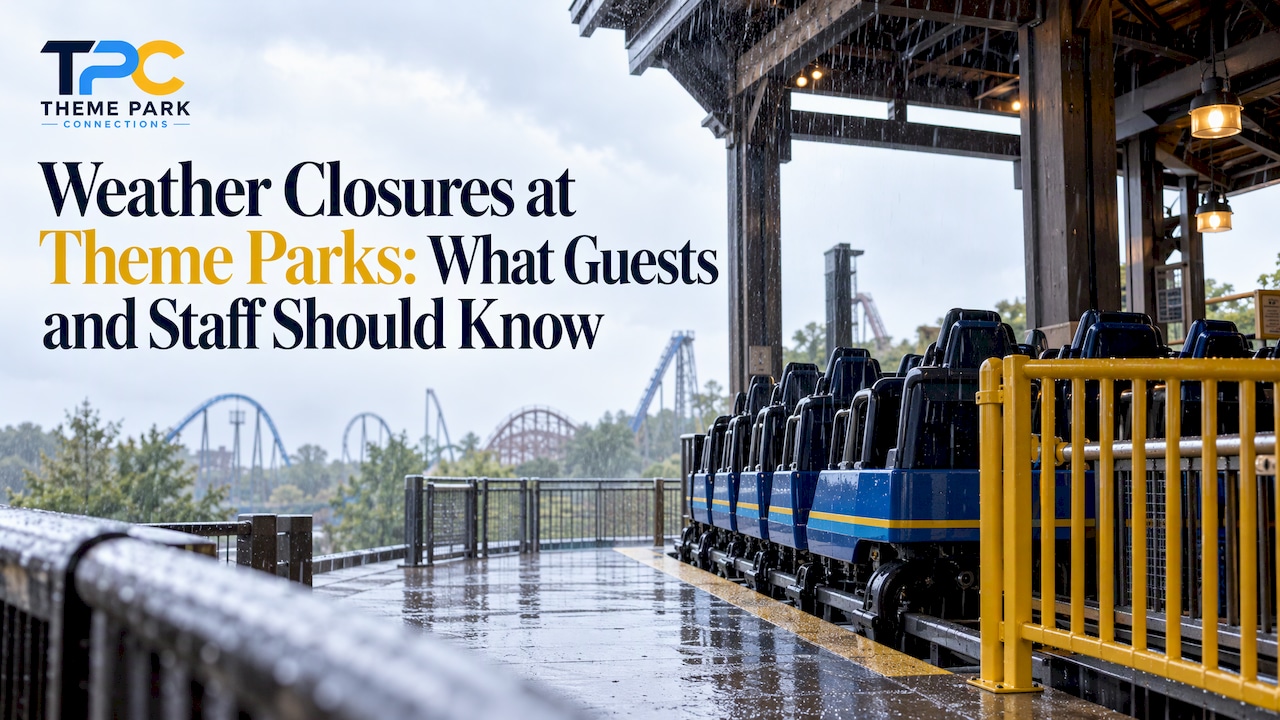
Weather Closures at Theme Parks: What Guests and Staff Should Know

Theme parks close rides, and sometimes the whole park, when lightning, high wind, flooding or a named storm makes operating unsafe. Most closures follow written thresholds, such as lightning within a set number of miles, rather than a manager’s gut call. They come in stages: tall or exposed rides first, then more attractions, then the park. If you work in a park, knowing those stages makes you calmer and more useful when the weather turns. If you are visiting, they tell you what to expect and what to ask for.
TL;DR
- Closures are staged. Tall, slow-to-evacuate rides stop first, often when lightning is 10 to 15 miles away, and more rides follow as it gets closer.
- Rides usually reopen only after about 15 minutes with no lightning, so a short storm can still mean a long hold.
- Ticket policies vary. Rain alone rarely earns a refund, but some parks offer return tickets when many attractions close for a long time.
- Hurricanes and named storms lead to full closures announced ahead of time, and parks post updates on apps, websites and social media.
- For employees, a weather day is a communication job: know the chain of command, the guest script and the plan for your area.
Table of Contents
- Why parks close for weather
- How the stages work: lightning, wind and rain
- Full-day closures and hurricanes
- How guests find out
- What happens to your ticket
- Can you go into a park that is closed?
- What a weather day means for park employees
- For hiring managers: plan the weather response before you hire
- Our perspective
- Find your place on the team
- FAQ
- Sources
Why parks close for weather
A coaster, drop tower or swing ride is built to manufacturer limits. Wind, lightning and heavy rain push conditions past those limits, and guests on a ride cannot take cover. Guests in a queue or on a midway can be hurt as well.
The rules are not only company policy. Maryland’s regulations, for example, require operators to follow manufacturers’ wind and weather restrictions and to unload or evacuate riders and close and secure an attraction right away in listed emergencies. Oklahoma’s rule, shown as amended in 2026, requires owners and operators to close the park or ride during inclement weather, including high winds and lightning, until conditions are safe. Rules differ by state, but the direction is the same everywhere.
At the national level, the National Weather Service publishes an Outdoor Venue Lightning Safety Toolkit that names amusement parks and water parks. It recommends a written lightning plan, access to NWS warnings, a designated person watching the weather, several ways to alert guests, clear shelter directions, and training for staff and guests.
How the stages work: lightning, wind and rain
Most parks do not flip a single switch. They use distance and condition triggers, and they act in layers.
Lightning distance rules
Lightning is the most common reason rides stop. Park policies are usually posted on their websites, and they look alike:
| Park | What the park’s posted guidelines say |
|---|---|
| Kings Island | Its weather policy lets its tallest rides suspend when lightning or a storm is about 15 miles away, adds more coasters and taller flat rides near 10 miles, and the remaining exposed flat rides at 5 miles. |
| Silver Dollar City | Named attractions suspend when lightning is within 10 miles, more at 5 miles, and all stay closed until 15 minutes pass after the last strike. |
| Dollywood | Listed attractions suspend within 10 miles, more within 5 miles, with the same 15-minute wait after the last strike. |
Kings Island also notes that it may act earlier, depending on how fast a storm is moving and how long evacuation takes. The NWS toolkit says the same thing in general terms: evacuation distances should fit the size of the venue and the time it takes people to reach safe buildings. It describes an evacuation lead time of 30 minutes or more for organized or fast-moving storms, and it uses 8 miles as a decision point in its example procedures.
Wind, cold and steady rain
Rain by itself often does not stop a ride. Kennywood says most of its rides can run in steady rain, but nearby lightning, high wind or low temperatures can close attractions for part or all of a day. It puts guest and team-member safety ahead of how fast it can reopen.
That is why a ride can sit closed under a bright sky. Lightning is tracked in a radius around the park, and wind limits are set by the ride’s design, not by how the weather feels on the ground.
Which rides go first
The International Association of Amusement Parks and Attractions (IAAPA) is the main trade group for the industry. Its 2024 extreme-weather report recommends that parks prioritize rides that take longer to evacuate or are more weather-sensitive as conditions worsen. That matches what guests see: the tall coasters and drop towers stop first, while indoor and covered rides keep going until a strong storm is directly overhead.
Full-day closures and hurricanes
A full closure usually comes from a threat that can be forecast, not from a passing cell. When a hurricane or named storm approaches Florida, parks announce closures in advance. During Hurricane Milton in October 2024, Disney announced it would close Magic Kingdom, EPCOT and Disney Springs ahead of landfall, with other Orlando parks making their own calls. Busch Gardens Tampa Bay, ahead of Hurricane Helene, enacted a named storm policy and closed for a set day.
Winter storms can do the same in places that rarely see snow. In February 2023, Southern California parks closed or shortened days when a storm hit, and Knott’s Berry Farm kept some marketplace shops open until early evening.
Smaller parks have similar language. Story Land says it operates rain or shine, but lightning or heavy rain can close some rides for a while, and severe weather may bring an early or full closure.
How guests find out
In the park, the fastest sources are announcements and the people in front of you. Kings Island says guests should follow in-park announcements and instructions from associates, and that rides reopen when the storm and lightning have passed and it is safe.
Major parks often do not use lightning sirens. WUSF reported in March 2026 that most big Florida parks lack them and rely on staff and other methods to alert guests. IAAPA lists apps, digital signage, websites and social media as channels for sharing changing conditions with both employees and the public.
Before a trip, check the park’s own app or website that morning and the forecast for the day before. The NWS recommends event organizers begin monitoring forecasts at least three days ahead, which is a good habit for guests planning a big day, too.

What happens to your ticket
Policies are set by each park and change, so read the current terms on the park’s own site. The general pattern is consistent.
- Ordinary rain or a short lightning hold: usually no refund. WUSF’s report says rain alone does not qualify Disney guests for a refund.
- Many attractions closed for a long time: some parks offer a return ticket. Idlewild’s Rainy Day Guarantee applies when the park announces an early closing or when a significant number of attractions are closed together for a significant time. Guests show a valid same-day wristband at Guest Services before leaving.
- Return tickets have rules: Story Land may issue a same-season return ticket when operations are affected for at least 30 minutes, but tickets are not issued after 4 p.m., and admission is not refunded.
- Hurricanes: WUSF reported that Disney allows reservation changes or cancellation when a Hurricane Warning applies to Orlando or the guest’s home location within seven days of arrival. Third-party bookings go through the seller.
USA Today’s January 2025 survey of ticket policies found that many parks do not refund ordinary weather visits, while some offer rescheduling or return tickets when significant attractions close. It also reported Disneyland tickets as nonrefundable and Universal Orlando as considering case-specific requests, with exceptions for qualifying hurricane impacts.
Can you go into a park that is closed?
No. When a park is closed for weather, it is closed to guests, even if the gates are unlocked or the storm has passed. Entering after a closure is trespassing, and it also puts you in an area where staff may be inspecting damage, clearing debris or checking ride systems. Wait for the park’s official reopening announcement.
What a weather day means for park employees
Guests see rides stop. Employees see everything behind that: radios, checklists, guest questions and a changing plan. If you work in a park or want to, this is where weather closures matter most.
IAAPA’s report says an established communication chain, tested plans and staff training help employees direct guests efficiently during extreme weather. IAAPA’s insurance guidance describes weather as an operations-wide issue. Deteriorating conditions may mean pausing rides, relocating guests, closing outdoor areas, postponing events and adjusting staffing, ideally under an established plan. It reaches parking, vendors and utilities, not just rides.
Staffing can shift as well. A customer account from a workforce software company describes one park moving employees between restaurants when weather or low attendance closes one area. Reassignment is one common response, so expect that your shift location or tasks might change.
A practical routine for your shift
- Know your trigger and your role. Ask your supervisor what happens in your area at each stage: who stops the ride, who clears the queue, and where guests are sent.
- Learn the channels. Find out which radio channel, app or lead gives official updates, and repeat only those.
- Use a short, steady script. For example: “The ride is paused because of lightning nearby. The team will reopen it once it is safe. The Guest Services location by the entrance can answer ticket questions.”
- Keep guests moving to shelter. Queue lines, ride exits and open midways are crowd-flow problems. Our queue management guide covers how teams keep lines orderly.
- Check your schedule rules. Closures can change when you work. Read how attendance policies work at theme parks and what to expect from part-time scheduling.
If you work in food service, a sudden closure can mean a rush followed by an empty dining room. The last 30 minutes of closing a park restaurant is a useful picture of how to wind down in an orderly way. Stage and entertainment teams face their own version when shows move or cancel, which our guide to weather-driven show changes addresses.
Communication is the skill that stands out
The people who earn trust on a weather day are the ones who relay information clearly and calmly. Our guide to clear communication across the park team in weather-driven operations shows what that looks like. It is also a skill that supports a move into leadership, operations control or guest services. If that is your goal, see how guest services staff move into operations.
For hiring managers: plan the weather response before you hire
If you recruit for a park, weather is part of the job description, even if the ad does not say so. Seasonal staff do better when they are trained on the plan before the first storm. IAAPA’s report points to tested plans and staff training, and the NWS toolkit calls for education of both staff and patrons. Our amusement park staffing guide shows how parks build teams, and the job ad mistakes guide helps you describe the real demands of the role honestly.
Our perspective
We think weather closures are one of the best windows into how a park really works. Every stage of a closure, from the first lightning hold to the reopening announcement, depends on people who know the plan and can say it plainly to a guest.
That is why Theme Park Connections pairs job listings with guides and a community of people who work in parks. A new hire can read how weather-driven operations are communicated before their first shift. A veteran can compare notes with colleagues at other parks. A hiring manager can reach an audience that already understands theme park work.
If you are building a career, weather days are where you can show calm, clear communication, and that is the kind of reputation that leads to lead, trainer and coordinator roles.
Mike
Find your place on the team
Theme Park Connections lists theme park jobs across operations, entertainment, food and beverage, hospitality, maintenance, guest services, retail and leadership, alongside guides and a community forum for peer support. If you want to see how parks hire and what roles involve, start with our amusement park staffing guide. Employers can post openings to an audience already familiar with theme park work, and our job posting cost guide explains the budget.

You can also browse everything from the Theme Park Connections home page.
FAQ
Does Six Flags close for bad weather?
Yes, it can. Kings Island’s Six Flags weather policy says its tallest rides can suspend when lightning or a storm is about 15 miles away, and the park may act sooner depending on storm speed. Severe weather can lead to wider closures. Check your park’s own website or app for current guidelines.
How long do rides stay closed after lightning?
At Silver Dollar City and Dollywood, suspended rides stay closed until lightning has been absent for at least 15 minutes after the last strike. A storm that passes quickly can still mean a hold of 30 minutes or more once you count the storm and the wait.
Do I get a refund if the park closes for rain?
Usually not for ordinary rain or short holds. Some parks offer return tickets or rescheduling when many attractions close for a long time or the park closes early, and hurricane exceptions exist at some. Ask Guest Services before you leave, and bring any wristband or proof of admission.
How do I find out if a park is closed today?
Check the park’s official app, website and social media accounts, which are the channels IAAPA identifies for communicating weather changes. Once inside, follow announcements and instructions from park associates.
What should I do as an employee when weather closes my area?
Follow the plan for your area, use official channels for updates, and give guests short, calm directions. Ask your supervisor in advance what each stage means for your post and your schedule.
Sources
- Maryland Regulations, General Environment
- Oklahoma Administrative Code 380:55-13-7
- NWS Outdoor Venue Lightning Safety Toolkit
- NWS Weather Considerations for Outdoor Events
- Kings Island rainy weather policy
- Silver Dollar City weather guidelines
- Dollywood weather guidelines
- Kennywood FAQs
- IAAPA: Preparing for Extreme Weather Situations
- IAAPA Insurance: Severe Weather Planning
- Story Land: Know Before You Go
- Idlewild FAQs
- USA Today: Are theme park tickets refundable?
- WUSF: Weather guide for Disney World and other Florida attractions
- Walner Law: Premises Liability, Amusement Parks
- UKG: Wahooz customer story