Emergency Drills at Theme Parks: What Staff Practice
Theme park emergency drills are rehearsals in which every kind of employee, from ride operators to food and beverage teams, practices the same few things: staying calm, calling for help, moving guests to safety, and reporting to a leader. Parks run them so that the first real ride shutdown, storm or medical call is not the first time anyone has done it. If you are starting a park career or growing within one, knowing how drills work shows employers you take guest safety seriously, and it makes your first week on the job far less stressful.
TL;DR
- Drills commonly cover medical emergencies, ride shutdowns, severe weather, lost children, fire alarms and zone evacuation.
- Every shift takes part, including part-time, hourly and contract staff, and roles are assigned in advance so nobody improvises.
- Large operators use tiered plans: close the park normally, evacuate to the nearest exit, or move guests to a safe haven.
- Some states require ride operators to be trained, and certified, in emergency procedures, and to keep written records.
- After a drill, good parks document what worked, find where people were confused and update the procedure.
Table of Contents
- What emergencies do parks drill for?
- Who takes part in a drill?
- What a cast member does in an evacuation
- Types of drills and how they build skill
- What the rules say
- How parks review a drill
- Turning drill experience into career growth
- Our perspective
- Find your next park role with Theme Park Connections
- FAQ
- Sources
What emergencies do parks drill for?
A park does not rehearse one emergency. According to one park operations training guide, drills can cover medical emergencies, ride shutdowns, severe weather, lost children, fire alarms and zone evacuation, and the mix should reflect the site’s own risk assessment, equipment, staffing and local regulations. A coastal park will spend more time on storms. A park with tall coasters will spend more time on ride evacuation. A park with a big water area will drill differently again.
Public venue emergency plans in the U.S. follow a similar list. One venue’s published plan covers fire, medical emergencies, severe weather, active shooter and other critical threats, and puts life safety, fast communication and coordination with law enforcement and EMS first.
Ride evacuations
This is the scenario guests worry about most, and the one attractions teams rehearse most carefully. One U.S. indoor park’s rider guide explains that a ride evacuation may be required because of an emergency, extreme weather or a mechanical problem, and that guests may have to walk across catwalks at height or down steeply inclined stairs. Your drill job is to know your ride’s evacuation route, how you will talk to guests who are nervous, and who needs extra help.
The industry association IAAPA publishes guidelines for a successful ride evacuation with best practices, responsibilities, a checklist and a flow chart that parks use to build and audit their own procedures.
Weather
Weather is the emergency most employees will actually meet. A written plan from one U.S. sports venue shows how specific the thresholds get: it delays activities for 30 minutes after the last lightning strike within 10 miles, encourages staff to begin clearing the park when lightning is under 8 miles away with multiple strikes, and calls for an evacuation announcement at 5 miles unless the storm is moving away. Your park’s numbers will differ, so ask your supervisor for yours. For the guest and staff side of closures, our guide on weather closures at theme parks walks through what to expect.
Lost children and medical calls
These are the everyday emergencies, and they are drilled because they happen so often. A separated child triggers a specific guest services routine, covered in our guide on responding to a separated child. For medical events, one U.S. training provider notes that local and state rules often call for staff to be certified in CPR, AED use and first aid, and that its theme park scenarios cover cardiac arrest, heat-related illness, ride injuries and choking.
Who takes part in a drill?
Everyone on duty. The venue plan cited above applies to full-time, part-time and contract staff alike. It requires each department to run a bi-annual course on the communication chain of command and reporting procedures, and department managers pass activation information to part-time and hourly staff.
This matters if you are seasonal. You may only be on the roster for a few months, but you are expected to know the same plan as a ten-year veteran.
Roles are assigned in advance
Good drills assign jobs before anything happens. The training guide mentioned earlier recommends that roles for incident coordination, emergency service calls, guest direction, zone security and event recording are set ahead of time and cover every shift and scenario, including times when senior managers are not on site. It also stresses that staff should not take actions beyond their training, which protects both you and guests.
How large resorts organize
Disney’s published Safety Report says its Unified Incident Command Teams at both domestic resorts prepare through comprehensive planning and frequent drills with law enforcement, fire departments and other agencies. Its radio systems can send a tone-out that reaches hundreds of cast members at once, and its command structure mirrors the Incident Command System that public safety agencies use, which is a standard way of organizing who is in charge during an emergency. For a frontline employee, the lesson is simple: you will be told what to do by a clear chain, so learn who is in it.
What a cast member does in an evacuation
The steps below follow Disney’s Cast Member Safety and Health Handbook, which gives a clear model of what frontline employees are taught. Your park will have its own version, but the sequence is a useful one to know.
- Stay calm and assess. Take a moment to see what is happening before you act.
- Get yourself and others out of harm’s way.
- Call 911 if needed. Give your name, the location and the nature of the emergency, and stay on the phone until directed.
- Notify your leader at the first opportunity.
- Follow the assigned plan. Report to a group leader at the assembly area and stay until released.
- Know where the nearest AED is in case of heart-related incidents or loss of consciousness.
Plan A, Plan B and Plan C
The same handbook describes tiered evacuation plans. In Plan A, an accelerated closure, the park is cleared through normal routes, with guests informed by PA announcements and cast interactions. In Plan B, cast members direct guests to the nearest exit along a route suited to the situation. In Plan C, a safe haven, guests take cover when buildings may be unsafe and leaving is not possible, for example during earthquakes or tornadoes in California or imminent-danger situations in Florida.
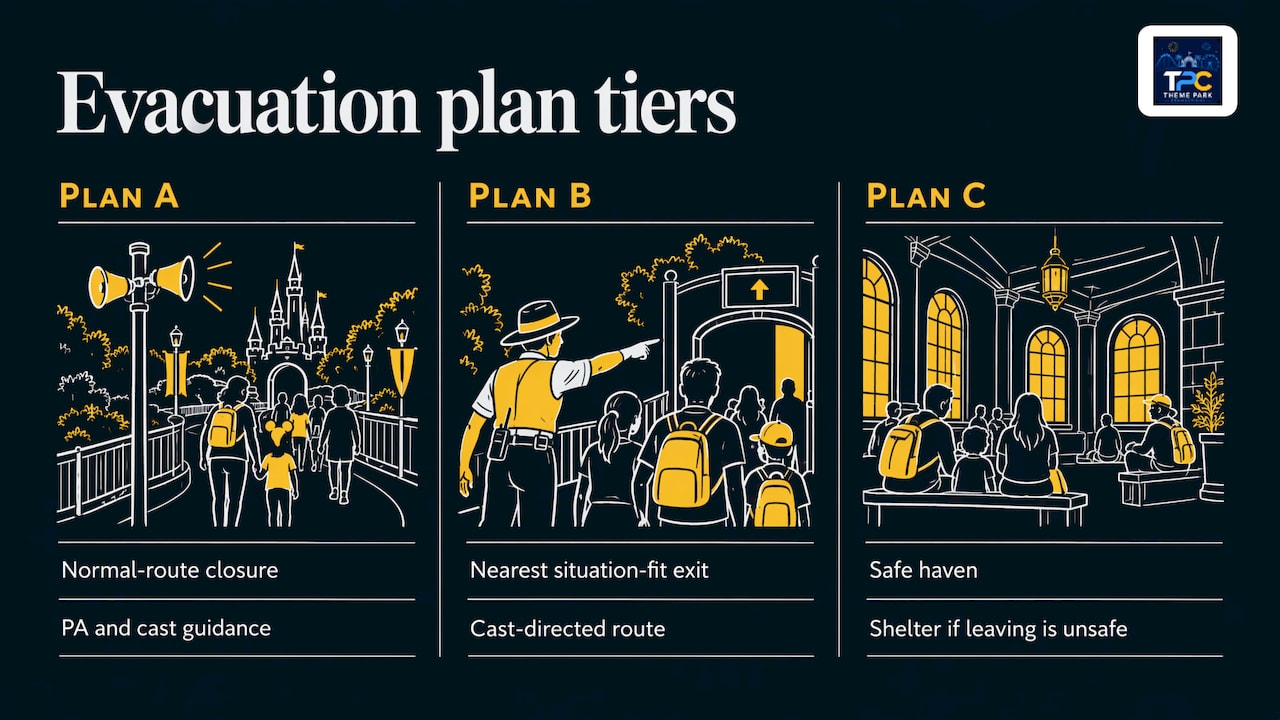
The tiers are worth learning as a concept. Even if your park labels them differently, you will probably be asked: do we close normally, do we move people out, or do we move people in?
Talking to guests and responders
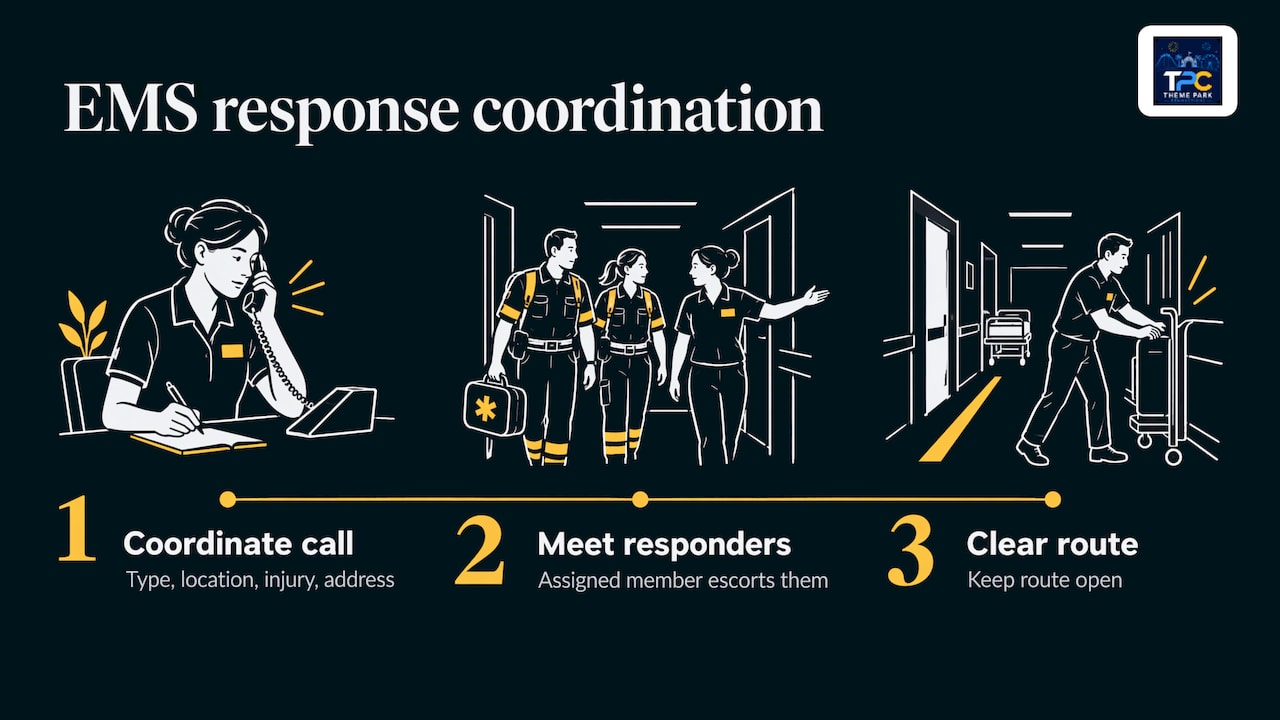
In a real event your voice is part of the safety system. Short, calm, specific directions work best: where to go, how far, and who will help. The handbook has cast members guide guests to exits or assembly areas, with designated coordinators who help reunite separated parties. When EMS is needed, the venue plan has the manager on duty coordinate the call with the emergency type, exact location, injury type and park address, a designated team member meets and escorts responders, and staff clear the area so responders can get through.
Here is a sample line you might practice for a ride stop: “Folks, we’re pausing the ride for a moment. Please stay seated, and a team member will be with you shortly.” It is plain, it gives guests a next step, and it avoids guessing about the cause. For more on this kind of guest communication, see our guide to guest services training.
Types of drills and how they build skill
Not every drill involves moving real people. Parks mix formats: a quick talk-through of a scenario, a radio-only communication check, and a full-scale exercise with responders. The point of mixing them is that each one tests something different. If you want to see how a different industry thinks about using different drill types to validate procedures, film production crisis planning follows the same logic: start small, then add realism.
There is evidence that repeated, layered practice works. A peer-reviewed study of the 2015 Baxian theme park dust explosion in Taiwan found that tailor-made one-year training programs for senior supervisors, middle-level supervisors and frontline staff strengthened the incident command system and first-responder skills in evacuation, triage and first aid. Skills improved gradually over several drills, and communication became more effective.
Directing guests during a full evacuation
A park-wide evacuation depends on clear signs, clear voices and staff standing in the right places. Planning guidance from the events world, such as this event evacuation and safety checklist, shows how exits, staff positions and guest direction are laid out before an event begins. Parks apply the same thinking at a much larger scale.
What the rules say
There is no single national rulebook for every park, and requirements vary by state. Two examples show the pattern.
- Oklahoma: The state’s amusement ride statutes, in the July 2026 version, require ride operators to hold a training certificate issued within one year of operating a ride. Training includes emergency procedures, and operators must show they understand them and know the ride’s normal and emergency controls. Owners keep written training records on the premises for state inspectors.
- Michigan: Under the state’s Carnival-Amusement Safety Act, as amended in 2022, ride owners must establish an emergency response plan that identifies ride-specific hazards, lists emergency equipment, and states when to give first aid, call emergency services and suspend operation. Employees who operate or maintain rides must be trained in the plan, and falsifying a training record is a misdemeanor.
For you, the takeaway is practical: keep your own copy of any certificate, and make sure your training is recorded. If you move between states, ask your new park what its state requires.
How parks review a drill
The drill itself is only half the job. Afterward, staff should document what worked, identify where people were confused and update procedures. The U.S. Homeland Security Exercise and Evaluation Program, a federal framework many organizations borrow from, describes an After-Action Report and Improvement Plan that records strengths, areas for improvement and corrective actions. It also says a scenario should be plausible, realistic and challenging.
If you are asked for feedback after a drill, give it. A comment like “the radio call was unclear at the north gate” is exactly what an improvement plan is built from.
Turning drill experience into career growth
Drill experience shows up in interviews more often than people expect. Hiring managers like stories about staying calm, following a chain of command and speaking clearly to guests. Our behavioral interview questions guide can help you shape those stories, and the operations control and dispatch career guide shows where a safety-minded employee can go next. If you are moving up from the guest-facing side, the guest services to operations transition guide is a good map.
For employers, drills are also a hiring and training topic: how parks hire and build teams is covered in our guide to amusement park staffing, and what they fund for instruction is in our guide to theme park training budgets.
Our perspective
Safety training is the most shared experience in a park. A ride operator, a lifeguard, a cook and a custodian all hear the same plan, and that common language is what lets a team move together when something goes wrong.
At Theme Park Connections, we built our platform around the idea that park careers are easier when people learn from each other. Drill knowledge is exactly that kind of knowledge: it is passed along in break rooms, in forums and in conversations with the person who has done the job. We want you to arrive prepared, ask good questions and carry what you learn from park to park.
Our guides are written for the real operational side of the industry, and our community is where you can compare how different roles handle the same situation. That is how one conversation becomes a professional relationship, and how a nervous new hire becomes the person others turn to.
Mike
Find your next park role with Theme Park Connections
Theme Park Connections combines theme park job listings with a community forum for peer support and practical career guides across operations, entertainment, food and beverage, hospitality, maintenance, guest services, retail and leadership. If you are hiring, you can post openings to an audience already familiar with park work, and our job posting cost guide explains the budget side. If you are looking, start at themeparkconnections.com.

Want to talk to someone who has been through park training? Our guide to finding a theme park mentor shows how to start that conversation.
FAQ
How often do theme parks run emergency drills?
It depends on the park and the state. One published venue plan requires a bi-annual chain-of-command training course in each department, and large resorts describe their drills with local agencies as frequent. Ask your supervisor for your park’s schedule when you start.
Do seasonal and part-time employees take part?
Yes. Published plans apply to full-time, part-time and contract staff on duty, and managers are expected to brief hourly employees. Seasonal staff are usually trained before their first shift on a ride or in a zone.
What should I do first if there is an emergency on my shift?
Stay calm, get yourself and others out of harm’s way, call 911 if needed, and tell your leader as soon as you can. Then follow your park’s assigned plan and stay at your assembly point until you are released.
Do I need CPR or first aid certification to work at a park?
It depends on your role and your state. Some local and state rules call for staff to be certified in CPR, AED use and first aid. Your hiring manager will tell you what your position requires, and many parks provide the training.
Sources
- Amusement Park Staff Training: How to Prepare Your Team Before Opening
- Nickelodeon Universe Rider Safety Guide 2025
- Emergency Action Plan for a U.S. public venue (FY 25)
- IAAPA: Guidelines for a Successful Ride Evacuation
- CPR, AED and First Aid Training for Theme Parks
- Disney Safety Report
- Disney Cast Member Safety and Health Handbook
- Emergency Response Training Program for Theme Parks: Experiences of Taiwan
- Oklahoma Amusement Ride Statutes and Rules
- Michigan Carnival-Amusement Safety Act of 1966
- Homeland Security Exercise and Evaluation Program (HSEEP)
- Crisis management on set
- Event safety checklist