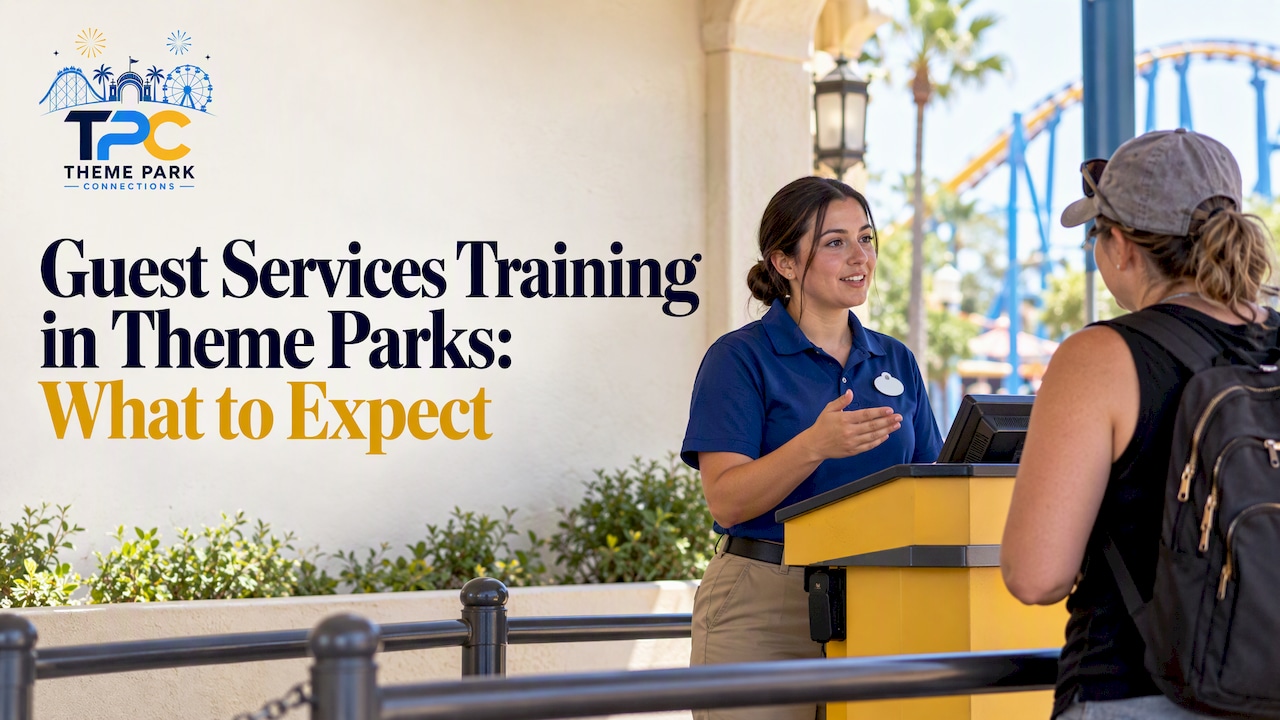
Guest Services Training in Theme Parks: What to Expect

Guest services training in a theme park teaches you to keep guests safe, answer their questions, recover when something goes wrong, and make the day feel easy. It combines service standards, park policies, communication skills and real scenarios, and it usually starts before your first shift and continues on the job. This guide explains what is typically covered, what employers look for in guest services and guest relations hiring, and how to build the skills and credentials that lead to your next role.
TL;DR
- Park guest services training covers service standards, complaint and service-recovery skills, park policies, accessibility, and teamwork, usually with real-life scenarios.
- Employers hiring for guest relations roles look for clear written and verbal communication, a friendly and professional manner, basic computer and phone skills, and availability for nights, weekends and holidays.
- Guest relations, admissions and entry roles are different jobs, so prepare for the one you apply to.
- A recognized credential such as Certified Guest Service Professional can support your growth, and you can earn it without a minimum time in a position.
- Practicing example questions and answers before an interview is the fastest way to feel confident.
Table of Contents
- What guest services training covers in a theme park
- The skills employers expect from guest services candidates
- How parks train new and returning team members
- Guest relations versus other guest services roles
- Preparing for guest services hiring
- Credentials that support career growth
- Our perspective: train for the moment, not the manual
- Find park roles and peers in one place
- FAQ
- Sources
What guest services training covers in a theme park
The label changes from park to park, but the core is consistent. You learn what good service looks like, how to act on it under pressure, and how to fix it when it fails.
IAAPA, the attractions industry association, describes guest-services training for attractions as something that should define guest service, explain a service-oriented culture, teach behaviors that meet or exceed expectations, and show how to resolve complaints and service failures. It also covers guest loyalty and repeat visits, which is why a single friendly interaction matters to the whole business.
Disney’s public course description for its Hospitality & Guest Service series gives a good picture of a large operator’s approach. It includes guest-service-recovery tools, soft skills for personalized attention, and the Four Keys. Its park-operations module uses real-life guest scenarios and addresses operational excellence. Disney’s service standards are often summarized as Safety, Courtesy, Show and Efficiency, in that order of priority. The order is the lesson: in a park, safety comes before everything, and friendliness never replaces it.
The usual building blocks
Expect most of these topics in some form:
- Service standards and culture. What the park promises guests and what that means at your location.
- Communication. Greeting guests, giving directions, explaining policies kindly, and using clear phone and radio language.
- Service recovery. Listening to a frustrated guest, apologizing, solving what you can, and escalating what you cannot.
- Park knowledge. Hours, ticket types, attraction rules, wait times, dining, and where to send guests for help.
- Accessibility. How to explain accessibility programs and accommodations respectfully.
- Safety and teamwork. Crowd awareness, reporting issues, and covering for teammates during peaks.
If you want a deeper look at how recovery skills apply to park careers, our page on theme park guest services careers and recovery skills collects them in one place.
The skills employers expect from guest services candidates
Job postings are the most honest description of what training has to build. Read a few and the same themes appear.
A Six Flags posting for a Guest Relations Representative asks for excellent written and verbal communication, a professional and friendly demeanor, knowledge of park policies and procedures, and basic computer and phone-system proficiency. It also lists teamwork and flexible availability, and notes that the role provides accessibility accommodations. A second Six Flags guest relations posting adds enthusiasm and availability for nights, weekends and holidays.
On the attractions side, a Universal Kids Resort attendant role combines safety-critical ride operation with guest engagement, themed information, queue and wait-time management, crowd control and accessibility standards. It also expects cleanliness, teamwork and environmental, health and safety training.
Put together, the skills fall into three groups:
- People skills: listening, empathy, a calm voice, and a genuine welcome.
- Operational skills: knowing policies, using systems, managing lines, and following safety procedures.
- Reliability: showing up on holidays, working as part of a shift team, and staying steady when the park is full.
Notice that none of these require previous park experience. Retail, restaurant, school and volunteer work all build them, and you can say so in an application.
How parks train new and returning team members
Most parks train in layers: a general orientation on culture, role-specific instruction, and on-the-job coaching with a lead or trainer.

Disney Institute describes this order directly. New Cast Members first learn the shared purpose in Traditions, and only afterward the hard skills of their specific role. The thinking is that guests receive better service when employees understand why they do the job and are empowered to act, not merely told which tasks to complete.
That is useful to know as an employee. If you are given room to solve a guest problem, such as offering a fast-pass resolution or a replacement item within the policy, use it. Training is meant to prepare you for those moments.
Short modules and seasonal refreshers
Not all training is long. IAAPA lists a 60-minute format built from videos, inline activities, real-life scenarios and a knowledge check. It is aimed at frontline employees, new hires and employees returning for a new season. If you return to the same park each summer, expect a refresher like this, and treat it as a chance to ask about anything that changed.
What on-the-job training looks like
The floor is where most learning happens. A Universal Kids Resort lead role shows how this works: leads conduct shift meetings and safety talks, train new hires on venue duties, monitor training plans and trainee progress, and document issues. They also review readiness and adjust staffing and rotations.
For you, that means your lead is the person to ask. Good questions in the first week include:
- “What are the three questions guests ask most often at this location?”
- “When should I call you instead of solving a problem myself?”
- “Can I shadow someone during the busiest hour?”
If you are building a program for your park
Employers designing training can start with the basics of hiring and onboarding. IAAPA’s recruiting bundle covers job analysis, job descriptions, effective postings, recruiting and interviewing techniques, onboarding, and designing on-the-job training, with a listed seat time of 155 minutes. Its courses include practical examples and knowledge checks. For new frontline supervisors, First Steps: Supervision trains them as motivators, leaders, trainers and administrators while reinforcing guest service, safety, cleanliness and teamwork.
A simple structure that holds up:
- Teach purpose and standards first.
- Add role skills with scenarios, not just slides.
- Pair every new hire with a trainer and check progress against a written plan.
- Collect guest feedback and turn it into updated standards.
That last step has support. One consultancy’s account of Disney’s service initiative says guest research was translated into service standards and tested against control properties, with double-digit gains in excellent ratings and return intent over a three-month test. Treat it as one reported case, not a promise, but the method of measuring before and after is worth copying.
Guest relations versus other guest services roles
Guest services is a family of jobs, and the hiring bar differs between them. Hersheypark’s seasonal job descriptions show the split clearly. Guest Relations Agents may handle concerns, accessibility-program enrollment, de-escalation, conflict resolution and problem-solving. Arrival Experience Attendants focus on entry, questions and guest flow. Ticketing and Admissions Agents sell tickets and add-ons and troubleshoot ticket issues.
| Role type | Main focus | What to show in an application |
|---|---|---|
| Guest relations | Concerns, accessibility enrollment, de-escalation | Calm communication, patience, problem-solving |
| Entry and arrival | Questions, directions, guest flow | Friendly energy, clear speech, standing for long shifts |
| Ticketing and admissions | Sales, add-ons, ticket issues | Accuracy, cash or system comfort, upselling with honesty |
| Attractions | Safe operation plus guest engagement | Attention to procedure, teamwork, safety mindset |
If you are applying for guest relations, lead with conflict examples. If you are applying for entry or admissions, lead with welcoming people and handling volume. Our guest services careers page shows how people move between these roles.
Preparing for guest services hiring
Employers often use scenario questions because they reveal how you act when a guest is upset and a line is growing. You can prepare with a simple structure: what happened, what you did, what the result was, and what you learned.
Sample questions and answers
Question: “A guest tells you they waited 45 minutes and the ride closed as they reached the front. What do you do?”
A strong answer: “I would start by acknowledging the frustration and apologizing that it happened. Then I would explain what I know about the reopening, offer what the park’s policy allows, and point them to the nearest alternative. If I could not resolve it, I would bring in my lead and make sure the guest knew what would happen next.”
Notice the order: listen, apologize, explain, act, escalate. It mirrors the recovery steps taught in most training programs.
Question: “A teammate does not show up and you are alone at the booth during a rush. What do you do?”
A strong answer: “I would let my lead know right away so help is on the way, keep guests informed about wait times, and prioritize safety and accuracy over speed.”
A short preparation checklist
- Read the job posting and underline every skill it names.
- Write down two stories: one where you helped an upset customer, one where you helped a team.
- Confirm your availability for nights, weekends and holidays, since postings list it.
- Learn the park’s accessibility programs and basic policies from its public website.
- Practice answering aloud, then ask a friend to interrupt you with a complaint.
Seasonal hiring is also fast. A 2022 PeopleScout case study is not needed to know that applying early and keeping your application short and clear helps, so apply as soon as postings go live and keep your résumé to one page.
Credentials that support career growth
On-the-job training builds skill, and a recognized credential makes it visible. The American Hotel & Lodging Educational Institute’s Guest Service Gold program applies to leisure travel, tourist attractions, amusement parks and cruises. It teaches anticipating needs, creating memorable experiences, recovering from difficult situations and interpersonal soft skills. After passing the exam you can earn the Certified Guest Service Professional (CGSP) designation, and there is no time-in-position requirement.
That last detail matters for seasonal workers, who often cannot show a year in one job. You can earn the certification between seasons and carry it into your next application.
Some destinations promote it widely. Lee County’s Guests First program in Florida pairs Guest Service Gold with CGSP certification, and its 2022 release reports more than 1,000 certifications. Local leaders in that release describe listening, empathy, solutions and professional development as outcomes. Check whether your own region’s tourism office runs something similar, and confirm current pricing with the provider.

From guest services to leadership
Strong guest services work often leads to trainer, lead and supervisor positions. Leads coach new hires, run shift meetings and monitor training progress, as the Universal posting above shows. If that is your goal, volunteer to train new team members, document what works, and ask your manager about a supervision course. Our leadership, trainer and coordinator careers page maps these steps.
Our perspective: train for the moment, not the manual
We hear the same thing from team members across parks: the manual never describes the exact situation in front of you. The guests are tired, the weather has changed, the ride is down, and the person at the podium has ten seconds to decide how the guest will feel about the day.
So we think the best guest services training does three things. It explains the why, so you can make a good call when the script runs out. It practices real scenarios, out loud, with a trainer who gives honest feedback. And it connects you with people who have done the job, because a peer who has handled a hard guest interaction teaches things a slide cannot.
If you are new, do not worry about knowing everything. Park careers are built one conversation at a time, and each good one with a lead, a teammate or a guest can become a professional relationship that supports you for years. Ask questions, write down what you learn, and share it with the next person.
— Mike
Find park roles and peers in one place
Theme Park Connections combines theme park job listings with a community where cast members and aspiring team members share experiences, guides for career moves, and practical resources for guest services, operations, food and beverage, hospitality, retail and leadership. Employers can post openings to an audience already familiar with park work.
If you are ready to look for your next role or compare notes with people in the industry, join the Theme Park Connections network and start with the guest services resources.
FAQ
What skills are needed for guest services in a theme park?
Park postings consistently ask for clear written and verbal communication, a friendly and professional manner, and knowledge of park policies. Basic computer and phone skills, teamwork, and availability for nights, weekends and holidays also appear often. Attractions roles add safety procedures, queue management and crowd control.
How long does guest services training take?
It varies by park and role. Short modules can run about an hour, as IAAPA describes for frontline staff and returning seasonal employees, while a full onboarding combines orientation, role training and on-the-job coaching over your first days and weeks. Ask your hiring manager what to expect for your role.
How do I become a certified guest service professional?
Complete a Guest Service Gold training through AHLEI or an approved local program, then pass the exam to earn the CGSP certification. AHLEI states there is no time-in-position requirement. Check the official AHLEI page for the current cost and format.
Do I need experience to get hired in guest relations?
Not necessarily. Employers look for communication, a friendly demeanor and reliability, and you can show these through retail, school, volunteer or restaurant work. Prepare two or three specific stories about helping an upset customer or supporting a team.
What is the difference between guest services and guest relations?
Guest services is the broad group of guest-facing jobs, including entry, ticketing and information. Guest relations is typically the desk or team that handles concerns, accessibility programs and de-escalation, so the role leans more on problem-solving and conflict resolution.
Sources
- Disney Hospitality & Guest Service course details
- IAAPA: Creating and Maintaining the Guest Experience
- Disney service standards overview (Be Our Guest)
- Six Flags Guest Relations Representative posting
- Six Flags Guest Relations Team Member posting
- Universal Kids Resort attendant posting
- Disney Institute: empowering people to deliver exceptional service
- How Disney empowers its employees
- Universal Kids Resort lead attractions operations posting
- IAAPA Recruiting for the Attractions Industry Bundle
- IAAPA First Steps: Supervision
- Building the business case for Disney’s guest service training
- Hersheypark guest experience seasonal job descriptions
- AHLEI Guest Service Gold
- Lee County Guests First release