Ride Operator Training Checklist: What to Learn and Show
A ride operator training checklist covers five things: instruction in procedures, a demonstration of the ride, supervised operation, a pre-opening inspection routine and clear steps for emergencies and reporting. Use it to track your own progress and to show a supervisor you are ready to run a ride on your own. Theme Park Connections is built for people on this path, with park job listings, a peer community and guides for moving from one role to the next.
TL;DR
- Operators generally need instruction, a ride demonstration and a period of supervised operation before running a ride alone, as in Ohio and Kansas.
- Your daily routine starts with a pre-opening inspection and a full test cycle, which is documented.
- Loading means balancing the load, helping guests lock restraints and making a real safety check before you dispatch.
- If something sounds or feels wrong, unload calmly, tell your supervisor and keep the ride closed until it is fixed.
- Rules differ by state, so ask your park for its written training checklist and your state’s requirements.
Table of Contents
- Why a checklist matters
- The training checklist
- The pre-opening inspection
- Loading, checking and dispatching
- When something goes wrong
- Know your ride, not only the steps
- Building toward more responsibility
- Where we see this going
- Find your next ride operations role
- FAQ
- Sources
Why a checklist matters
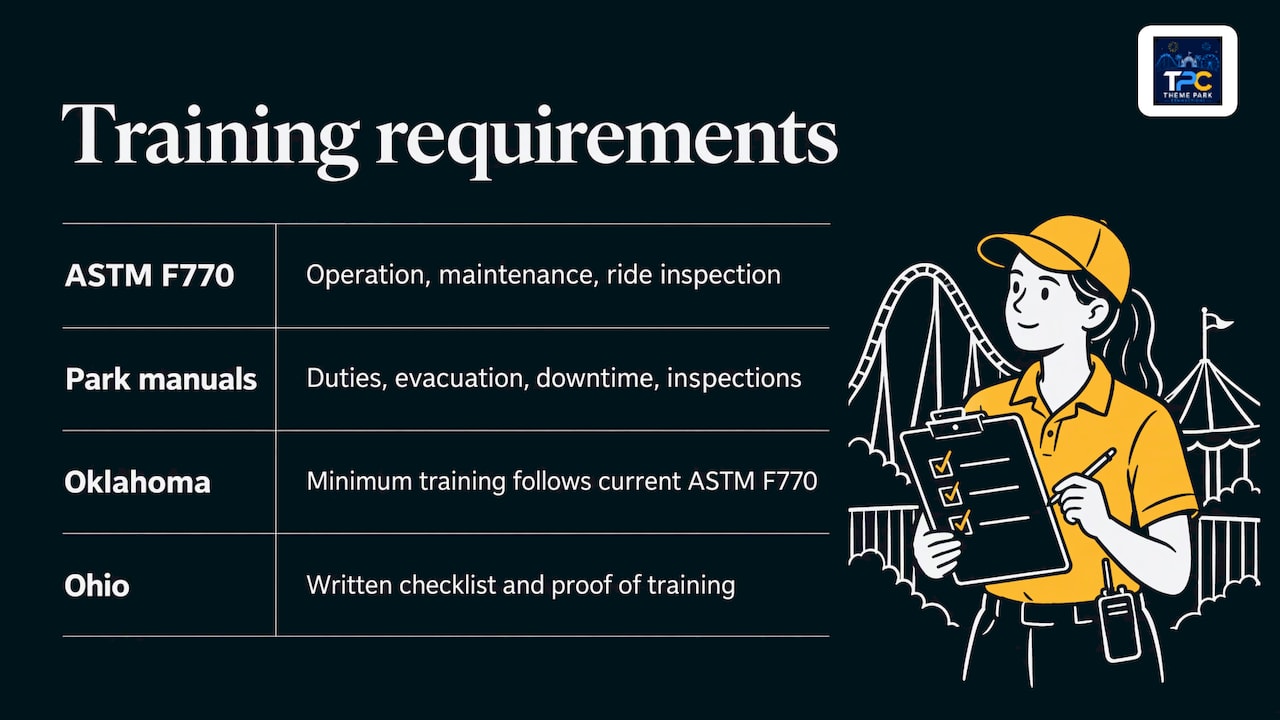
Training for ride operations is set by each state on top of the national ASTM F770 standard, which covers operation, maintenance and inspection of amusement rides. IAAPA’s Safety Corner explains that this standard calls for park procedures manuals with operator duties, evacuation plans, downtime and unusual-condition protocols and inspection steps. Oklahoma’s rulebook, for example, ties its minimum training to the current ASTM F770.
A checklist turns all of that into something you can tick off. It also gives you a record. Some states require one: Ohio asks for a written training checklist and written proof of training.
The training checklist
Use this list during your first weeks on a ride. Your park’s own checklist comes first, and the items below match what state rules commonly ask for.
Instruction
Per Ohio’s rules and Kansas statute 44-1605, an operator receives instruction on:
- [ ] Ride operating procedures
- [ ] The duties of each position on the ride
- [ ] General safety procedures
- [ ] Emergency procedures
Ohio also requires the operator to be at least 16 and to run no more than one ride at a time.
Demonstration and supervised operation
- [ ] You watched a demonstration of the physical operation of the ride
- [ ] You operated the ride under a trainer’s supervision
- [ ] Your trainer signed off, and the record is on file
Oklahoma adds ride-specific demonstrations of pre-startup checks, the daily maintenance inspection, emergency controls and safe physical operation, with a training certificate issued within one year of operating the ride and a name tag identifying you as trained.
What a certification form can look like
New Jersey’s operator training certification form is a useful model because it is specific. It certifies 11 items, including:
- Safety-based rider limitations
- Pre-startup checks
- All normal and emergency controls
- Restraint and lap bar systems
- Location of fire extinguishers, the main electrical disconnect and lock-out points
- Emergency communications
- Satisfactory operation of the ride under a trainer’s supervision
The form also expects you to know what can reasonably go wrong, how to recognize it and how to get the ride and riders into a position that minimizes injury risk. That is the difference between memorizing steps and understanding the ride.
The pre-opening inspection
Every day before guests ride, you or your team inspect and test the ride. Florida’s rule 5J-18.009, which follows ASTM F770-23, lists what the daily check covers:
- [ ] Carriers, restraint devices and latches
- [ ] Entrances, exits, stairways and ramps
- [ ] Loading and unloading areas
- [ ] Communication devices
- [ ] Safety devices and braking systems
- [ ] Fencing and guarding
- [ ] Structural integrity and safety signage
- [ ] An operational test
California’s inspection guide adds that the ride should run at least one complete cycle and that the inspection is documented and signed. For portable rides it describes fencing, gates and barricades 42 inches tall with no gap larger than 4 inches. It names the brakes to test: service, emergency, parking and back stops.
Pennsylvania’s operator manual also lists cars, belts, chains, straps, ramps, gates and general appearance, with a complete ride cycle before opening and a copy kept on site. In North Carolina, signed pre-opening records must be kept for at least 12 months.
Where it goes wrong: rushing the test cycle, signing a line you did not physically check, or skipping a gate because it looked fine yesterday. Treat every line as a real check.
Loading, checking and dispatching
Pennsylvania’s manual gives a clear routine for the loading platform:
- Load guests so the ride stays balanced.
- Help guests lock safety bars, belts, chains and straps.
- Make an actual safety check before you start the ride.
- Assist guests who may benefit from help during loading and unloading.
Good guest communication belongs here too. Short, calm instructions keep a line moving, and clear rider-limit explanations avoid arguments at the gate. For the queue side of this work, see our guide to queue management strategies. If a guest needs an accommodation, our ADA accommodations guide covers the worker side of that conversation.
A sample line for a rider whose restraint is not secure: “Let’s try that bar once more. I’ll check it before we go.” You stay friendly, and you do not dispatch until the check is real.
When something goes wrong
Stop and unload
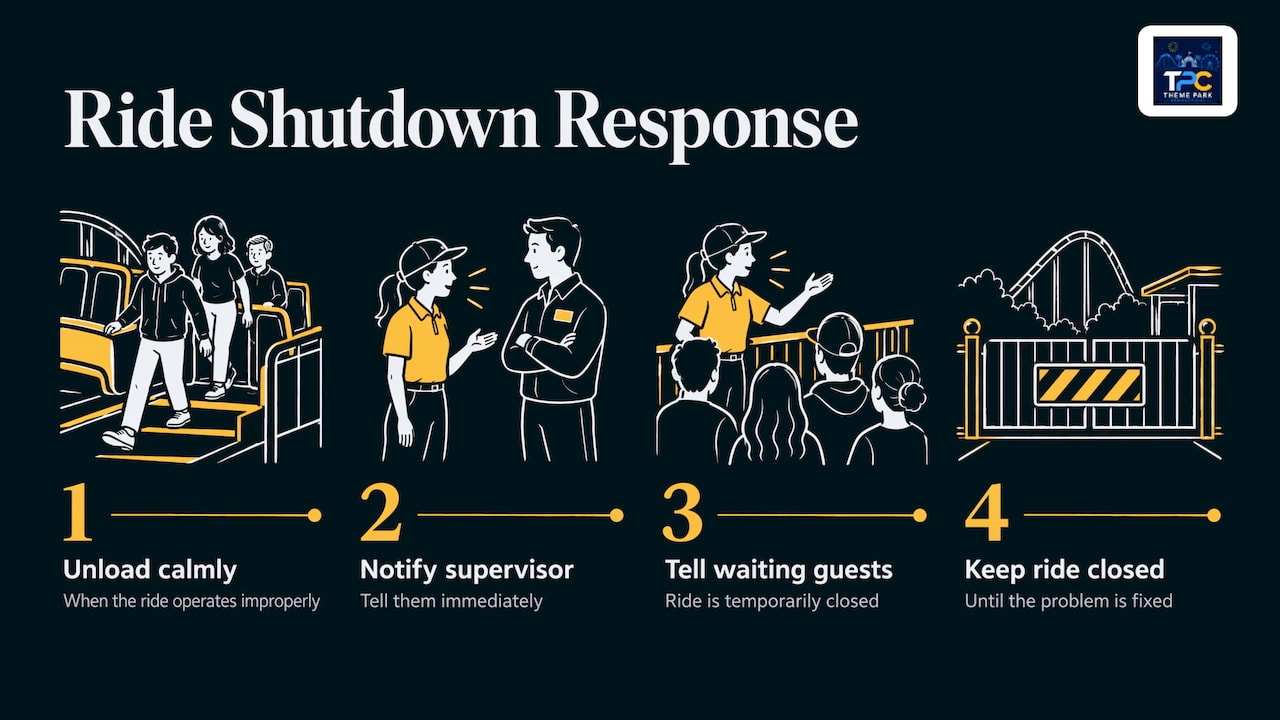
Pennsylvania’s manual says that if you hear an unusual noise or the ride does not operate properly, you calmly unload the ride, tell your supervisor immediately, tell waiting guests the ride is closing temporarily and keep it closed until the problem is fixed. Oklahoma’s rules let owners authorize operators to shut down a ride when they judge continued operation hazardous. Know that you have that authority before you need it.
Weather is one common trigger. Our guides on weather closures and weather-driven operations show how teams communicate through them.
Reporting
Reporting duties are set by state law, and your manager handles the official filing. Know the pattern so you can give accurate facts fast:
| State | What triggers it | Timing |
|---|---|---|
| New Jersey | Ejection, critical component failure, serious injury or illness | Shut down and secure the area; phone report plus emailed report within 24 hours |
| New Jersey | Mechanical malfunction or emergency evacuation | Report within 24 hours; written report within five days |
| Michigan | Major breakdown | Report within 24 hours; confirm on the department form within 7 days |
| North Carolina | Death, injury beyond first aid, or damage showing a substantial defect | Notify within 24 hours |
In these states the ride stays out of service and the scene is secured until the state clears it. Michigan’s 2022 amendments also require training records and an emergency response plan, and falsifying a training record is a misdemeanor. Keep your own records accurate.
Know your ride, not only the steps
IAAPA’s editor makes the point that a facility’s own operating experience must be layered onto standards and manufacturer guidelines: guest flow, evacuation, weather closures and unusual emergencies differ by park. Manufacturer guidelines cannot be overridden, and operational changes go through the manufacturer or a qualified reviewer.
When you write attraction-specific procedures, event teams map staff roles to the guest journey, a useful way to see who stands where at each stage of loading and unloading.
Building toward more responsibility
Pennsylvania’s manual advises you to read the operation manual, learn the machine’s sound and feel, know its maximum speeds and loads, and watch professional operators. Ask to shadow a senior operator on a different ride. Learn the handoff routine: our guide to shift handoff communication shows why clear notes matter. When you are ready for the next step, read about operations control and dispatch careers or moving from guest services into operations.
Where we see this going
Operators who treat the checklist as a learning tool, not paperwork, move up faster. The best habit we can suggest is simple: after each shift, write down one thing you noticed about the ride, and ask a senior operator about it.
That is what a community is for. On Theme Park Connections, cast members and operations staff share what works at their parks, so one conversation can turn into a mentor relationship. Employers post roles to people who already know park work, and you get guides that match real operations.
Mike
Find your next ride operations role
If you are ready to put this training to work, Theme Park Connections lists theme park jobs and gives you a community of peers across operations, guest services, maintenance and leadership. Start at Theme Park Connections, or read how parks hire and build teams to see what hiring managers look for.

FAQ
Do I need a certificate to operate a ride?
It depends on your state. Oklahoma requires a training certificate issued within one year of operating the ride. Ohio requires written proof of training. Ask your park for its state requirements.
How old do I have to be?
Ohio requires operators to be at least 16. Other states and parks set their own limits, and federal and state youth labor rules also apply. Our youth labor laws guide explains them.
What is the most important daily check?
The pre-opening inspection and full test cycle. It covers restraints, gates, brakes, fencing and communication devices, and it is documented and signed.
Can I shut down a ride myself?
Yes, where your park’s procedures give you that authority. Oklahoma’s rules, for example, allow owners to let operators shut down a ride they judge hazardous. Unload calmly and call your supervisor.
Sources
- Ohio Administrative Code Chapter 901:9-1
- Oklahoma Department of Labor amusement ride statutes and rules
- New Jersey operator training certification form
- New Jersey incident reporting
- IAAPA Safety Corner on ride operations standards
- Florida Rule 5J-18.009
- California Portable Ride Owner Inspection Guide
- Pennsylvania Operators’ and Attendants’ Manual
- North Carolina G.S. Chapter 95, Article 14B
- Michigan Carnival and Amusement Safety General Rules
- Michigan Carnival-Amusement Safety Act