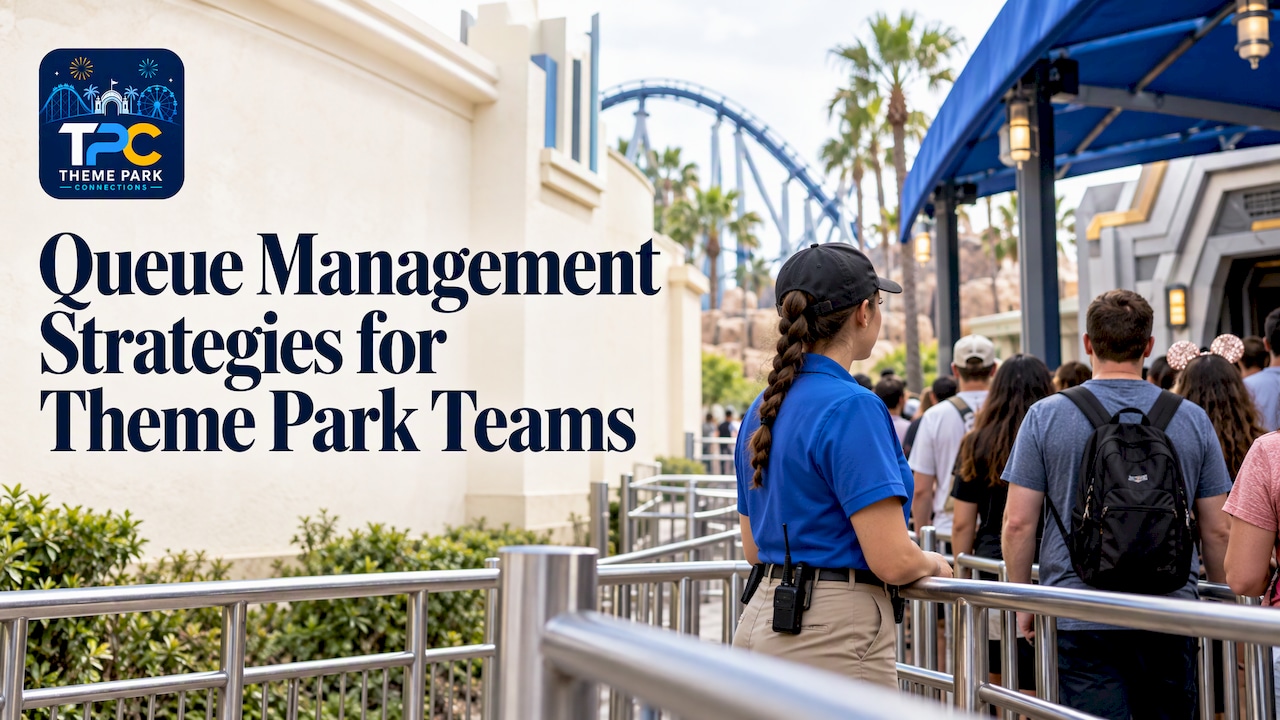
Queue Management Strategies for Theme Park Teams

The strongest queue management strategies in a theme park work on three fronts at once: they raise how many guests an attraction moves per hour, they spread demand across the day and the site, and they make the wait feel fair and informed. If you work in attractions, guest services or park operations, most of that is within your reach. Much of it comes down to dispatch habits, staffing decisions and how you talk to guests in line.
This guide walks through what operators do, with the numbers and examples behind each practice, and ends with ways to measure whether your changes worked. It also shows how to talk about queue skills when you are building your career.
TL;DR
- Capacity comes first. Faster, steadier dispatches usually shorten a line more than any signage or app does.
- Forecast, then staff. Use admission counts and point-of-sale timestamps to predict hourly demand, and build flexible staffing templates you can adjust in real time.
- Tell guests the truth. An accurate posted wait, a clear explanation of downtime and a friendly team make waiting feel shorter and fairer.
- Design and manage the whole site. Queue space, shade, show times and food availability all move crowds.
- Measure and repeat. Track waits, breakdowns and dispatch cycles, then review changes with your team.
Table of Contents
- Start with capacity, not the line
- Forecast demand and staff flexibly
- Spread demand across the day and the site
- Handle downtime and surges
- Make the wait feel shorter and fairer
- Handle questions and problems in line
- Measure what works
- Turn queue skills into career progress
- Our perspective
- Find your next role, and the people who can help
- FAQ
- Sources
Start with capacity, not the line
A queue is the visible symptom. The cause is usually a gap between how many guests want a ride and how many it can actually carry. That is why experienced operators begin with throughput.
Theme Park Insider’s operations guidance gives a useful benchmark: well-designed major-park attractions should handle roughly 1,000 to 3,000 people per hour, and an attraction that cannot reliably handle 500 per hour should be treated differently, for example as an upsell, age-restricted, reservation-only or closed (Robert Niles, Theme Park Insider). You may not set that policy, but knowing the benchmark helps you read your own ride’s numbers.
Two terms are worth knowing. Theoretical hourly capacity is what the ride could carry on paper. Operational capacity is what it carries once loading, unloading, restraint checks and real guests are involved. Closing that gap is where front-line teams make the biggest difference.
Dispatch when you are ready
The same Theme Park Insider piece recommends a load-and-go approach: send out a vehicle that is ready instead of holding it for stragglers, because cycle time determines hourly capacity. The author reports at least 10% higher hourly capacity from this practice at Magic Kingdom (Theme Park Insider).
In practice, load-and-go looks like this:
- Keep the next party staged and moving before the vehicle arrives.
- Give short, clear loading instructions, so guests do not stop to ask.
- Complete the safety checks your ride requires, then dispatch without waiting for a perfect fill.
- Never skip a required check to save seconds. Safety procedures come first, and your training and ride manual define them.
A small saving of seconds per cycle adds up across a long day. If a ride runs a vehicle every few minutes, those seconds become extra guests served each hour.
Plan the queue to match the ride
Queue design shapes both throughput and comfort. Falcon’s Creative Group, a themed-design firm, describes standard practice for major parks in warmer U.S. climates: queues sized to hold at least one hour of riders, split into three 20-minute segments covering conditioned indoor space, shaded outdoor space and non-shaded outdoor space (Falcon’s Creative Group). The same source calculates queue length by multiplying theoretical hourly capacity by 1.5 linear feet per person, the average space an adult takes up standing in line.
Here is what that formula means for a hypothetical ride with a theoretical capacity of 1,200 guests per hour: 1,200 × 1.5 gives 1,800 linear feet of queue to hold an hour of riders. That example is our own arithmetic, not a figure from the source. It shows why a popular ride needs switchbacks, indoor holding areas and overflow plans.
Theme Park Insider adds details that matter to operators on the ground (Theme Park Insider):
- Clear sightlines into approaching parties, so you can plan loading early.
- Visual references for checking height requirements before guests reach the gate.
- Accessible alternate loading arrangements, so guests who need extra boarding time do not delay ordinary dispatches.
If you are in attractions, notice which of these your queue already has. When something is missing, a short written suggestion to your supervisor often goes further than a complaint.
Forecast demand and staff flexibly
A ride can be perfectly designed and still back up if the right people are not in the right places. An IAAPA planning session on queue, capacity and staffing describes three habits worth copying (IAAPA):
- Use data such as admission counts and point-of-sale timestamps to forecast hourly demand.
- Develop flexible staffing templates that you can adjust as conditions change.
- Apply whole-site flow thinking, coordinating show times and food and beverage availability with ride demand.
That third point is easy to miss from inside one ride. When a show lets out or a restaurant is full, thousands of guests move at once. Teams that talk to each other can see the surge coming.
Put people where the pressure is
Theme Park Insider’s guidance says to schedule enough staff at the right times and to place experienced team members in the roles where they are strongest (Theme Park Insider). For a team lead, that means a few simple moves:
- Put your quickest, calmest loader on the busiest position.
- Keep a floater who can step into a gap without a long handover.
- Pre-plan which roles you will pull from when a surge starts.
A SeaWorld San Diego study on queuing theory makes a related point: have flexible capacity available early enough to respond when queues surge, not after the line has already spilled out (Western Decision Sciences Institute proceedings). The same paper observes that some managers treat service delivery as predictable when it is often variable. Build your plans with that variability in mind.
Queue-busting tactics you can use today
Attractions.io, which makes guest apps for attractions, lists queue-busting tactics such as stationing staff at a ride entrance to warn guests of longer-than-normal waits, or moving entertainers into a busy area to add capacity (Attractions.io). Both are cheap, and both change how guests feel about the same wait.
Spread demand across the day and the site
You cannot always make a ride faster, so you move some demand elsewhere.
The Attractions.io guide notes that telling guests which areas are busy, through digital signage or a mobile app, encourages better crowd distribution and helps them make informed choices (Attractions.io). Its author also frames waiting times as the currency guests use to plan their day, which is why accurate communication matters and inaccurate data can backfire.
Virtual queues work on the same principle. An academic analysis of theme park queue management in the journal literature describes a paid priority virtual queue as a way to encourage guests to visit popular attractions at designated times and reduce waiting (PubMed Central). Whether a park uses paid or free systems, the front-line job is the same: explain the return time clearly, answer questions patiently and keep the return line moving.
Crowd control around new, high-demand areas shows what flexible tactics look like. The Los Angeles Times reported that Disneyland employees managed crowding in Star Wars: Galaxy’s Edge by directing pedestrian flow, adding switchback lines when needed and controlling entry to an attraction venue as capacity filled (Los Angeles Times). These are people-based solutions, and they depend on trained, confident team members.

Handle downtime and surges
Breakdowns are one of the biggest threats to a wait time. The SeaWorld study identifies ride-equipment failures as a frequent cause of excessive delay and recommends studying how often breakdowns happen and how long they last. It suggests reducing them with Failure Mode and Effects Analysis (FMEA), a structured way of listing what can fail and what to do about it (Western Decision Sciences Institute proceedings).
When a ride does go down, Theme Park Insider advises adjusting posted wait times quickly once it reopens and warning guests at nearby lines (Theme Park Insider). Here is a simple recovery routine:
- Tell guests in line what you know, as soon as you know it.
- Update the posted wait through your usual channel.
- Let nearby attractions and guest services know, so they can manage overflow.
- After reopening, expect a surge and bring in flexible capacity early.
- Log the cause and duration, so the team can look for patterns.
Make the wait feel shorter and fairer
Perceived time matters as much as clock time. Several U.S. studies point the same way.
- A graduate thesis on theme park queuing reports that posting estimated wait times reduces uncertainty and anxiety, and that announcing ride downtime explains delays and helps guests feel included rather than ignored (Governors State University thesis).
- A University of Central Florida thesis finds that guests commonly value information about estimated waits and delays. It also summarizes research showing that queue ambience, physical design and employee interactions influence how waiting is perceived (University of Central Florida thesis).
- A paper on designing amusement park queues recommends spaces that encourage social interaction, such as wider lines, and a baseline wait-time estimate at the start of the queue to manage expectations (Ledbetter et al., ResearchGate).
Amusement Logic interviewed Ahmed Al Jassim, an area operations manager at Six Flags Qiddiya City, who said organized, comfortable and smoothly moving queue areas can make waits feel shorter even when the actual duration is the same (Amusement Logic). That is good news for front-line teams, because comfort and flow are things you shape every shift.
What this sounds like on the line
Your words are part of the queue experience. A few examples you can adapt:
- Setting expectations: “Good afternoon! The wait from this point is about 25 minutes. We’ll keep things moving.”
- Explaining a delay: “We’ve paused for a quick check. I’ll update you as soon as I hear more, and I’ll let you know the moment we reopen.”
- Redirecting a question: “Great question. Our guest services team at the front of the land can help with that, and I’m happy to point you the right way.”
Keep your tone warm, your language plain and your promises honest. Never guess at a reopening time you do not know.
Keep access clear for every guest
Accessible routes and alternate loading arrangements need to stay clear when the park is busiest. Theme Park Insider recommends alternate loading that lets guests who need extra boarding time board without slowing ordinary dispatches (Theme Park Insider). Follow your park’s own accessibility procedures, and ask your supervisor when a situation is not covered.
Handle questions and problems in line
One frustrated guest can slow everyone behind them. Good teams solve that by being early and calm: step forward, listen, and move the conversation out of the flow of the line when needed. The posting of estimated waits and clear downtime announcements, as the graduate thesis above notes, answers many questions before guests ask them (Governors State University thesis).
A short script helps:
“Thanks for telling me. Let’s step over here so I can help you without holding up your family’s spot, and then we’ll get you back in line.”
Then follow your park’s procedure for escalation, whether that means a lead, guest services or a safety team. If a guest raises a safety concern, treat it as one right away.
Measure what works
Without measurement, queue improvements are guesses. The SeaWorld study recommends tracking service data and waiting performance, investigating the frequency and duration of equipment breakdowns, comparing alternative staffing and process designs, and having process-improvement teams observe queues and recommend revisions (Western Decision Sciences Institute proceedings).
A simple weekly review for a ride team might include:
| What to track | Why it matters | Example question |
|---|---|---|
| Dispatch cycle time | Cycle time drives hourly capacity | Which position slows loading? |
| Posted vs. actual wait | Accurate times build trust | Are we updating often enough? |
| Breakdown frequency and length | Downtime is a leading delay cause | Is one failure repeating? |
| Staffing by hour | Shows when flexible capacity is needed | When did the line spill out? |
| Guest comments | Reveals how the wait felt | What did guests say about information? |
Measuring wait times is harder than it looks. The Los Angeles Times analyzed Disneyland waits using more than 4 million app and sign snapshots, and reported that Disney validated measurements by scanning an RFID-enabled card when guests entered and exited an attraction queue (Los Angeles Times). You do not need that scale. A stopwatch, a clipboard and a consistent routine will teach you a lot about your own line.
Turn queue skills into career progress
Queue management is one of the clearest ways to show leadership in a park. When you can explain how you cut a dispatch cycle, handled a downtime surge or trained a new loader, you are describing the results supervisors look for. Here is how to put that into practice:
- Keep a short log of changes you suggested and what happened.
- Learn the vocabulary: guest-flow, cycle time, capacity, crowd-management procedures.
- Ask a lead for five minutes about how they plan staffing for a busy day.
- Share what you learn with newer teammates. Mentoring is leadership practice.
A message you can send to someone further along in the industry:
“Hi Jordan, I work attractions at a regional park and I’m trying to get better at managing peak-hour lines. Could I ask how you decide when to add staff to a ride? I’d really appreciate any advice.”
A specific, courteous question like this is how one conversation becomes a professional relationship. You can explore more about the roles themselves in our guide to attractions and ride operations careers.
Our perspective
Queue management is often described as a technology problem, but the people on the ground decide whether a plan works. A forecast means nothing until someone loads the next party quickly, explains a delay kindly and tells a lead that the line is about to spill out.
That is why we built Theme Park Connections around community as well as job listings. Attractions teams, guest services and food and beverage crews all handle the same crowds from different positions, and each position sees something the others miss. When those people can share what works across parks and roles, good practice spreads faster than any manual can carry it.
If you are early in your career, ask questions, document your wins and find a mentor who has run a busy line. If you are experienced, share what you know. The industry gets better when the people who run the lines learn from each other.
Mike
Find your next role, and the people who can help
If you want to put these skills to work, Theme Park Connections combines theme park job listings with a community of current and aspiring team members and practical guides for career growth. Whether you are moving from a seasonal role into something longer term or looking for peers who understand park operations, you can start on our Theme Park Connections home page.

Employers can also post openings to an audience already familiar with theme park work.
FAQ
What is the most effective queue management strategy in a theme park?
There is no single answer, but raising operational capacity is usually the foundation. Practices such as load-and-go dispatch, enough well-placed staff and flexible capacity that arrives early all help a ride move more guests per hour. Accurate wait communication then keeps the line feeling fair.
How can I help reduce wait times as a ride operator?
Focus on what you control: keep the next party staged, give short loading instructions and dispatch as soon as a vehicle is ready within your safety procedures. Report patterns, such as a slow position or repeated breakdowns, to your lead. Those observations are the raw material for process improvements.
How do theme parks make waiting feel shorter?
Parks combine honest wait-time estimates, clear explanations of downtime and comfortable, well-designed queue spaces. Research summarized in a University of Central Florida thesis says that ambience, physical design and employee interactions all influence how waiting is perceived. Friendly, informative staff are part of that experience.
How do you measure queue performance?
Track waiting performance, dispatch cycle times, staffing by hour and the frequency and duration of breakdowns, then review the data with your team. Comparing posted waits with actual waits shows whether your information is trustworthy. Small, consistent observations beat occasional big studies.
Sources
- Mastering Flow: Queue, Capacity, and Staffing (IAAPA)
- Analysis of queue management in theme parks (PubMed Central)
- Introducing Robert’s Rules of Theme Park Operations (Theme Park Insider)
- What Makes for the Perfect Theme Park Queue? (Theme Park Insider)
- Worth the Wait: Design Methodologies for the Attraction Queue (Falcon’s Creative Group)
- Learning Queuing Theory at SeaWorld San Diego
- Beat the crowds (Attractions.io)
- Star Wars: Galaxy’s Edge forces Disney to tap eons of experience (Los Angeles Times)
- Disneyland raised prices to shorten waits (Los Angeles Times)
- Queuing Theory in Theme Parks (Governors State University)
- Analysis and Implications of Guest Attitudes Towards Queuing (University of Central Florida)
- Your Wait Time From This Point Will Be… (ResearchGate)
- Ahmed Al Jassim interview (Amusement Logic)