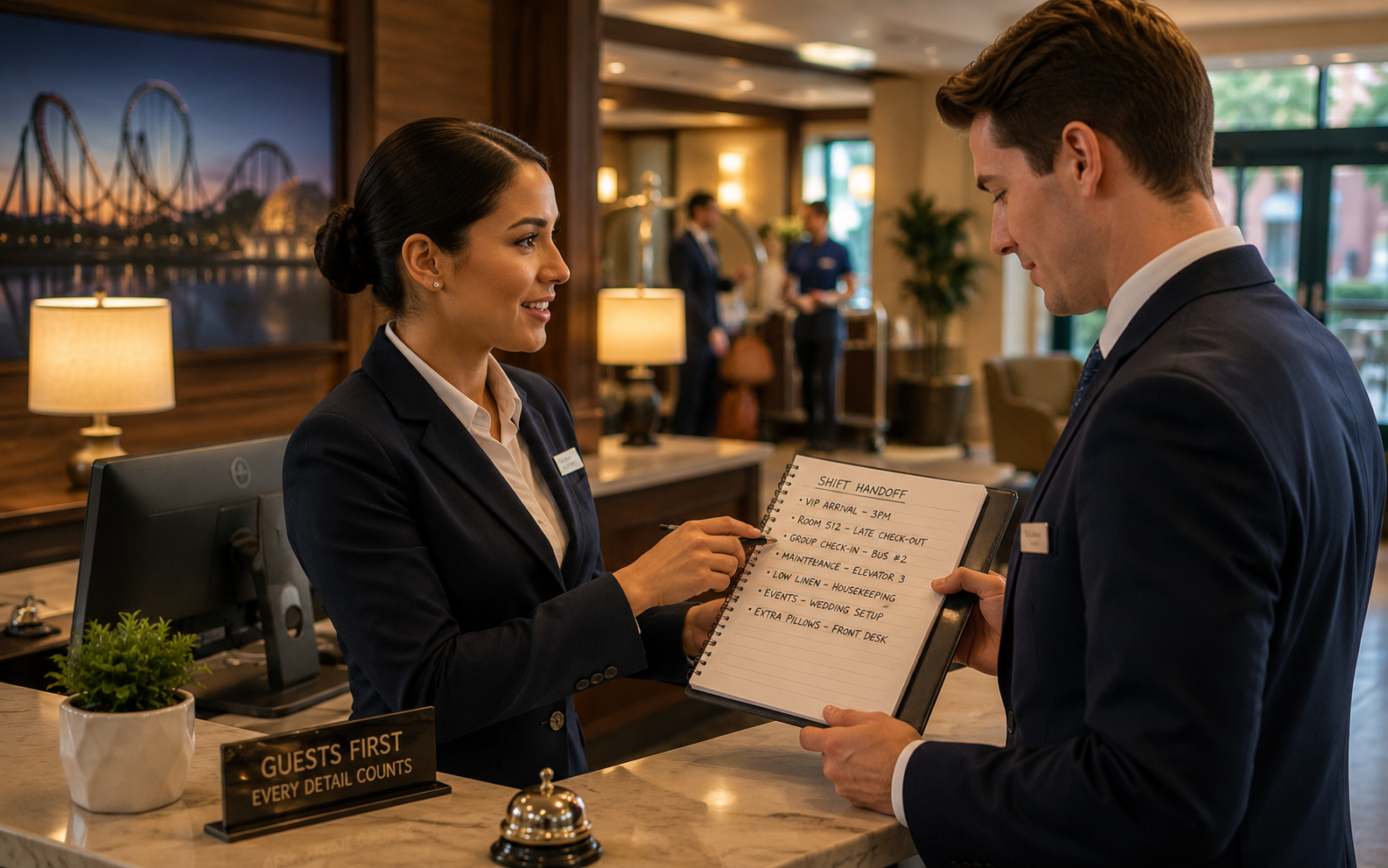
The Hotel Shift Handoff: Small Details That Keep Resort Operations Running
At a theme park resort, a shift rarely ends when an employee clocks out. Guests are still arriving, rooms are still being serviced, maintenance requests are still open, and front desk teams are still answering questions that began hours earlier. A strong shift handoff makes sure the next team knows what is happening before they walk into the operation.
In hotels and resort environments, handoffs are more than a quick “everything is fine” at the end of the day. They are an operational tool that protects guest experience, reduces duplicated work, and helps the incoming team make good decisions quickly.
Why Shift Handoffs Matter in Resort Operations
Theme park hotels operate across multiple departments and schedules. Front desk, housekeeping, bell services, engineering, recreation, security, food and beverage, and management may all interact with the same guest during one stay.
That creates plenty of opportunities for information to get lost. A guest may have reported a room issue to housekeeping, called the front desk about it later, and then asked a bell services team member for an update. If the information is not shared clearly, the guest may have to explain the problem repeatedly.
A useful handoff helps the next shift understand:
- Which guest concerns remain unresolved
- Which rooms or areas require follow-up
- What operational issues affected the previous shift
- Which leaders or departments have already been contacted
- What promises were made to guests
- What needs immediate attention versus routine follow-up
The goal is not to document every minor interaction. The goal is to pass along the information that could affect safety, service, staffing, or the next guest decision.
What Belongs in a Hotel Shift Handoff?
Open guest concerns
Start with situations that are still active. This might include a room move that has not been completed, a missing item, an accessibility request awaiting support, or a guest waiting for a manager callback.
Be specific. “Guest in 412 needs help” does not give the incoming employee enough information. A stronger handoff might explain that the guest requested a room change because of a maintenance issue, has been given an estimated follow-up time, and is currently at the park.
Include only information the next team needs to perform its role. Avoid unnecessary personal details or commentary about the guest.
Promises and expected follow-up
One of the most important parts of a handoff is identifying what a guest has been told. If someone was promised a call, delivery, inspection, room check, or manager follow-up, that commitment should not disappear when the original employee leaves.
When possible, record:
- What was promised
- Who is responsible for completing it
- When the guest expects an update
- What should happen if the original solution is not possible
Guests are often more understanding when employees are honest about limitations. They become frustrated when different team members provide conflicting answers or when a promised update never arrives.
Room status and maintenance issues
Housekeeping and engineering handoffs can directly affect check-in readiness. A room may be clean but waiting for a repair. It may have been inspected but still need a replacement item. A room move may be approved but not yet reflected in every system or department’s workflow.
Use clear status language rather than assumptions. “Engineering notified” is different from “repair complete.” “Housekeeping requested” is different from “room inspected.” Accurate wording prevents the next shift from treating an incomplete task as finished.
Staffing and coverage concerns
Resort operations can change quickly when an employee calls out, a department experiences an unexpected surge, or a guest need requires additional support. The next shift may need to know about adjusted assignments, delayed breaks, or a department that is temporarily operating with reduced coverage.
This does not mean using the handoff to criticize absent employees or complain about staffing. Keep the focus on operational impact and the plan for handling it.
Make the Handoff Easy to Scan
A handoff that takes ten minutes to understand may not be useful during a busy arrival period. Organize information so the next employee can quickly identify urgent items.
A practical structure is:
- Immediate: Safety concerns, active escalations, time-sensitive guest needs, or issues affecting current arrivals
- Pending: Tasks already assigned but not yet completed
- Watch: Situations that may develop during the next shift
- Completed: Important issues resolved during the shift that could still generate questions
For example, a completed room move may still matter if the guest’s luggage, dining reservation, or transportation plan needs to be coordinated. A resolved maintenance issue may matter if other rooms or common areas could experience the same problem.
Follow the communication tools and documentation practices established by your employer. Some properties may use written logs, digital systems, radios, brief in-person meetings, or a combination of methods. The specific tool matters less than clarity, accuracy, and consistency.
Common Handoff Mistakes
Passing along rumors instead of facts
Employees sometimes repeat what they heard from another department without confirming the information. That can create confusion and damage trust between teams.
If you are not certain, say so. Use language such as “awaiting confirmation” or “engineering has been contacted; completion time is not confirmed.” Honest uncertainty is more useful than false confidence.
Leaving out the guest’s expected next step
A handoff may explain the problem but not what the guest expects to happen next. The incoming employee then has to reconstruct the situation from scratch.
Always identify the next action when one exists. If no solution has been promised, say that as well. That gives the next team room to respond appropriately without accidentally making a new commitment.
Overloading the handoff with emotion
Words such as “difficult,” “angry,” or “impossible” do not explain what the next employee needs to do. Describe the behavior or request instead. For example, note that the guest has requested a manager and is waiting in the lobby, rather than labeling the guest.
Professional, neutral language helps the next team approach the interaction with a fresh perspective.
Assuming another department knows
In a large resort, information can be shared with one person without reaching the department responsible for the next step. If an issue affects multiple teams, confirm that the appropriate contact has received it rather than assuming the message traveled.
Build Handoff Skills That Help Your Career
Strong handoffs demonstrate several skills that matter beyond hotel operations:
- Clear written and verbal communication
- Prioritization under pressure
- Attention to detail
- Respect for privacy and professionalism
- Cross-department coordination
- Ownership of guest commitments
- Operational judgment
These skills are valuable for front desk agents, coordinators, leads, supervisors, trainers, and managers. Employees who consistently leave organized, reliable handoffs become people others trust with complicated shifts and high-visibility situations.
If you are preparing for a leadership role, pay attention to how your handoffs affect the incoming team. A good handoff does not simply transfer problems. It gives the next person enough context to make progress.
Leave the Next Shift a Clear Starting Point
The best hotel shift handoffs answer three questions: What is happening? What has already been done? What needs to happen next?
That information helps the incoming team protect the guest experience without repeating work, missing deadlines, or making promises they cannot keep. In a resort environment where many departments contribute to one stay, reliable communication is part of the operation itself.
For employees building a career in hospitality, ThemeParkConnections.com offers a place to connect with professionals across hotels, theme parks, attractions, food and beverage, entertainment, retail, and maintenance. Sharing experiences with people in other departments can reveal new career paths, practical operating habits, and opportunities throughout the attractions industry.