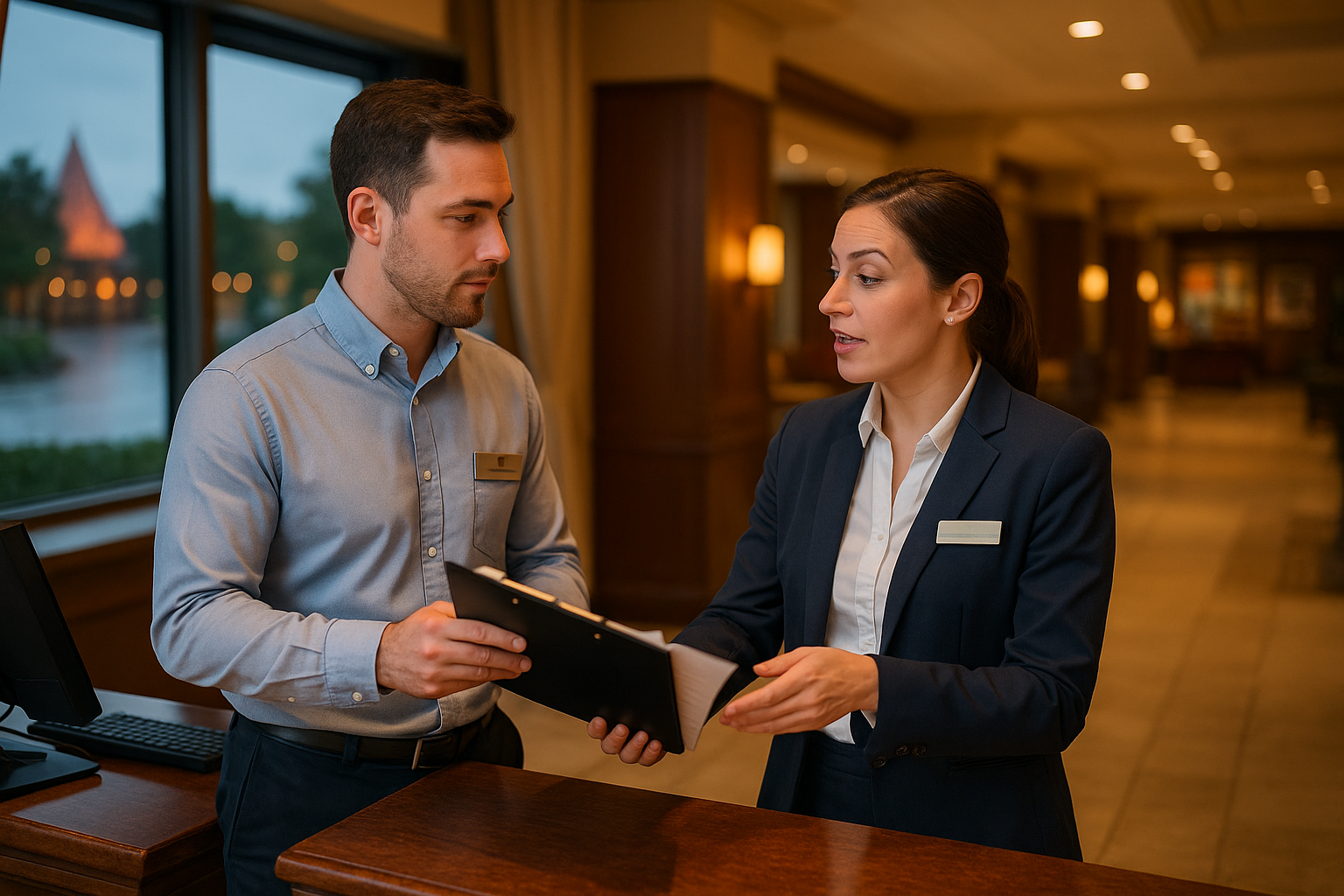
The Shift Handoff That Keeps Theme Park Hotels Running Smoothly
In a theme park hotel, small details rarely stay small for long. A room that needs maintenance, a guest waiting on a crib, a delayed luggage delivery, or a family expecting an accessibility accommodation can quickly become a larger service issue if the next team does not know what happened before them.
That is why an effective shift handoff matters. A good handoff is more than saying, “Everything is fine,” or leaving a few notes in a logbook. It is a focused exchange of information that helps the incoming team understand what is open, what has changed, and what needs attention first.
For front desk employees, housekeeping teams, bell services, resort recreation staff, maintenance personnel, and leaders, strong handoffs reduce repeated work and help create a more consistent guest experience.
Why Shift Handoffs Matter in Hospitality
Theme park hotels operate across multiple shifts, departments, and guest touchpoints. A guest may speak with a front desk representative in the morning, a housekeeper in the afternoon, and a bell services employee in the evening. Each person may only see one part of the guest’s experience.
Without a clear handoff, employees may have to start from the beginning. The guest repeats the same explanation, the next team has to investigate the issue again, and important details can be missed.
A useful handoff helps the next employee answer three basic questions:
- What is happening right now?
- What action has already been taken?
- What still needs to happen, and by when?
The goal is not to document every conversation from the shift. The goal is to transfer the information that affects safety, service, timing, or the next team’s workload.
What Belongs in a Professional Shift Handoff?
Different departments use different systems, but the most useful handoffs usually include the same core information.
Open guest concerns
Explain any guest issue that has not been fully resolved. Include the nature of the concern, the guest’s preferred contact method when appropriate, and what the guest has already been told.
For example, “Guest in Room 412 reported that the air conditioning is not cooling properly. Maintenance was contacted at 3:20 p.m. and is expected to inspect the unit. Guest requested a room update before dinner” gives the next employee something actionable.
By contrast, “Room 412 has an AC problem” leaves out the timeline, the response already provided, and the guest’s expectations.
Pending requests
Some requests are simple but time-sensitive. These might include:
- Extra bedding or towels
- A requested wake-up call
- A crib, refrigerator, or accessibility item
- Luggage delivery or storage follow-up
- A room move that is not yet complete
- A maintenance repair awaiting parts or additional support
Be specific about what is pending and who currently owns the next step. If a request has been passed to another department, note that clearly instead of assuming the issue is finished.
Operational changes
Handoffs should also cover changes that affect the way the next shift works. A temporarily unavailable elevator, a closed pool area, a delayed housekeeping section, or a change in transportation service can create confusion if the incoming team is not briefed.
Employees do not need to speculate about how long a disruption will last. Share confirmed information, the current status, and where the next team can obtain updates.
Use Facts, Not Frustration
A shift handoff is not the place to vent about a difficult guest, criticize another department, or make assumptions about what happened. Emotional or vague language can influence the next employee before they have spoken with the guest or reviewed the facts.
Instead of writing, “Guest is being unreasonable about the room,” describe the actual situation: “Guest contacted the desk twice regarding the room readiness delay and requested a manager call if the room is not available by 5:00 p.m.”
This approach is more professional and more useful. It helps the next employee prepare without creating unnecessary bias.
Good handoff language is:
- Specific
- Neutral
- Timely
- Easy to understand
- Focused on the next action
Make the Handoff Two-Way
The best shift handoffs are conversations, not announcements. The outgoing employee should share the key information, but the incoming employee should have an opportunity to ask questions and confirm priorities.
A quick two-way handoff might sound like this:
“There are two items still open. Room 218 is waiting for a maintenance update on the bathroom sink, and Room 506 requested a room move if one becomes available. Maintenance has inspected 218 but needs to return with a part. For 506, the guest has been told we will call if inventory changes. Can you take the room-move follow-up while I finish the maintenance note?”
This exchange clarifies responsibility and reduces the chance that both employees assume someone else will handle the issue.
Confirm priorities
Not every open item has the same urgency. A handoff should help the incoming employee distinguish between something that needs immediate attention and something that can be monitored.
Safety concerns, accessibility needs, time-sensitive guest commitments, and issues affecting multiple rooms or public areas generally deserve immediate visibility. Routine requests may be handled in normal order, provided the expected timing has been communicated accurately.
Avoid the “Everything Is in the System” Trap
Digital records are valuable, but they should not replace judgment. An incoming employee may not have time to search through multiple notes, messages, or department systems while guests are waiting in front of them.
If something is urgent, unusual, or likely to generate another guest contact, mention it directly during the handoff even if it has already been documented electronically.
Likewise, do not assume that a ticket being created means the guest’s concern has been resolved. A work order, service request, or case number shows that an action was started. It does not necessarily show that the final action was completed.
Common Handoff Mistakes
Passing along too much information
A long list of minor details can bury the items that actually matter. Focus on unresolved concerns, deadlines, promises, safety issues, and changes affecting operations.
Leaving out the guest expectation
If a guest was told they would receive a call by a certain time, that commitment belongs in the handoff. The next employee needs to know not only what happened, but what the guest is expecting next.
Assuming another department will follow up
Cross-department communication is essential in hospitality, but responsibility can become unclear when several teams are involved. State who is waiting on whom and identify the next check-in point.
Failing to close the loop
When an issue is resolved, update the record and, when appropriate, notify the guest or affected department. Closing the loop prevents an old issue from appearing active during every future handoff.
Building a Handoff Habit
Employees can improve their handoffs by using a simple routine at the end of every shift:
- Review unresolved guest concerns.
- Check requests with promised follow-up times.
- Identify safety, accessibility, or operational issues.
- Confirm which departments or employees are involved.
- State the next action and expected timing.
- Ask the incoming employee to repeat or confirm the highest-priority items.
Over time, this process becomes faster because employees learn which information their department truly needs. It also creates a reputation for reliability. Coworkers know they can take over your area without having to reconstruct the entire shift.
A Small Practice with a Big Career Benefit
Strong handoffs demonstrate several skills that matter throughout the attractions industry: organization, judgment, written communication, guest awareness, follow-through, and cross-department collaboration.
Those skills are useful far beyond a hotel front desk or housekeeping assignment. They apply to attractions operations, entertainment, food and beverage, maintenance, retail, and leadership roles where one team depends on another to continue the work.
In a business built around timing and teamwork, a clear handoff is one of the simplest ways to protect the guest experience and support the employees who come after you.
Theme Park Connections gives professionals across the theme park and attractions industry a place to connect with other employees, expand their professional networks, share experiences, learn about different departments, and discover career opportunities. For anyone looking to build stronger industry relationships, ThemeParkConnections.com can be a useful starting point.