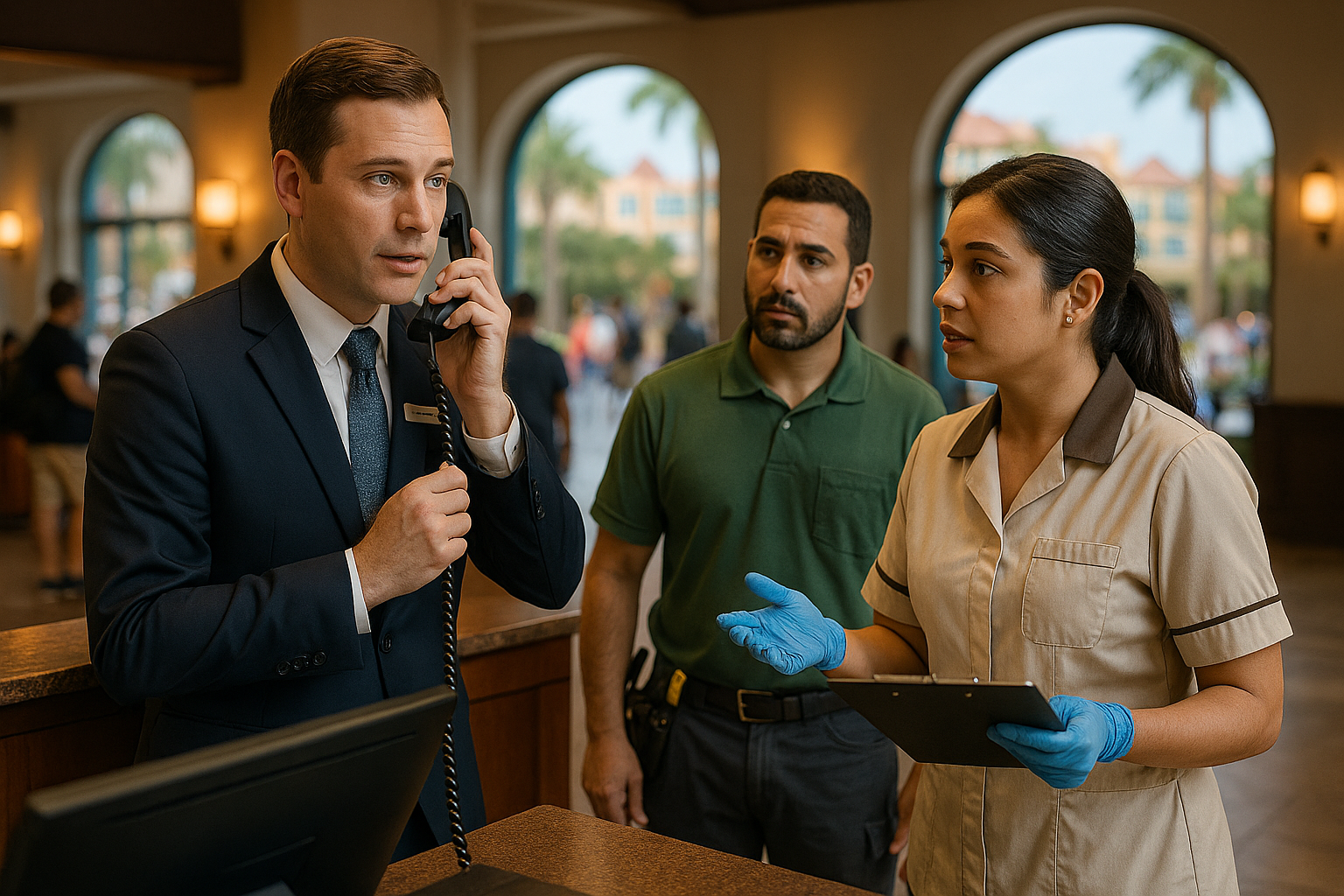
When a Resort Room Isn’t Ready: Coordinating Front Desk, Housekeeping, and Engineering During Arrival Peaks
A guest arriving at a theme park resort expects more than a room key. They expect the beginning of a smooth vacation, and a delayed room can quickly become the first problem of the trip. During busy arrival periods, front desk teams may be managing long lines, housekeeping may be working through a large departure load, and engineering may be responding to urgent room issues. A room that is unavailable for one reason can create pressure across several departments.
Handling these situations well requires more than asking, “Is the room ready yet?” It requires clear communication, accurate status updates, realistic expectations, and respect for the work each department is doing behind the scenes.
Why Room Readiness Becomes Difficult During Peak Arrivals
Resort arrival patterns rarely occur at a steady pace. Guests may arrive in waves after airport transfers, transportation routes, park closures, or major events. A hotel can move from a manageable lobby to a crowded one within a short period of time.
At the same time, room readiness depends on several steps:
- The previous guest must complete checkout.
- Housekeeping must clean and inspect the room.
- Maintenance concerns may need to be reported and resolved.
- Room status must be updated accurately in the hotel system.
- Front desk employees need reliable information before assigning the room.
A room may appear vacant but still require cleaning. A room may be clean but waiting for an engineering repair. Another room may be ready physically but not correctly updated in the system. Treating every delay as a simple housekeeping issue can lead to confusion and unnecessary frustration.
Start With an Accurate Room Status
The most useful information during an arrival rush is not an optimistic estimate. It is an accurate status.
Front desk employees should learn the difference between a room that is:
- Occupied and unavailable
- Vacant but dirty
- Being cleaned
- Clean but awaiting inspection or release
- Out of order because of a maintenance concern
- Ready and available for assignment
These distinctions help the team determine what can realistically happen next. For example, asking housekeeping for the earliest likely completion time makes sense for a room already being cleaned. It does not make sense for a room that still needs a plumbing repair.
When communicating, use specific information instead of vague statements. “The room is being cleaned now” is more useful than “It should be soon.” If an employee does not know the answer, it is better to say that the status is being confirmed than to provide a guess that may later be repeated to the guest as a promise.
How Front Desk and Housekeeping Can Work Together
During high-volume arrivals, front desk and housekeeping need a shared understanding of priorities. That does not mean every room should be rushed ahead of others. It means the departments should identify which rooms can have the greatest operational value.
Useful information may include:
- Rooms needed for guests with accessibility requirements
- Connecting rooms for families or groups
- Rooms assigned to guests with time-sensitive event plans
- Rooms blocked because of a specific maintenance concern
- Early-arriving guests who have already been waiting
Front desk employees should avoid pressuring housekeeping with repeated individual requests that compete with the department’s overall plan. Instead, provide organized information through the established communication channel. A concise list of priority rooms is easier to manage than a series of radio calls or interruptions.
Housekeeping employees can also help by giving updates that reflect the actual stage of work. If a room still needs a full clean, it should not be described as nearly ready simply because the guest is waiting. Honest information allows the front desk to make better decisions and protect the guest relationship.
Know When Engineering Needs to Be Involved
Some room delays are operational. Others are technical. A room with a malfunctioning air-conditioning unit, plumbing issue, damaged lock, electrical problem, or safety concern may require engineering support before it can be assigned.
In those cases, speed matters, but accuracy matters more. Employees should not minimize a problem to make the room appear closer to completion. Assigning a room that has not been properly cleared can create a second, more serious guest issue after arrival.
Helpful Information for a Maintenance Request
A strong request includes enough detail for the technician to understand the problem without having to start the investigation from the beginning. When permitted by local procedures, include:
- The exact room number
- The reported issue
- When the issue was discovered
- Whether the issue affects guest comfort, access, or safety
- Whether the room is occupied, vacant, or awaiting arrival
“Guest reports a problem” does not give engineering much to work with. “The room’s air-conditioning is not cooling and the incoming guest is waiting in the lobby” provides useful context and helps the team prioritize appropriately.
What to Tell the Guest
Guests do not need a detailed explanation of internal workflow, but they do need clear and respectful communication. A good update acknowledges the inconvenience, explains what is happening at a high level, and provides the next realistic point of contact.
For example:
“Your room is still being prepared, and our team is working to complete it as soon as possible. I’m checking the status directly and will update you by 3:30 p.m., even if I do not yet have a final room assignment.”
This approach is stronger than repeatedly saying, “It should only be a few more minutes.” If the estimate changes, communicate the change rather than allowing the guest to discover it after waiting without information.
When possible, help the guest make practical use of the waiting period. Depending on the property and its policies, that may include directing them to luggage storage, dining, recreation, transportation, or another comfortable waiting area. Never promise a service, compensation, or exception without knowing that it is authorized.
Common Mistakes During a Room Delay
Several habits can make a busy arrival period more difficult:
- Guessing at completion times: An inaccurate estimate can damage trust more than an honest uncertain answer.
- Blaming another department: Guests should not be pulled into internal disagreements between front desk, housekeeping, and engineering.
- Assigning a room before it is truly ready: This can create additional work and a poor first impression.
- Failing to document updates: Without clear notes or handoffs, the next employee may repeat questions or provide conflicting information.
- Ignoring emotional cues: A guest traveling with tired children, mobility needs, or a scheduled event may require a different communication approach than a guest who is simply early.
The Career Skills Hidden in a Delayed Room
Room readiness challenges are valuable opportunities to develop skills that apply throughout the hospitality and attractions industries. Employees learn to prioritize competing needs, communicate across departments, manage expectations, and remain composed while several guests need assistance at once.
These situations also reveal who can see the larger operation. A strong hospitality professional understands that the goal is not merely to move a guest through the front desk. The goal is to coordinate people and information so the guest experiences as little disruption as possible.
Those skills can support future opportunities in hotel leadership, guest recovery, rooms operations, training, event operations, and other roles throughout the attractions industry.
Building Better Connections Across Resort Operations
The best solutions to room-readiness challenges rarely come from one department working alone. Front desk employees, housekeepers, engineers, supervisors, and resort leaders all see different parts of the same guest experience. Learning how those roles connect can make you more effective in your current position and help you discover career paths you may not have considered.
ThemeParkConnections.com gives professionals throughout the theme park and attractions industry a place to connect with other employees, expand their professional networks, share experiences, learn about different departments, discover career opportunities, and build relationships across the industry. Those connections can be especially valuable when you want to understand how resort operations work beyond your own role.