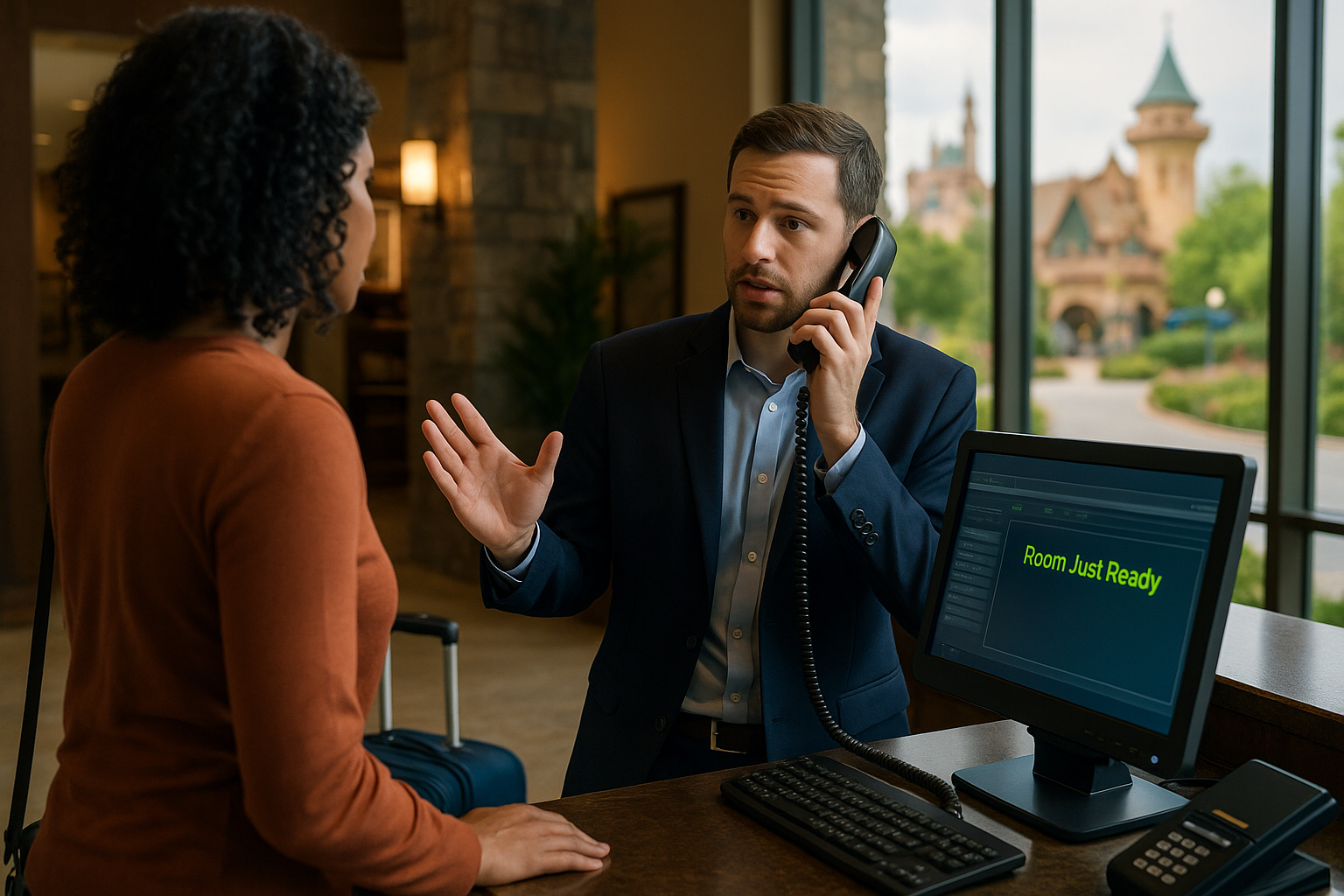
The Room Isn’t Ready: Managing Room-Status Discrepancies in Theme Park Hospitality
At a theme park resort, a guest’s arrival experience often depends on information moving accurately between the front desk, housekeeping, maintenance, and resort operations teams. When the system says a room is ready but the room is still being cleaned—or when a room appears unavailable even though it has been inspected—the problem is more than a minor clerical error. It can affect guest expectations, room assignments, luggage plans, transportation, and the workload of several departments.
These situations are known as room-status discrepancies. Learning how to recognize, communicate, and resolve them is an important skill for resort employees, especially during high-arrival periods, holidays, and special events.
What a Room-Status Discrepancy Looks Like
A discrepancy occurs when the information in the room-status system does not match the room’s actual condition. Common examples include:
- A room is marked clean, but housekeeping has not completed the final work.
- A room is listed as vacant, but a guest’s belongings are still inside.
- A room is marked out of order, but maintenance has completed the repair and the room has not been returned to service.
- A room is listed as occupied, but the front desk has reason to believe it is vacant.
- A room has been cleaned but still requires inspection before it can be assigned.
- A guest has been moved to another room, but the original assignment remains active in one system.
Not every discrepancy has the same cause, and employees should avoid assuming that the issue is simply someone’s mistake. A delayed update, a missed radio call, a maintenance issue, a room move, or an unclear handoff can all create conflicting information.
Why Accurate Room Status Matters
Room status affects much more than whether a guest receives a key. Front desk teams use it to make room assignments and estimate availability. Housekeeping uses it to prioritize work. Maintenance relies on accurate information before entering or releasing a room. Resort leadership uses it to understand operational capacity.
An incorrect status can create several problems at once. A guest may be sent to a room that is not ready, while housekeeping receives an urgent request for a room that was already completed. A room may remain unavailable longer than necessary, reducing the number of rooms the resort can offer. Employees may also make repeated trips to verify information that should have been clear in the first place.
Most importantly, room-status accuracy protects the guest experience. A guest arriving after a long trip may be tired, carrying luggage, or trying to reach the theme park for a scheduled event. Sending that guest to an unavailable room can create frustration that could have been avoided with a timely and professional handoff.
Start With Verification, Not Assumptions
When information conflicts, the first step is to verify the situation using the appropriate channel. An employee should not rely only on an outdated screen, an overheard conversation, or a handwritten note left in an unusual location.
Ask specific questions
Clear questions help other departments respond quickly. Instead of asking, “Is room 412 ready?” consider asking:
- Has housekeeping completed the room?
- Has the room received any required inspection?
- Is maintenance still working on an issue?
- Has the room been released for assignment?
- Was the room status updated after the last change?
Specific questions reduce back-and-forth communication and make it easier to identify which part of the process is incomplete. A room may be physically clean but not yet available because it still requires inspection or a maintenance release.
Confirm the physical situation safely
If a room requires in-person verification, employees should follow their property’s established access and communication procedures. No one should enter a guest room casually or bypass required notifications. If there is any indication that a guest may still be inside, the situation should be handled according to local policy and with appropriate regard for privacy and safety.
The Handoff Is Where Many Problems Begin
Room-status errors often happen during transitions: a housekeeping shift is ending, a room is transferred to maintenance, a supervisor is changing assignments, or a front desk employee is resolving several arrivals at once.
A strong handoff should include four basic details:
- Room number or location: Identify the room clearly.
- Current condition: Explain whether the room is dirty, partially serviced, inspected, occupied, or awaiting repair.
- Outstanding action: State exactly what still needs to happen.
- Expected update: Clarify who will update the system or notify the next department.
For example, “Room 412 is mostly complete, but the bathroom fixture still needs maintenance. Housekeeping will return after the repair, and the room should not be assigned yet” is far more useful than “412 has an issue.”
Good handoffs also avoid vague time estimates. If an employee cannot predict when a room will be ready, it is better to say that the room is awaiting a specific step than to promise a time that may not be realistic.
Handling a Guest Who Has Been Sent to an Unready Room
When a guest discovers that the assigned room is not ready, the employee’s response can either calm the situation or make it worse. The first priority is to acknowledge the problem without blaming another department in front of the guest.
A professional response might include:
“I’m sorry this room was not ready as expected. I’m going to verify its current status and find the best available solution for you.”
This wording recognizes the inconvenience and communicates action. It does not speculate about who caused the error or make promises before the facts are known.
While the issue is being checked, the employee should consider the guest’s immediate needs. Does the guest need a place to wait? Are they traveling with children, mobility equipment, or several bags? Do they have a time-sensitive reservation or event? The appropriate response will depend on the property’s procedures, but the employee can still demonstrate ownership by keeping the guest informed rather than sending them from one department to another.
Preventing Repeat Discrepancies
Employees who notice recurring status problems can help improve the process by identifying patterns. Useful questions include:
- Do discrepancies happen most often during a particular shift change?
- Are certain room types delayed because they require additional work?
- Are maintenance releases being communicated to housekeeping and the front desk?
- Are room moves being updated consistently in every required system?
- Do employees know which department owns the next step?
These observations can be shared with a supervisor through the appropriate channel. The goal is not to assign blame. It is to make the workflow clearer and reduce repeated guest impact.
Simple habits can also help individual employees:
- Update room information as soon as the status changes.
- Repeat important details during verbal handoffs.
- Document unresolved issues according to department procedure.
- Escalate uncertainty instead of guessing.
- Close the communication loop when an action is complete.
A Small Detail With a Large Operational Impact
Accurate room status may seem like an administrative responsibility, but it reflects the larger coordination required to operate a resort successfully. Front desk agents, housekeepers, maintenance technicians, supervisors, and other team members all depend on one another’s updates.
Employees who become skilled at clear handoffs, careful verification, and calm guest communication build abilities that apply well beyond hospitality. Those skills are useful in resort operations, guest services leadership, scheduling, facilities coordination, and many other attractions-industry roles.
ThemeParkConnections.com gives professionals across the theme park and attractions industry a place to connect with other industry employees, expand their professional networks, share experiences, learn about different departments, and discover career opportunities. Conversations about everyday operational challenges—such as room-status discrepancies—can reveal how much different departments have in common and help employees build connections throughout the attractions industry.