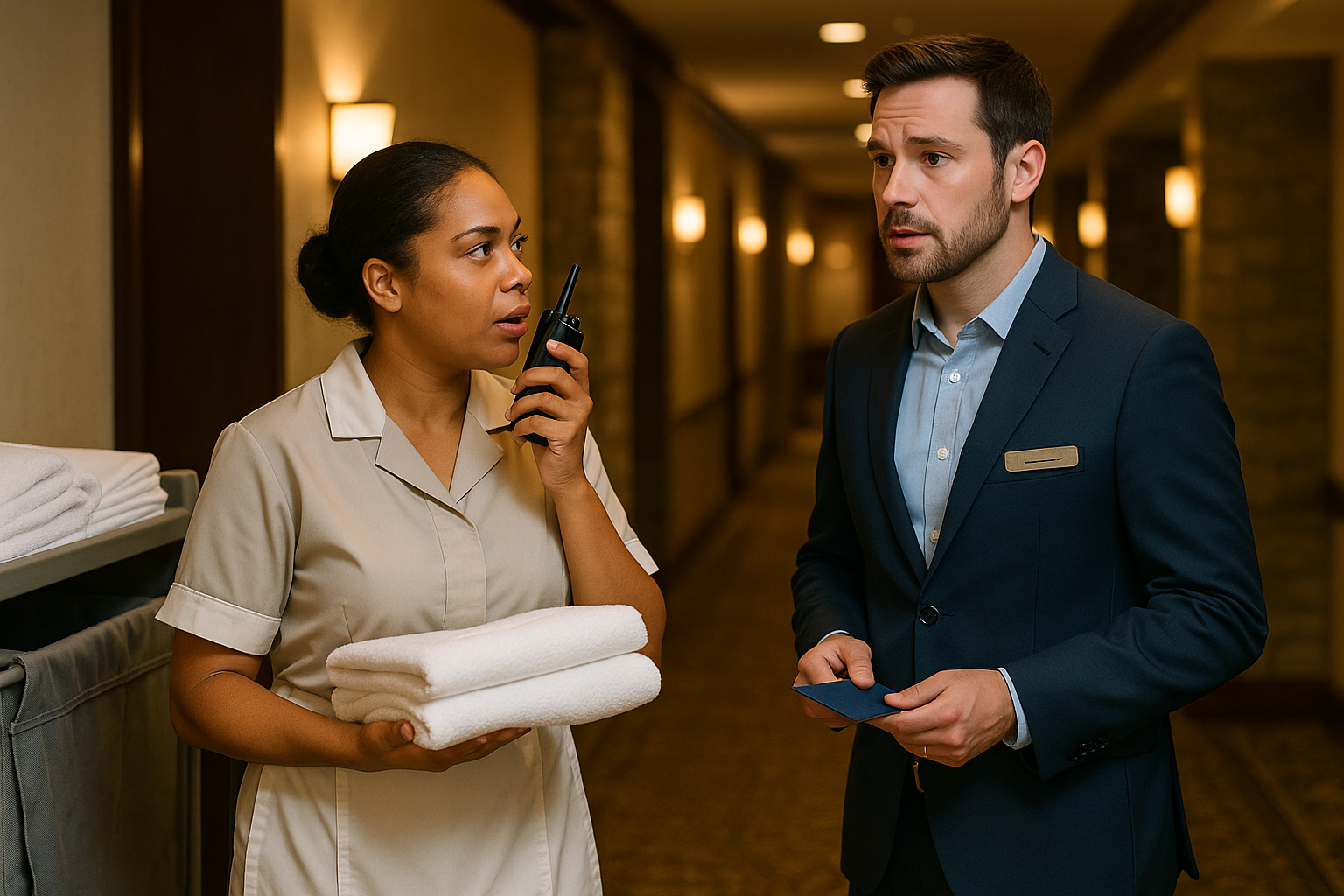
The Room Isn’t Ready Yet: Better Handoffs Between Resort Housekeeping and Front Desk Teams
At a theme park resort, a guest’s arrival experience often depends on work they never see. Before a front desk employee hands over a room key, housekeeping has inspected the room, replenished supplies, reported maintenance concerns, and confirmed that the space is ready for the next guest.
When that process breaks down, the result can be more than a delayed check-in. A room may be marked ready before it has been fully inspected, a maintenance issue may not reach the right department, or a front desk employee may have no useful update to provide a waiting guest. Strong communication between housekeeping and front desk teams helps prevent these situations and creates a smoother experience for everyone.
Why Room-Status Accuracy Matters
Room status is more than a label in a property-management system or on a department communication board. It represents a promise that the room is prepared for occupancy.
If a room is listed as ready when it is not, several problems can follow:
- A guest may enter a room that has not been fully cleaned or inspected.
- The front desk may need to relocate the guest or arrange an additional cleaning visit.
- Housekeeping may receive repeated requests because the original issue was not clearly documented.
- Maintenance concerns may remain unresolved until after check-in.
- Employees may lose time trying to determine who last handled the room.
Accurate status updates protect the guest experience and help departments plan their workload. A delayed room is frustrating, but an inaccurate room status creates confusion that can affect multiple teams.
What Makes a Good Room Handoff?
A useful handoff gives the next employee enough information to understand the room’s current condition and what still needs to happen. Simply saying “the room is almost done” may not be enough.
A stronger update might clarify:
- Whether cleaning is complete or still in progress
- Whether the room has received its final inspection
- Whether supplies, linens, or amenities are still needed
- Whether a maintenance issue has been reported
- Whether the room should remain unavailable until another department responds
- When the next update is likely to be available
The goal is not to create unnecessary paperwork or lengthy conversations. The goal is to eliminate uncertainty. A front desk employee should be able to understand what can be promised to the guest, while housekeeping should know whether the room has a time-sensitive priority.
Common Handoff Problems and Better Alternatives
“It should be ready soon”
This phrase is common during busy arrival periods, but it does not give the front desk enough information to set reasonable expectations. If possible, provide a more specific estimate or identify the remaining task.
For example, “The room is cleaned but waiting for inspection” is more useful than “It should be ready soon.” The front desk can then explain that the room is in its final preparation stage rather than implying that the guest can receive access immediately.
Unreported maintenance concerns
A housekeeping employee may notice a dripping faucet, damaged furniture, a malfunctioning light, or an unusual sound while preparing a room. These observations should be communicated through the appropriate reporting channel rather than mentioned casually and assumed to be remembered.
When reporting an issue, describe what was observed without guessing at the cause. “The bathroom sink continues to drip after the handle is turned off” is more actionable than “The sink is broken.” Clear descriptions help maintenance teams prioritize and diagnose the problem more efficiently.
Assuming someone else passed along the information
During a busy shift, several employees may interact with the same room. A housekeeper may tell a supervisor, the supervisor may speak with another department, and the front desk may hear a partial version from a different employee.
Important room information should be recorded or communicated through the established department process. When speaking directly with another team, confirm that the message was received. A brief acknowledgment can prevent a problem from disappearing between shifts.
Marking a room ready before the final check
Pressure can build when guests are waiting and arrivals are arriving faster than rooms can be completed. Even so, room readiness should reflect the actual condition of the room. A room that still needs a final inspection, missing supplies, or follow-up work should not be treated as fully ready simply because the cleaning portion is finished.
Accurate updates may feel slower in the moment, but they reduce rework and prevent guests from encountering avoidable problems.
Handling the Arrival Rush
Large arrival waves create predictable challenges. Housekeeping teams may be completing the final rooms of the day while front desk employees are assisting guests who have already arrived. This is when short, structured communication becomes especially valuable.
Both departments can improve coordination by identifying priority rooms and keeping updates focused. Useful information may include:
- Rooms connected to guests who are already waiting
- Rooms needed for accessibility accommodations
- Rooms requiring a maintenance response before occupancy
- Rooms that are clean but awaiting inspection
- Rooms delayed because of a missing item or additional service request
Front desk employees should avoid promising a precise completion time unless they have a reliable update. Instead, they can explain the current stage and provide a reasonable time for the next communication. Guests generally respond better to an honest update than to a confident estimate that changes repeatedly.
Communicating With Guests When a Room Is Delayed
Front desk employees do not need to explain every internal detail, but they should provide enough information to show that the situation is being actively managed.
A professional update might include three parts:
- Acknowledge the delay: Recognize that the guest has been waiting.
- Share the current status: Explain whether the room is being cleaned, inspected, or checked by another department.
- Set the next point of contact: Provide a realistic time for another update rather than making an unsupported promise.
Housekeeping employees may also interact directly with arriving guests in hallways or near guest rooms. A simple, courteous explanation can help, but employees should avoid discussing private room details where other guests can hear. When a concern requires front desk involvement, guide the guest to the appropriate contact rather than attempting to resolve a situation outside the employee’s role.
Building Better Cross-Department Habits
Strong handoffs are usually built through small, repeatable habits rather than dramatic changes. Employees can contribute by:
- Using consistent language for room conditions
- Documenting issues through the approved communication method
- Confirming when a time-sensitive message has been received
- Separating completed tasks from outstanding tasks
- Sharing relevant updates during shift changes
- Asking clarifying questions instead of making assumptions
- Thanking other departments when they respond quickly during a busy period
These habits also help employees develop skills that apply beyond resort operations. Accurate documentation, prioritization, calm communication, and cross-department coordination are valuable in front office leadership, housekeeping supervision, guest services, operations, and other hospitality roles.
Small Details Create a Smoother Guest Arrival
A room handoff may seem like a routine operational task, but it has a direct effect on guest confidence. When housekeeping and front desk teams share accurate information, employees can make better decisions, guests receive clearer expectations, and maintenance concerns are less likely to be overlooked.
The best handoffs are concise, specific, and timely. They do not require every employee to know every detail about another department’s work. They simply ensure that the right information reaches the right person before a small issue becomes a larger one.
For professionals working in theme parks, resorts, and attractions, ThemeParkConnections.com offers a place to connect with other industry professionals, share experiences, learn about different departments, and expand your professional network. It can also help you discover career opportunities and build relationships throughout the attractions industry—whether your current role is in housekeeping, front desk operations, food and beverage, maintenance, entertainment, or guest services.