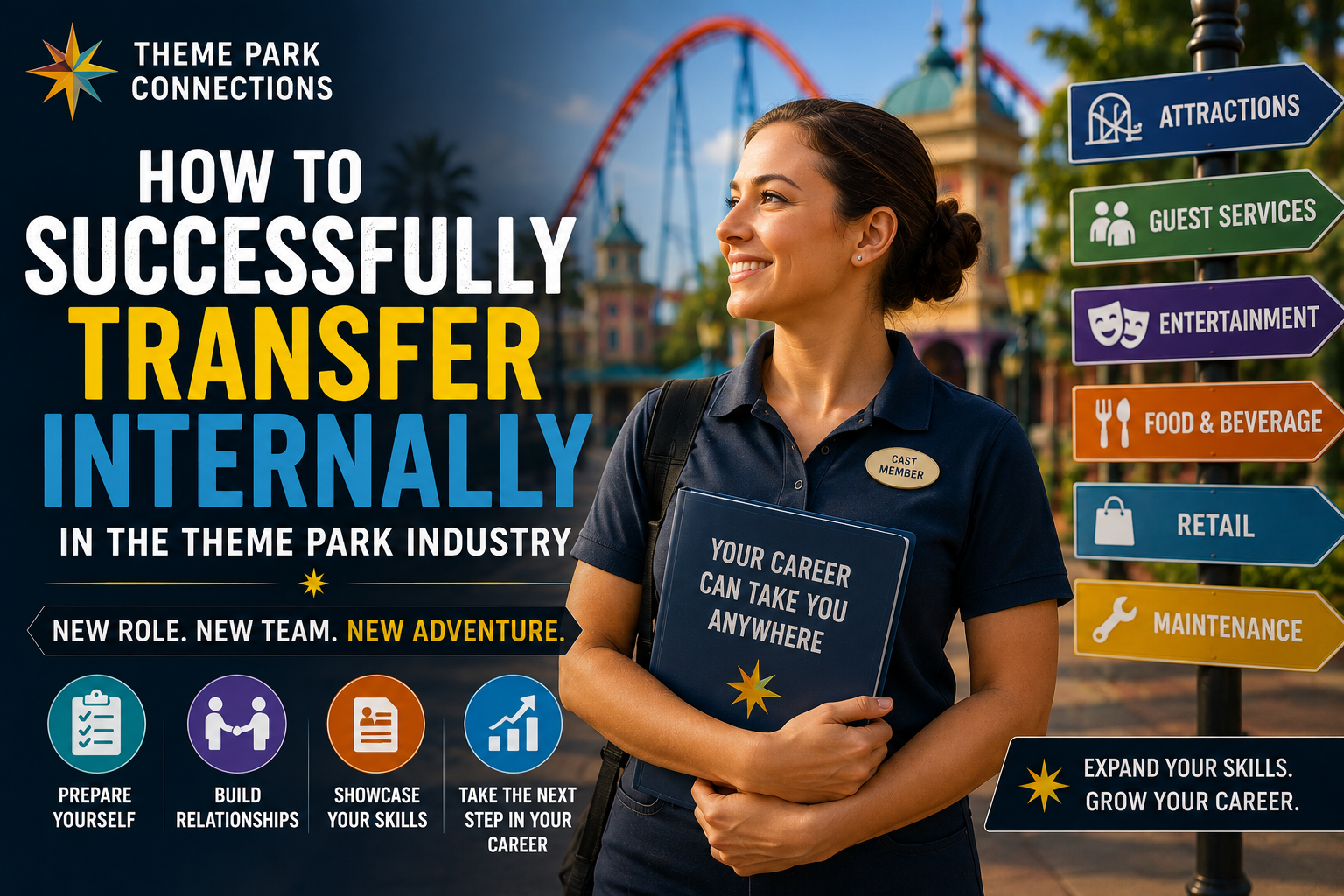
How to Transfer from Attraction Operations to Guest Services Without Starting Over
Moving from attraction operations into guest services can be a smart next step for theme park employees who enjoy helping people, solving problems, and seeing the larger picture of the guest experience. The transition may look like a complete career change from the outside, but your attraction experience already gives you many of the skills hiring leaders look for.
The key is learning how to translate what you already do into guest services language. Operating an attraction is not just about dispatching vehicles or following safety procedures. You communicate under pressure, manage crowds, explain policies, respond to concerns, and make decisions that affect the entire park day. Those experiences can become a strong foundation for a new department.
Understand What Guest Services Teams Actually Do
Guest services work is often associated with answering questions, but the role involves much more than providing directions. Depending on the operation, guest services employees may assist with accessibility needs, ticketing concerns, park policies, lost items, service recovery, special circumstances, and complicated itineraries.
Unlike attraction operations, where the same safety and service sequence may repeat throughout the day, guest services interactions are less predictable. One conversation may involve a simple question about operating hours. The next may require patience, careful documentation, and coordination with several departments.
Before applying for a transfer, spend time learning what the department handles. Talk with current team members, observe how they communicate with guests, and review internal job descriptions carefully. You want to understand the work beyond the job title.
Recognize the Skills You Already Have
Attraction operators sometimes underestimate how much transferable experience they have. Your current role may have prepared you for guest services in several important ways.
- Clear communication: You explain safety instructions, height requirements, boarding procedures, and operational changes to guests from many backgrounds.
- Emotional control: You remain professional when guests are frustrated, confused, or unhappy with a wait time or restriction.
- Policy knowledge: You follow procedures consistently and explain rules without making the guest feel dismissed.
- Situational awareness: You notice changes in crowd behavior, operational conditions, and guest needs.
- Department coordination: You communicate with leads, maintenance, custodial teams, security, entertainment, and other operations.
- Accessibility awareness: You help guests understand boarding options and identify when additional assistance may be needed.
The challenge is not necessarily gaining new abilities. It is showing how those abilities apply to a different setting.
Translate Attraction Experience on Your Resume
A resume that simply says “operated attraction according to safety procedures” may be accurate, but it does not show the full value of your work. Use language that highlights communication, judgment, and guest interaction.
Instead of Listing Tasks, Show the Impact
Consider the difference between these two descriptions:
Basic: “Operated attraction and assisted guests with boarding.”
Stronger: “Communicated safety requirements and boarding procedures to large volumes of guests while maintaining a welcoming experience during changing operational conditions.”
The second version explains why the work required skill. You can also mention responsibilities such as handling delayed operations, assisting guests with accessibility questions, responding to complaints, or helping manage a crowded queue.
Whenever possible, prepare specific examples. You might describe a time you:
- Explained an attraction restriction to a disappointed family.
- Helped a guest find an appropriate boarding solution.
- Managed questions during an unexpected closure.
- De-escalated a tense interaction without making promises outside your authority.
- Coordinated with another department to help resolve a guest concern.
These examples demonstrate the judgment and communication skills that guest services leaders need.
Prepare for the Internal Interview
An internal interview for guest services will likely focus on your ability to handle ambiguity. Attraction operations often has defined procedures for common situations. Guest services requires you to determine which procedure, resource, or department applies to the specific situation in front of you.
Be ready to answer questions about difficult conversations, policy enforcement, teamwork, and service recovery. Use real examples from your current role, even if they do not seem directly connected to guest services.
A Useful Structure for Your Answers
When describing a workplace situation, explain:
- The situation: What was happening, and why was it challenging?
- Your responsibility: What part of the situation did you own?
- Your action: What did you say or do, and who did you involve?
- The result: How did the interaction end, and what did you learn?
For example, you might explain how an attraction closed unexpectedly during a busy period. Rather than focusing only on the closure itself, discuss how you communicated the change, acknowledged the guest’s disappointment, avoided speculation, and directed the guest to an appropriate source for additional information.
That answer shows honesty, empathy, and good judgment—three qualities that matter in any guest-facing department.
Learn the Difference Between Empathy and Exceptions
One of the most difficult adjustments in guest services is supporting a guest without automatically granting every request. Attraction employees already understand that safety rules cannot be negotiated. In guest services, you may encounter other policies involving tickets, refunds, reservations, accessibility, or compensation.
Empathy means recognizing the guest’s experience. It does not mean promising an outcome you cannot deliver.
Useful language often sounds simple:
“I understand why that was frustrating. Let me explain what options are available from here.”
This approach acknowledges the concern while keeping the conversation focused on realistic solutions. Avoid phrases that sound dismissive, such as “That’s just the policy,” even when the policy is correct. Explain the reason or next step whenever you can.
Build Relationships Before You Apply
A transfer becomes easier when people in the new department understand your work ethic and communication style. This does not mean trying to collect favors or interrupting guest services employees during busy periods. It means building professional relationships naturally.
Ask thoughtful questions during appropriate moments. Find out what successful new hires commonly struggle with, which skills are most valuable, and what the department wishes applicants understood before transferring.
You can also strengthen your reputation in your current role by becoming known as someone who is reliable, calm, and helpful across department lines. Leaders often remember employees who support the operation without creating unnecessary conflict.
At the same time, continue performing well where you are. A transfer application is not a reason to mentally leave your current department. Strong performance in your present role is one of the clearest indicators that you are ready for a new opportunity.
Expect a Learning Curve
Your attraction experience will help you get started, but guest services will introduce new systems, terminology, and boundaries. You may need to learn ticketing platforms, accessibility resources, escalation procedures, documentation standards, and the correct contacts for specialized issues.
Give yourself time to become comfortable. Ask questions early rather than guessing. Keep notes on recurring situations, approved resources, and phrases that help explain complicated information clearly.
Pay attention to how experienced team members manage conversations. Notice how they listen, summarize the issue, set expectations, and close the interaction. Guest services is a skill built through repetition, and every conversation teaches you something about clarity and judgment.
Use the Transfer to Shape Your Long-Term Career
Guest services experience can open doors beyond the front line. It may lead to roles in accessibility, operations leadership, training, guest experience, communications, resort services, or other departments that depend on strong problem-solving skills.
The most valuable outcome is not simply leaving attraction operations. It is developing a broader understanding of how the park works and how different departments contribute to the guest experience.
Your attraction background gives you operational credibility. Guest services can add policy knowledge, conflict resolution, and a deeper understanding of guest needs. Together, those experiences can make you a stronger candidate for future leadership opportunities.
Changing departments does not erase your previous experience. It gives that experience a new context. If you can clearly explain what you have learned, remain open to the department’s expectations, and continue treating every guest interaction as an opportunity to build trust, you can make the move without starting over.
Connect With Other Attractions Professionals
Career moves are easier when you can learn from people who have already taken similar paths. Theme Park Connections gives professionals throughout the theme park and attractions industry a place to connect with other employees, expand their network, share experiences, and discover opportunities across different departments and career paths.
Join the community, start a conversation, and learn how other attractions professionals are building their careers.