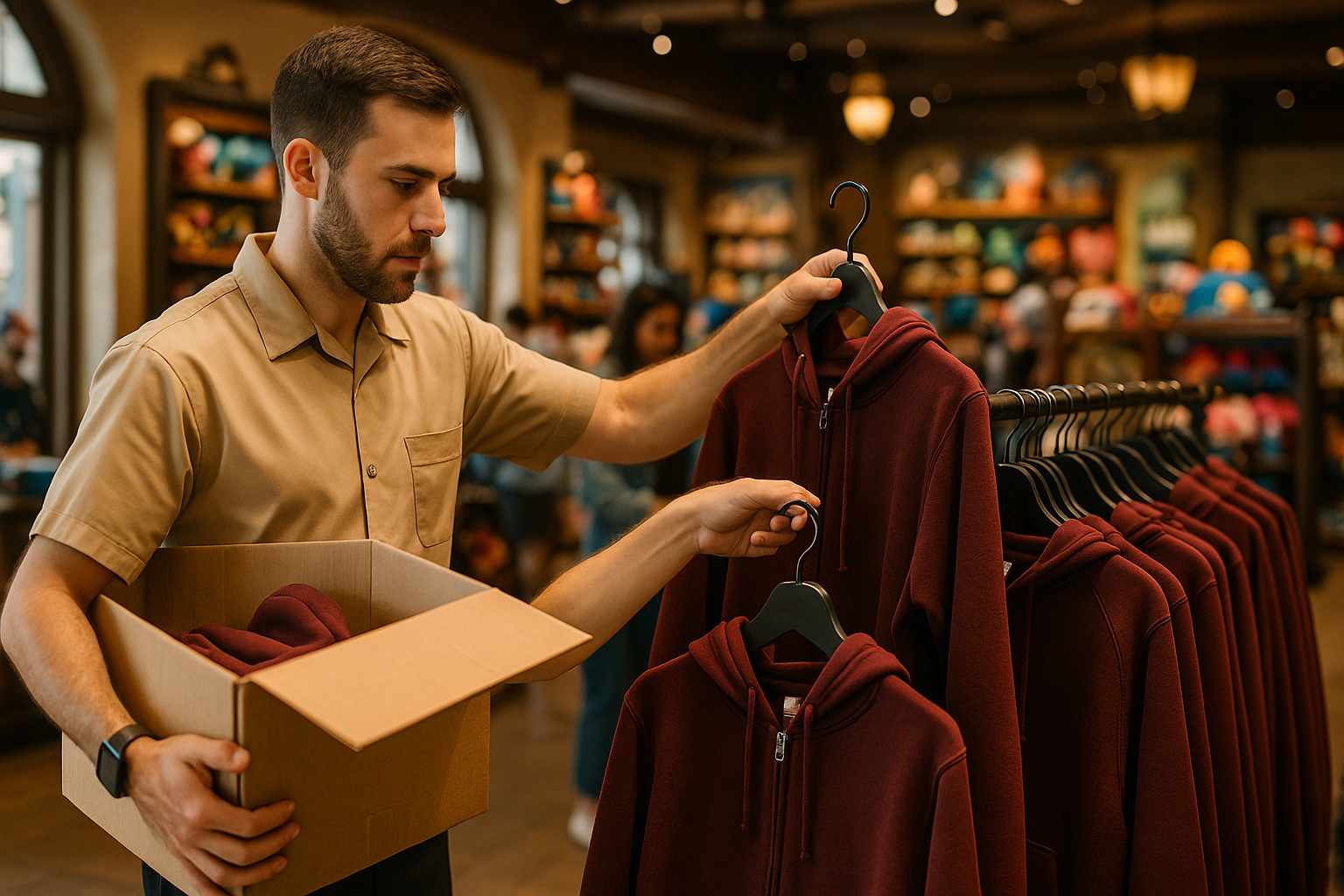
The Stockroom-to-Shopfloor Handoff: Preventing Merchandise Gaps During Peak Hours
A busy merchandise location can sell through a popular item faster than anyone expects. A limited-edition product appears on a display, a character meet ends nearby, or a parade sends a wave of guests toward the shops, and suddenly the sales floor needs replenishment immediately.
That is where the relationship between the stockroom and the shop floor becomes critical. Merchandise employees are not simply moving products from one place to another. They are managing timing, presentation, inventory awareness, guest expectations, and communication during some of the busiest moments in a park.
A strong stockroom-to-shopfloor handoff helps a retail team keep displays full, respond to demand quickly, and avoid unnecessary confusion during peak attendance. It is also a practical skill that can help employees stand out for trainer, coordinator, and leadership opportunities.
Why Merchandise Handoffs Matter
Retail operations often involve several employees working different parts of the same process. One person may notice that a display is running low, another may retrieve the product from the stockroom, and a third may be assisting guests or handling the register when the merchandise arrives.
Without clear communication, the product may sit in the wrong place, be restocked on an incorrect fixture, or remain unavailable even though the team believes it has already been handled.
A useful handoff answers three basic questions:
- What product or display needs attention?
- What action has already been taken?
- What still needs to happen next?
This information can be shared in the method established by the employer, such as a department communication tool, written note, radio call, task list, or in-person conversation. The specific system may vary, but the goal remains the same: make the next step obvious.
Recognizing More Than an Empty Shelf
An empty or nearly empty display does not always mean the same thing. The product may be stored nearby, waiting for a delivery, intentionally held for another location, or temporarily unavailable because of an inventory issue.
Before escalating a concern, observe the situation carefully. Look for details such as:
- Whether the display is completely empty or simply low
- Whether the missing product belongs on a specific fixture or table
- Whether similar items are also selling quickly
- Whether the product has a size, color, or style variation
- Whether guests are actively asking for the item
- Whether nearby displays have been disturbed or mixed together
Good observation helps the stockroom employee retrieve the correct merchandise and helps the sales-floor team recognize patterns. If several guests ask for the same item within a short period, that may be more important than one display needing a routine refill.
What the Shop Floor Should Communicate
A vague request such as “Can we get more shirts?” creates unnecessary back-and-forth. The stockroom employee may need to ask which design, size range, or location is involved before beginning the search.
A stronger request includes enough detail to support quick action:
- Product name or clear description
- Display or department location
- Approximate quantity needed
- Specific sizes, colors, or styles if relevant
- Whether guests are currently waiting for the item
- Whether the request is urgent or part of routine replenishment
For example, “The blue park-logo hoodies are low at the front wall display, especially medium and large. Guests have asked for both sizes. Can someone check the stockroom when available?” gives the receiving employee a much clearer starting point.
If the request is urgent because guests are waiting, say that directly. The word “urgent” should be used thoughtfully, but the team needs to know when a product request is affecting an active guest interaction.
What the Stockroom Should Confirm
Stockroom work often involves competing requests. A team member may be locating several products, receiving a shipment, organizing backstock, or supporting another location. When a request cannot be completed immediately, a quick update can prevent the shop floor from assuming that the task has been forgotten.
A useful response might confirm:
- Whether the product was located
- Whether the requested quantity is available
- Whether only certain sizes or variations are in stock
- Whether the product has been sent out
- Whether the item is unavailable or needs further follow-up
“We found six medium hoodies but no large; four are heading to the front display now” is much more useful than “We’re checking.” It gives the sales-floor team information they can use immediately when speaking with guests.
When the Product Is Not Available
One of the most important parts of a merchandise handoff is communicating an accurate shortage. Employees should not promise that more inventory is coming unless that information has been confirmed through the appropriate process.
If the product cannot be found, the shop-floor employee may need to offer another option, such as a different size, style, color, or nearby location. The guest may also appreciate an honest explanation that the team is checking availability rather than receiving a confident but inaccurate promise.
Clear communication protects trust between departments and helps employees provide realistic information to guests.
Restocking Without Losing the Sales Floor
Replenishment is not finished simply because a box has arrived at the shop. Merchandise should be placed where guests can find it, displays should remain organized, and packaging should be removed or handled according to department expectations.
During a peak period, employees may need to balance restocking with active guest service. A practical approach is to:
- Prioritize high-demand or guest-requested items
- Keep pathways and selling areas clear
- Avoid leaving open cartons unattended in guest areas
- Return misplaced products to the correct display
- Check that sizes and styles are presented in an understandable order
- Communicate when a display has been replenished
That final update matters. If one employee requests replenishment and another completes it without telling anyone, a third employee may repeat the request or continue telling guests that the product is unavailable.
Common Handoff Mistakes
Using product nicknames that others do not know
Regular employees may use informal names for popular merchandise, but newer team members or employees from another location may not recognize them. Include a visual description, collection name, or display location when possible.
Leaving out partial availability
Finding some of the requested merchandise is still useful information. If only certain sizes or colors are available, communicate that clearly rather than treating the request as completely fulfilled.
Assuming the display will stay organized
During peak periods, guests may move products between racks, tables, and shelves while browsing. A quick visual check after replenishment can prevent a full display from becoming difficult to shop.
Failing to close the loop
The person who identifies the need does not always need to be the person who completes the task. However, someone should confirm whether the request was completed, partially completed, or unable to be completed.
Why This Skill Helps Your Career
Strong merchandise handoffs demonstrate more than retail knowledge. They show that an employee can prioritize, communicate clearly, notice operational patterns, and think about the guest experience while managing behind-the-scenes work.
Those abilities are useful in roles such as:
- Merchandise trainer
- Stockroom coordinator
- Retail lead
- Inventory or allocation support
- Operations coordinator
- Department supervisor
If you want to build a reputation as a dependable retail employee, focus on making the next person’s job easier. Give complete information, provide accurate updates, and notice problems before they become guest-facing issues.
Keep the Product Moving and the Information Clear
Peak-period merchandise operations depend on timing. A product must be located, delivered, presented, and communicated about quickly enough to meet guest demand. When the shop floor and stockroom treat replenishment as one connected process, the team can respond faster and avoid duplicated effort.
The best handoff is often brief, but never vague. Identify the product, explain the need, confirm what happened, and make the next action clear.
For employees building careers across the attractions industry, ThemeParkConnections.com provides a place to connect with other professionals, share experiences, learn about different departments, discover career opportunities, and expand a network throughout theme parks, resorts, entertainment, food and beverage, retail, maintenance, and guest services.