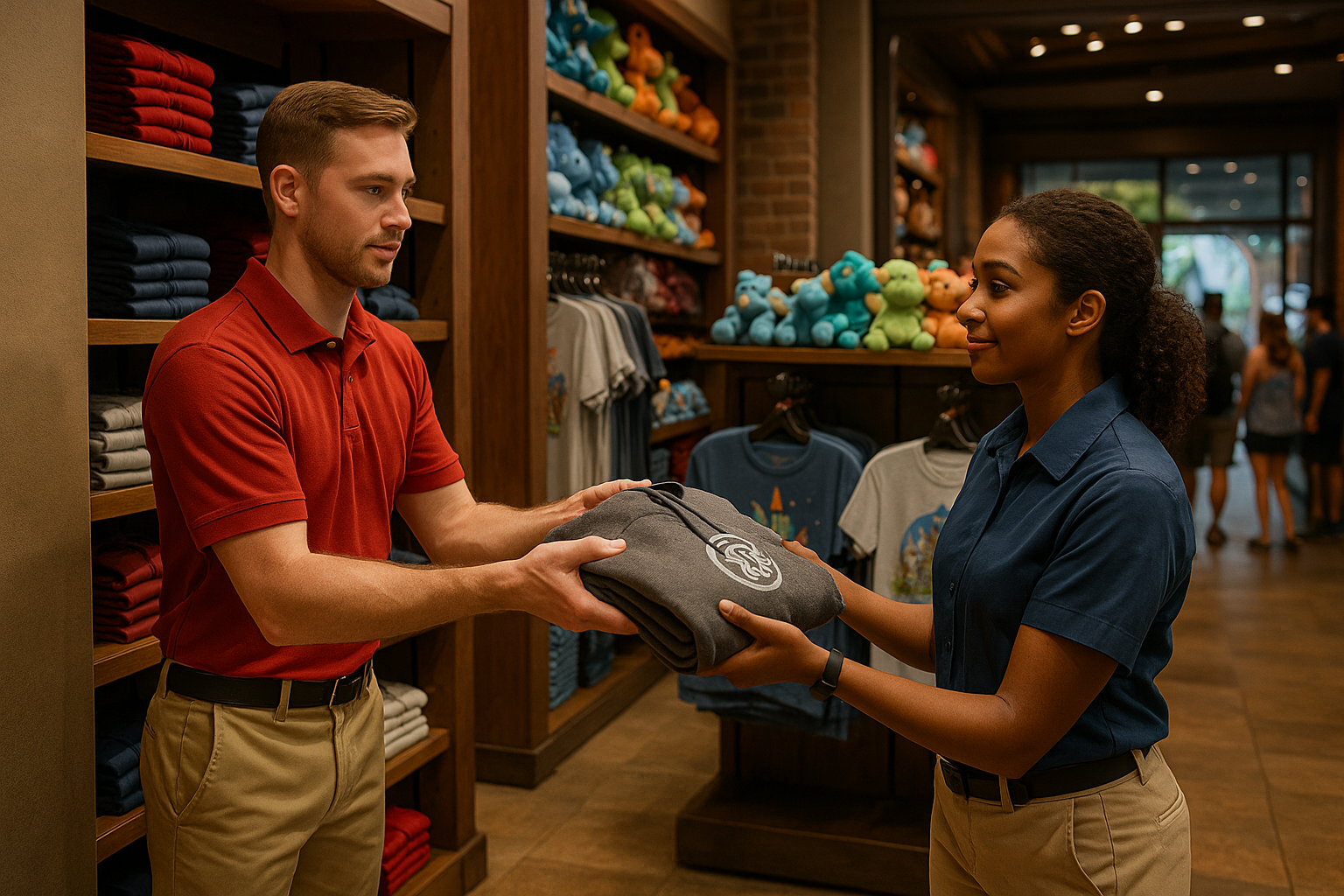
The Stockroom-to-Sales-Floor Handoff During Peak Season
In a theme park retail location, guests usually notice the sales floor: the displays, merchandise walls, fitting rooms, registers, and employees ready to answer questions. They rarely see the work happening behind the scenes to keep that space stocked and organized.
During peak attendance periods, the connection between the stockroom and the sales floor becomes especially important. A popular product can disappear from a display within minutes. A long line may form while an employee searches for a size. A new shipment may arrive while the team is already trying to recover from a busy afternoon.
A strong stockroom-to-sales-floor handoff helps retail teams respond quickly without creating unnecessary confusion. It also builds skills in communication, organization, inventory awareness, and teamwork that can benefit employees throughout the attractions industry.
Why the Handoff Matters in Theme Park Retail
Retail operations depend on more than simply having merchandise somewhere in the building. The right product needs to be available, easy to locate, properly presented, and replenished at the right time.
A weak handoff can create several problems:
- Employees may search for merchandise that has already sold out.
- Multiple team members may look for the same item without communicating.
- Stockroom employees may bring out products that are not the most urgent needs.
- Displays may remain empty even though replenishment is available.
- Guests may receive inconsistent answers about product availability.
During slower periods, these issues may be manageable. During holidays, special events, or high-attendance days, they can quickly affect the guest experience and place additional pressure on the team.
What Makes Peak-Period Replenishment Different
Peak-season retail is not simply a normal shift with more guests. The pace, priorities, and volume of communication all change.
Employees may need to manage several demands at once:
- Answering product questions while monitoring a busy display.
- Locating different sizes or colors for guests.
- Replenishing high-demand items before the sales floor looks empty.
- Keeping walkways, fixtures, and fitting areas organized.
- Communicating changing product availability to fellow employees.
Some merchandise will move predictably, such as event-specific apparel, seasonal products, or items associated with a new attraction. Other products may become unexpectedly popular because guests see them in another location or because a particular size is in high demand.
That is why the handoff cannot rely only on a routine checklist. Employees also need to share what they are observing in real time.
Information the Sales Floor Should Communicate
A useful request is specific enough for the stockroom employee to act on immediately. Saying “we need more shirts” does not provide much direction. A better request identifies the product, location, and urgency.
Helpful information may include:
- The exact product name or a clear description.
- Size, color, style, or variation.
- The fixture or display where the item belongs.
- How many units are needed, if known.
- Whether a guest is currently waiting for the item.
- Whether the product is selling quickly or needed for display recovery.
For example, “Can someone check for additional adult medium attraction logo hoodies for the front wall? A guest is waiting, and the display has only one remaining” is much more useful than “Can you check the hoodies?”
Clear communication reduces repeated questions and allows stockroom employees to prioritize requests correctly.
Information the Stockroom Should Communicate Back
The handoff is not complete when a request is sent. The stockroom team should provide a clear response, even when the answer is not what the sales-floor employee hoped to hear.
A useful response might confirm:
- Whether the item is available.
- How many units were found.
- Whether the item is being brought out or held for a guest.
- Whether only certain sizes or variations remain.
- Whether the stockroom was checked and the product could not be located.
- Whether another location or resource should be contacted.
“We found two adult mediums and one large; they are coming out now” gives the sales floor a clear expectation. “We do not have any additional adult mediums in this stockroom, but we found two larges” also helps the employee speak accurately with the guest.
Creating a Simple Priority System
When several requests arrive at the same time, employees need a practical way to determine what should happen first. The exact process may differ by employer, but a basic priority system can help teams make decisions consistently.
Guest-specific requests
If a guest is waiting for a particular size or product, that request may require immediate attention. A fast, accurate response can prevent the guest from leaving disappointed or requiring multiple employees to become involved.
Empty high-visibility displays
A completely empty display near an entrance, register, or major walkway can make a location look understocked even when merchandise is available elsewhere. Replenishing high-visibility areas may be more urgent than filling a less noticeable section.
Fast-selling merchandise
If a product is moving quickly, replenishing it in larger quantities may reduce repeated trips to the stockroom. Employees should communicate when an item is consistently selling rather than treating every request as an isolated event.
Routine recovery
Folding, sizing, and general merchandise recovery remain important, but they may need to be balanced against immediate guest needs and urgent replenishment during the busiest periods.
Common Handoff Mistakes
Even experienced employees can run into communication problems when the store becomes busy. Several mistakes appear frequently during peak operations.
- Using vague descriptions: “The red one” may not be enough when multiple products have similar colors.
- Failing to close the loop: If a request cannot be completed, the sales floor needs to know rather than continuing to wait.
- Making repeated requests: Multiple employees may unknowingly contact the stockroom about the same item.
- Ignoring partial availability: If only some sizes remain, that information can still help the guest.
- Leaving returned merchandise uncommunicated: A product may appear unavailable in the stockroom while a return is waiting to be processed or sorted.
- Overloading one employee: During a rush, assigning every stockroom request to one person can create delays and errors.
Building Better Habits as a Retail Employee
Employees can improve the stockroom-to-sales-floor handoff through a few consistent habits:
- Learn the basic layout of the stockroom and sales floor.
- Pay attention to which products sell fastest during different periods.
- Use precise product descriptions in person or over the radio.
- Repeat important details when the location is noisy.
- Confirm when a request has been completed.
- Share patterns, such as a particular size repeatedly selling out.
- Keep communication professional, especially when the store is under pressure.
These habits do more than improve one retail location. They demonstrate operational awareness. Employees who understand how inventory, presentation, guest service, and teamwork connect are often better prepared for lead responsibilities, training roles, inventory assignments, and other opportunities within the industry.
Turning Replenishment Into Teamwork
The best retail teams do not treat the stockroom and sales floor as separate departments. They understand that both areas are working toward the same result: helping guests find what they want while keeping the operation organized and responsive.
A strong handoff is brief, accurate, and followed through. During a busy shift, that may be the difference between a guest receiving quick assistance and spending several frustrating minutes waiting for an answer. It may also determine whether a sales floor appears prepared for the next wave of guests.
For professionals looking to connect with others in the attractions industry, ThemeParkConnections.com offers a place to share experiences like these, expand a professional network, learn about different departments, and discover career opportunities throughout theme parks, resorts, entertainment venues, and other attractions. The lessons learned in a retail stockroom can be valuable far beyond the store itself.