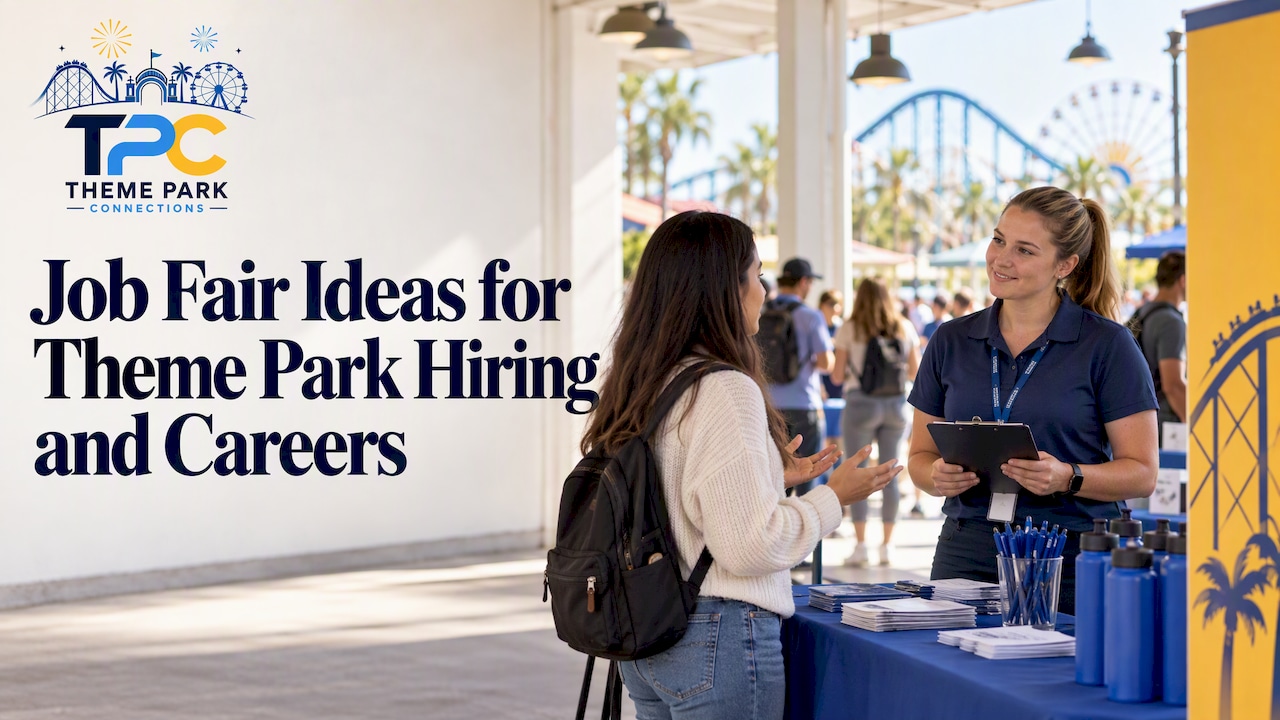
Job Fair Ideas for Theme Park Hiring and Careers

The best job fair ideas for a theme park are the ones that let people experience the work before they commit to it. Employers get there with hands-on booths, on-the-spot interviews and honest conversations about peak-season reality. Job seekers get there by researching the park, asking operational questions and following up within a day.
This guide covers both sides of the table. If you hire park staff, you’ll find formats and booth tactics. If you want a park job or a step up inside one, you’ll find a plan for before, during and after the event.
TL;DR
- Treat a job fair as a conversation, not a resume drop. Recruiters remember people who talk shop about the park, not people who hand over paper.
- Employers: give candidates a taste of the job with a demo, a themed booth or a quick interview, and be ready to explain schedules, pay ranges and growth paths.
- Job seekers: pick 5 to 10 employers ahead of time, bring 3 to 5 clean resume copies, and prepare a short pitch with your goal and 3 to 4 skills.
- Current employees: use fairs to learn about internal moves and meet peers from other parks.
- Follow up with a personal thank-you that mentions something specific you discussed.
Table of Contents
- Why job fairs still work for park careers
- Job fair ideas for theme park employers
- Job fair ideas for job seekers
- Ideas for current park employees and career changers
- Beyond the fair: networking formats that keep conversations going
- A simple plan for your next event
- Our perspective
- Where Theme Park Connections fits
- FAQ
- Sources
Why job fairs still work for park careers
Job fairs are not old-fashioned. NACE data, as summarized by one recruiting resource, shows that 78% of employers say fairs help build a stronger talent pipeline, and 56% report making direct hires from these connections. Those numbers come from college recruiting, but the logic carries over to parks, where hiring is fast and seasonal and where personality matters as much as a resume.
Parks also use fairs to fill big seasonal gaps. IAAPA, the attractions industry association, reports that some park hiring events aim for 300 to 900 seasonal roles per session, with incentives that can include signing bonuses. Big operators run dedicated events too. Walt Disney World, for example, lists scheduled hiring events on its careers site, including events for facilities and attractions mechanics roles.

That tells you something useful. A park fair is rarely only about filling a form. It is a chance to judge culture fit on both sides, and it works best when it feels like the park.
Job fair ideas for theme park employers
If you are a hiring manager or HR lead, the goal is simple: stand out in a room where every booth looks the same, and give candidates a reason to stay five minutes instead of thirty seconds.
Make the booth feel like your park
Your booth is, in the words of one recruiting guide, your first handshake. Use it. A few ideas that suit park work:
- Show the uniform. Display costumes, name tags and role badges so candidates can picture themselves in the job.
- Run a mini-demo. A short guest-service role play, a sample queue-greeting, or a basic ride-dispatch briefing lets candidates try the work.
- Use real park imagery. A looping video of a busy summer day is more honest than a polished brand reel.
- Offer park snacks. Food samples draw people in and start conversations naturally. IAAPA lists on-site food samples among tactics park hiring events have used.
- Display a growth map. A simple poster showing how a ride operator becomes a supervisor, then a manager, answers the question many candidates are too shy to ask.
Give candidates a reason to act today
Seasonal hiring moves quickly, so build urgency into the event:
- Early-access interviews. Offer short on-site interviews for candidates who arrive prepared.
- Ride pass or ticket incentives. A guest pass for attending or for completing an application gives people a tangible reward.
- Same-week offers. If your process allows it, tell people when they will hear back and keep that promise.
- Referral cards. Hand every attendee two cards to give friends. Park teams often grow through peers.
Staff the booth with the right people
Send a recruiter, but also send someone who works the job. A ride operator, a food and beverage lead or a guest services supervisor can answer the questions recruiters can’t: how a double shift feels in July, what the break rotation looks like, what a good week is.
Make sure your team knows the basics candidates will ask about, such as pay ranges, scheduling, uniform rules, housing or transportation if relevant, and how employees move between departments. Where you can’t share a number, say when and how candidates will find out. Evasive answers cost you trust.
Pick a format that fits the role
| Format | Best for | Why it works |
|---|---|---|
| Open-house hiring day at the park | High-volume seasonal roles | Candidates see the property and the guest flow first-hand |
| Role-specific event (culinary, maintenance, entertainment) | Skilled or technical hires | Fewer, better-matched candidates |
| Campus or community fair table | Entry-level and student talent | Reaches people who haven’t considered parks |
| Hybrid or virtual session | Out-of-area or returning seasonal staff | Easy to attend, good for first screening |
| Internal mobility night | Current employees | Surfaces growth paths and reduces turnover |
Don’t overlook the last row. Cast members and crew often don’t know what roles exist two departments over. A short internal event with managers from other areas can fill a leadership role faster than an outside search.
Avoid the turnoffs candidates remember
Candidates have a long memory for a bad booth. Skip the vague “apply online” answer, the unprepared rep and the giveaway that has nothing to do with the job. Quality swag helps, but a conversation about the role helps more. Recruiters in an SHRM survey said they value candidates who research the company, communicate well and ask probing questions. Your own team should hold itself to the same standard.
Job fair ideas for job seekers
Now the other side of the table. You don’t need to be the loudest person in the room. You need to be the most prepared one.
Before the fair
CareerOneStop recommends pre-registering and researching the top 5 to 10 participating employers so you can match specific roles to your skills. For a park fair, that research might look like this:
- Read the park’s recent news: a new attraction, an expansion, a seasonal event.
- Look at the current openings and note two or three that fit you.
- Find the recruiters attending and, if you can, connect with them on LinkedIn beforehand.
- Print 3 to 5 resumes and carry them in a clean folder. CareerOneStop’s veteran transition guidance treats this as a baseline expectation.
- Write a 20 to 30 second pitch with your goal and 3 to 4 key skills.
Here is a pitch that works for a first-timer:
“Hi, I’m Jordan. I’m looking for a seasonal attractions role this summer. I’ve spent two years in retail handling busy weekends, so I’m comfortable with crowds and keeping guests informed. I’d love to hear how new operators are trained.”
It is short, specific and ends with a question. That is the whole recipe.
During the fair
A Department of Labor networking guide describes a job fair as a planned networking event with many employers looking to meet and hire. Recruiters there often hesitate to trust strangers, so your job is to lower that risk. Build rapport first and talk about the industry before you ask about a job.
Good questions show you understand the work. Try these:
- “How does your team handle guest flow on peak weekends?”
- “What does training look like for crowd-management procedures?”
- “I saw the announcement about the new coaster. Which teams are growing because of it?”
- “What do your best seasonal employees do differently in their first month?”
- “What does a typical path from this role to a lead position look like?”
Avoid questions that signal you haven’t done homework, such as “What does your company do?” Save pay questions for later in the process unless the recruiter raises them. The CareerOneStop guidance above lists asking about pay at the booth among the questions to avoid.
If you’re nervous, start at a booth that is not your top choice. Warm up, then walk to the one you care about most.
After the fair
This is where most people drop the ball. Within 24 hours:
- Write down who you met and what you discussed while it’s fresh.
- Send each person a personal thank-you email that references your conversation.
- Submit any application the recruiter asked you to complete, and mention the conversation in your note.
- Set a reminder to check in again in a week or two if you haven’t heard back.
A sample message:
“Hi Dana, thank you for speaking with me today about the attractions team. I appreciated what you said about guest flow during holiday weekends. I’ve applied for the Ride Operator position and would welcome the chance to interview. Thanks again for your time.”
That one message can turn a two-minute chat into a professional relationship.
Ideas for current park employees and career changers
You may already work in a park and wonder why a job fair matters. It matters because fairs are also networking hubs. Even employers who aren’t hiring often treat them as branding exercises, which means people at the booth are open to conversation.
Here is how to use one if you already have a badge:
- Ask about internal growth. Hiring managers can tell you which roles open up and what skills they look for, long before a posting goes live.
- Meet peers from other parks. A colleague at another property can explain how their department works and what is different.
- Look for seminars and panels. For career growth, events with talks or industry tracks beat standing in a booth line, because you can speak with professionals in a more relaxed setting.
- Bring questions, not a pitch. “How did you move from operations into leadership?” invites a story. Stories lead to mentors.
If you are moving from seasonal work to year-round work, say so clearly. Describe what you have already handled, such as holiday crowds, weather closures or training new hires, and ask what the next step looks like.
Beyond the fair: networking formats that keep conversations going
A fair is one afternoon. Relationships take longer. Mixing formats helps: a small meetup, a speaker evening, a skills workshop or a casual social can all lead to conversations that a crowded hall can’t. If you want inspiration, look at formats that build career contacts, from supper clubs to guest-speaker sessions. The same ideas translate well to park communities, like a pre-season meetup for returning crew or a skills night for aspiring supervisors.
Whatever format you choose, keep it simple: a clear topic, a small group and time to talk.
A simple plan for your next event
If you want a quick checklist, use this one.
Employers
- Choose one hands-on element (demo, snack, uniform display).
- Bring an employee from the job, not only a recruiter.
- Decide in advance what you can say about pay, schedule and growth.
- Offer a fast next step, such as an interview slot.
- Follow up with every candidate, even the ones you won’t hire.
Job seekers and employees
- Research 5 to 10 employers and read recent park news.
- Bring resumes, a pitch and three smart questions.
- Talk shop before you ask for a job.
- Send personal thank-you notes within 24 hours.
Our perspective
We built Theme Park Connections because park careers can feel closed off. The industry is competitive and a bit insular, and people at the start of their careers often don’t know whom to ask. A job fair can be a great door, but only if you walk through it prepared.

What we see is that the people who move forward treat every conversation as the start of something. They ask about operations, they remember names and they follow up. Employers who do well do the same thing in reverse: they show what the work is really like and they don’t oversell it.
We also believe the fair shouldn’t be the only door. A job board is more useful when it sits next to a community where you can ask a peer what a role is like, and next to guides that explain how to move from seasonal to year-round work. If you take one thing from this article, let it be this: you don’t need a perfect pitch. You need curiosity, a little preparation and the courage to say hello.
— Mike
Where Theme Park Connections fits
If you are searching for park roles, Theme Park Connections brings job listings together with a community of cast members, crew and aspiring park professionals, plus guides on seasonal job transitions and day-to-day operations. If you hire park staff, you can post openings to an audience that already understands theme park work, which means fewer surprises for candidates and for you.
FAQ
Can you give me an example of a job fair?
A park hiring day is a good example. An operator invites candidates to the property, sets up stations for roles like attractions, food and beverage and guest services, and runs short interviews on the spot. Walt Disney World, for instance, posts hiring events on its careers site. Smaller parks may run a single-day open house with a handful of tables.
Are job fairs really worth it?
Yes, if you treat them as a networking opportunity rather than a place to land a job on the spot. NACE data cited by one recruiting resource shows that 56% of employers report direct hires from fair connections. You’ll get the most from them if you prepare, ask good questions and follow up.
How do you stand out at a job fair?
Research the employer and mention something specific, like a new attraction or an expansion. Carry clean resume copies, give a short pitch and ask about real operations such as guest flow or training. Then send a personal thank-you note that refers to your conversation.
What should employers hand out at a job fair?
Useful, role-related items work best: a one-page guide to roles and growth paths, a park snack, a guest pass incentive or a referral card. Giveaways draw people to the table, but the conversation is what convinces them. Pair any item with a clear next step.
Sources
- Hiring at Career Fairs: How to Stand Out and Make Meaningful Connections
- Job Fairs, CareerOneStop
- Job fairs, Veteran and Military Transition Center, CareerOneStop
- Job Fair Networking and Strategies, U.S. Department of Labor
- Warning Signs: Recruiters Reveal Their Biggest Turnoffs, SHRM
- IAAPA
- Disney Parks and Resorts job opportunities
- Cardiff events for young professionals