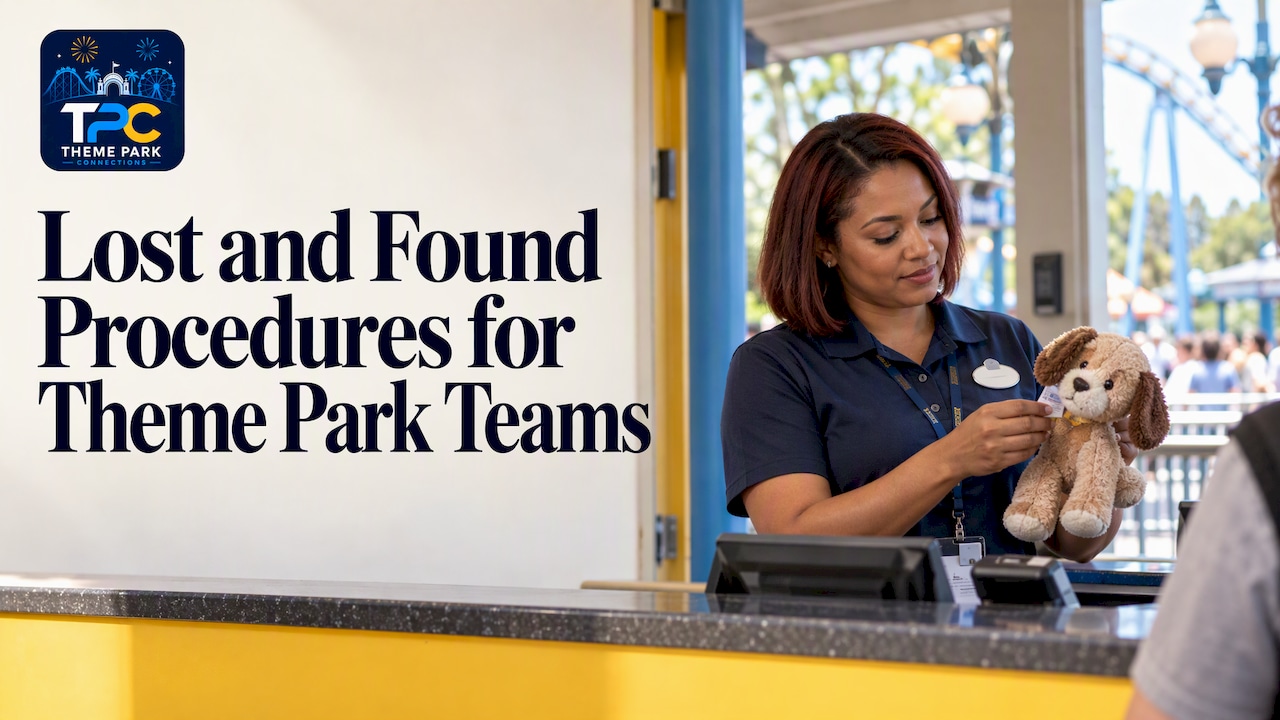
Lost and Found Procedures for Theme Park Teams

A good lost and found procedure at a theme park comes down to five steps: receive the item, log it right away, store it securely, match it to a claim with proof of ownership, and release or dispose of it by a written timeline. The lost child protocol is a separate, urgent process that runs on its own rules. If you work in guest services, or want to, this guide walks you through both so you can handle them with confidence from your first shift.
Most of what ranks online for this topic is written for hotels. Parks are different. Guests lose phones on coasters, strollers at parades and wallets in water parks, and they lose them among tens of thousands of other people. Here is how the work looks on the park side of the counter.
TL;DR
- Log every found item immediately with the date, time, location and who found it. An item that is not logged cannot be returned.
- Separate items by type: valuables, everyday items, perishables and anything with an ID. Each gets its own storage and holding time.
- Verify ownership before release. Ask guests to describe the item rather than showing them a list of what you hold.
- Holding periods vary by park. SeaWorld Orlando, for example, holds items for 90 days.
- A lost child is not a lost and found case. Follow your park’s protocol, stay with the child and communicate often with the family.
Table of Contents
- Why lost and found matters more than it looks
- The lost and found process, step by step
- How long do parks hold items?
- Customer communication is half the job
- Common mistakes and how to avoid them
- The lost child protocol
- Perspective: what we see in park careers
- Where Theme Park Connections fits in
- Building these skills into a career
- FAQ
- Sources
Why lost and found matters more than it looks
It is easy to treat lost and found as a back-office chore. Guests do not see it that way. Someone who has lost a phone or a child’s favorite toy is already stressed, and your response is often what they remember about the visit.
There is also a practical side. Legal commentary aimed at hotels and large venues points out that formal, consistent policies help limit liability, because venues are expected to take reasonable care of guests’ property. The same logic applies in a park. A written process, followed every time, protects the guest, the team member and the company.
That is why guest services teams are often where people build their reputation early. If you want to see how these skills translate into career paths, our page on guest services careers and recovery skills is a good next stop.
The lost and found process, step by step
Exact systems differ from park to park, and your training will always come first. The sequence below reflects the common shape of the work.
1. Receive the item
Items reach lost and found from several directions: guests who hand something in, attractions teams who find items at ride exits, custodial teams, food and beverage locations and shuttle or parking staff. Whoever finds the item should bring it to a guest services location or follow the local hand-off route, and should never keep it at their location overnight.
One rule saves a lot of trouble: never go through a bag or wallet alone. If you need to look for identification, do it with a second team member or a supervisor present, and note that you did.
2. Log it immediately
A useful log entry answers six questions:
- What is the item, described in plain terms (brand, color, size, distinguishing marks)?
- Where was it found?
- When was it found, by date and time?
- Who found it?
- Where is it stored now?
- Who handled it, and when?
That last question matters most when something goes missing or a claim is disputed. Many large parks now use digital systems for this. Worlds of Fun and Oceans of Fun, for example, use the Chargerback system for lost article reporting, and Disneyland Resort also directs guests to an online form. A digital record gives you a timestamped trail from report to final outcome, which is what keeps items from being returned to the wrong person.
3. Classify and store
Sorting by category keeps your holding area manageable. A simple scheme looks like this:
| Category | Examples | Typical handling |
|---|---|---|
| Valuables | Phones, wallets, jewelry, cameras, keys | Locked storage, limited access, double-check on release |
| Identification and cards | Driver’s licenses, passports, credit cards, season passes | Secured separately, owner contacted if possible |
| Everyday items | Hats, sunglasses, water bottles, chargers | Tagged shelving, held for the park’s standard period |
| Clothing and soft goods | Jackets, towels, plush toys | Bagged and tagged, same standard period |
| Perishables | Food, drinks | Discarded promptly under your health and safety rules |
| Medical items | Medications, mobility aids | Escalate to a supervisor right away |
Tag each item with its log number so the physical object and the record always match.
4. Match items to claims
Guests contact you in person at guest services or through an online form. Either way, your job is to find a match without giving away too much information.

Ask open questions first: What color was it? Is there a case? What is on the lock screen? Is there anything inside? Do not read out descriptions of what you are holding. If the guest’s answer matches your log, confirm with a second detail before you release the item.
A short sample exchange shows the tone to aim for:
Guest: “I think I left my sunglasses on the log flume this morning.”
You: “I’m sorry about that, let’s see if we can find them. Can you tell me the brand, the color and anything that would help me recognize them?”
Guest: “They’re black, with a small scratch on the left arm, and in a green case.”
You: “Thank you. That helps. Give me a moment to check our log and the shelves.”
It is warm, it is specific and it does not hand the answer over.
5. Release, ship or dispose
When you find a match, release the item with a signature, ID check or confirmation number, and record the outcome in the log. Many parks also arrange shipping for guests who have already gone home. Check your park’s rules on who covers the cost and what proof is required.
When the holding period ends, items go to disposal, donation or turnover to local authorities, depending on type and local law. This is where your park’s written policy takes over.
How long do parks hold items?
There is no single national standard. SeaWorld Orlando states that all items are held for 90 days. Other parks use shorter windows, and some hold valuables longer than everyday items. If a guest asks how long you can hold something, give your park’s actual policy, not a guess.
Some general rules of thumb apply across the industry:
- Valuables and ID usually get the longest hold and the tightest controls.
- Perishables are discarded quickly.
- Items with obvious personal or sentimental value, even a child’s toy, deserve more care than the label “low value” suggests.
Legal commentary also notes a difference between lost and abandoned property. Items left next to a trash can or in discarded packaging may be treated as abandoned, while items with real or sentimental value can create a duty to safeguard them. When you are unsure which side an item falls on, ask your supervisor. That is the right call every time.
Customer communication is half the job
The best lost and found teams treat updates as part of the service. A guest who hears nothing for a week assumes the worst. A guest who receives a clear confirmation that a report is on file, and a follow-up when an item is found, feels looked after.
Here is a message you can adapt:
“Hi, this is [Name] from guest services at [Park]. We have your report for a black phone with a blue case, logged on [date]. We have not located it yet, but we are checking again at the end of each day. We will contact you as soon as we have news.”
Three habits make this easier:
- Confirm the report in writing so the guest has a reference number.
- Tell the guest what happens next and when they can expect to hear from you.
- Close the loop even when the news is bad. A clear “we did not find it” is better than silence.
Disney’s own guest-facing page shows this approach in practice by giving guests an online form to track down a misplaced item across its locations rather than leaving them to guess where to go.
Common mistakes and how to avoid them
Skipping the log “just this once.” The item that is not logged is the one a guest comes back for in three days.

Describing the item too early. If you say “yes, we have a black wallet,” you have given away the answer. Ask first.
Mixing up locations. Parks are large. A found item should always be logged with where it was found, because that helps reunite it with the right report.
Letting items pile up at attractions. Hand items in at the end of each shift or on the route your park uses.
Handling cash or valuables alone. Count and record with a witness.
Guessing at policy. If you are not sure about a rule, check with your lead. A confident wrong answer causes more trouble than “let me confirm that for you.”
The lost child protocol
A missing child is never a lost and found item, and the process should never be mixed with it. Every park writes its own protocol, and you will be trained on yours, so what follows is a general frame and not a replacement for your park’s procedure.
The core principles tend to look like this:
- Act immediately. Any team member who finds a child alone, or who is told a child is missing, responds right away and does not wait for a more senior person.
- Stay with the child. A found child should never be left alone, and should not be taken somewhere unobserved.
- Calm and reassure. Get down to the child’s level, use a gentle voice, and ask for their name and who they came with, without leading questions.
- Radio or call it in. Follow your park’s escalation route so security, guest services and attractions teams all know.
- Reunite at a designated location. One example is that Walt Disney World’s approach, as described in a guest-facing parenting guide, is to bring a found child under 11 to the park’s Baby Care Center. Your park will have its own named location.
- Verify the adult before release. Matching a child to a parent follows its own steps, and security is often involved.
- Document it. Record the time, place and what happened, according to your park’s incident reporting rules.
What to say to a parent
Parents in this situation are scared. Your tone sets the first minute.
“I’m going to help you right now. Can you tell me your child’s name, age, and what they are wearing? We are alerting our team as we speak, and I will stay with you.”
It is brief, it is calm and it moves straight to the information you need. Avoid saying “I’m sure they’re fine.” You do not know that yet, and a parent will notice.
Quick tips for guests, which you can share
- Pick a meeting spot before you enter the park.
- Make sure children know to look for someone in a park uniform if they get separated.
- Take a photo of your child each morning so you remember what they are wearing.
For a team member, the real skill is steady communication. That skill comes up again and again in guest services roles, and it is the same skill that moves people toward trainer and leadership positions.
Perspective: what we see in park careers
We talk with people across the park industry, from first-season seasonal staff to coordinators. Lost and found rarely shows up on a job description, but it comes up often when people describe the moments they learned the most.
Here is what we believe, based on the kind of career conversations our community has.
It is a small task with a large reputation effect. Guest services is where a park earns trust one interaction at a time. A team member who handles a lost item with care is practicing the same skills they will need for service recovery, guest escalations and, later, coaching a team.
The process protects you as much as the guest. Logs, witnesses and written policies are not red tape. They keep your name clear if something is questioned later.
Ask questions in your first week. Who holds the keys? Where do items go after hours? What do I do with a found phone that is ringing? People who ask early look prepared, not unsure.
Move your skills with you. Whether you are going from seasonal to year-round, or from one park to another, procedural habits like logging, verifying and communicating travel well. Our guide to transferring theme park jobs between brands and cities shows how people carry that experience forward.
If you are early in your career, a simple goal helps: become the person on the team whom others trust to follow the process and stay kind while doing it.
— Mike
Where Theme Park Connections fits in
If you are looking for a park role in guest services, or you already work in one and want to grow, Theme Park Connections brings park job listings together with a community of current and aspiring team members and practical guides. You can ask how others handled a tough guest moment, learn what a role really involves, or get ready for a seasonal start with our seasonal jobs and college programs guide. Employers can also post openings to an audience that already understands park work.
Building these skills into a career
Lost and found work is a good training ground. If you are building your resume, these are the skills you are actually showing:
- Attention to detail: accurate descriptions and complete logs.
- Guest communication: clear, kind updates under pressure.
- Judgment: knowing when to escalate to a lead or security.
- Integrity: handling other people’s property with care.
- Process discipline: following the same steps every time.
When you talk about your experience in an interview, use a specific example. “I handled lost items” is vague. “I logged each item, verified guest descriptions before release and followed up with guests who were waiting on updates” shows what you can do.
These habits also help in other areas. Entertainment teams, for instance, deal with costume and prop control, and the same logging mindset applies. If that area interests you, see our page on entertainment careers.
FAQ
How long do theme parks keep lost items?
It depends on the park. SeaWorld Orlando states a 90-day hold, while other parks use different windows and may treat valuables differently from everyday items. Check the specific park’s lost and found page or ask guest services.
What should I do if I lose something in a theme park?
Retrace your steps and ask a team member nearby, then go to guest services and file a report with a detailed description. Many parks also have an online form, so you can report an item after you leave. Keep the confirmation or reference number.
What do cast members do when they find a lost item?
They follow their park’s hand-off route, bring it to guest services or the designated collection point, and make sure it is logged with the time, location and finder. They do not keep it at their work location or search through personal belongings alone.
What is the lost child protocol at theme parks?
Each park has its own procedure, but the common thread is to stay with the child, reassure them, alert the right teams immediately and reunite the child with a verified parent or guardian at a designated location. If you are a guest, tell the nearest team member right away. If you are a team member, follow your park’s training exactly.
Is lost and found different at a hotel and at a theme park?
The basics are the same: log, store, verify, release. Parks handle much higher guest volume, many more drop-off points and often include an online claim process. Hotel-focused guides are a decent starting point, but your park’s own policy always governs.
Sources
- SeaWorld Orlando: How to retrieve lost items
- Worlds of Fun: Lost & Found
- Disneyland Resort: Lost and Found
- Walt Disney World Resort: Lost and Found
- Lodging Magazine: Lost and Found, Legal Implications and Guest Expectations
- Walsh Wilson: Appropriate Policies Help Limit Hotels’ Liability
- Scary Mommy: What to do if you lose your kid in Disney World