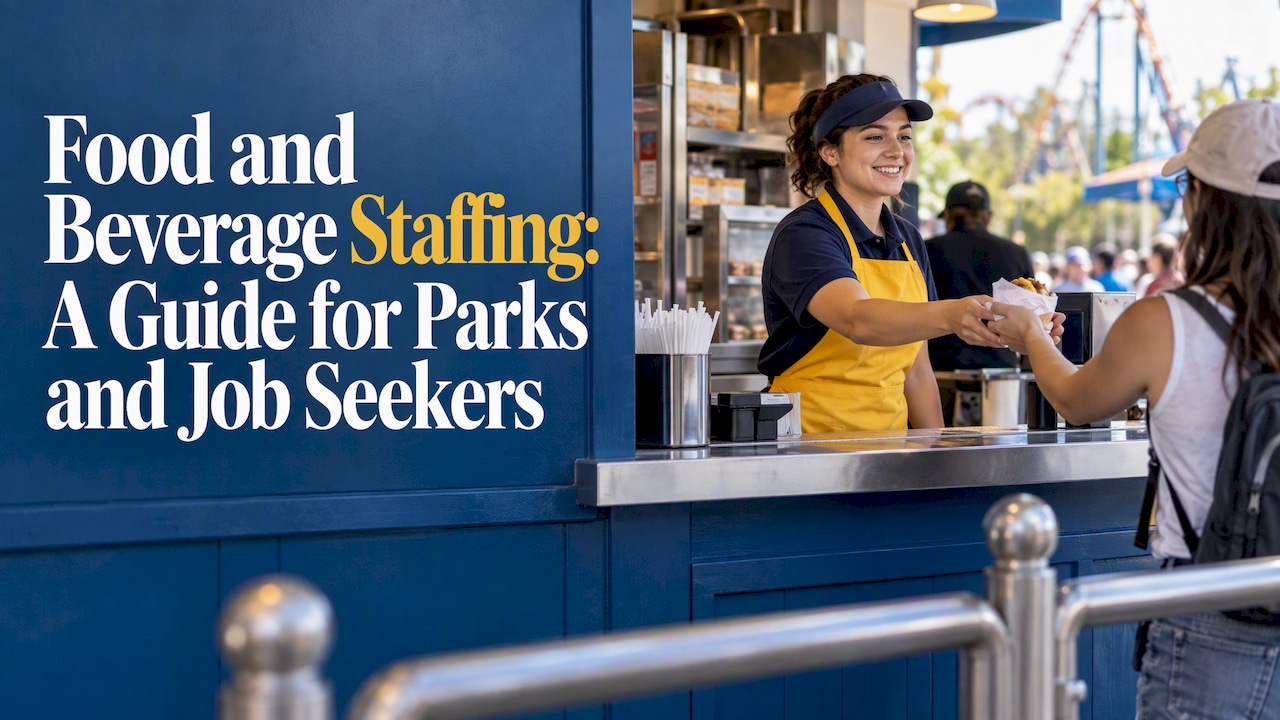
Food and Beverage Staffing: A Guide for Parks and Job Seekers

Food and beverage staffing means finding, hiring, scheduling and keeping the people who prepare and serve food and drinks, whether that is a restaurant, a stadium, a caterer or a theme park. In a park, it also means building a team that can handle a 12:30 p.m. rush at a quick-service stand and still make a guest feel welcome. This guide covers both sides: how hiring managers can staff F&B with fewer gaps, and how you can find and grow a food and beverage career inside a park.
TL;DR
- Food and beverage staffing covers three routes: agencies for fast temporary cover, general job boards for volume, and industry-specific channels for people who already understand park operations.
- Park F&B is shift work built around peak transaction hours, so the best staffing plans map labor to demand instead of filling a flat schedule.
- Retention is the cheapest staffing strategy. Moving people between food stands, retail and the front gate keeps trained staff and gives them a path forward.
- Safety training matters most for young workers. Federal rules limit what workers under 16 can do in a kitchen, and fryers are a leading cause of burns.
- If you are looking for work, start with the theme park food and beverage jobs hub and learn the role types before you apply.
Table of Contents
- What food and beverage staffing includes in a theme park
- Why park food service is harder to staff than a standard restaurant
- The main ways to staff food and beverage roles
- Map your labor to your transactions
- Keep your people: retention is staffing
- What guests expect now
- Pay: what to expect and what to offer
- Safety and age rules every F&B staffing plan needs
- Our perspective: staffing is a career question
- For job seekers: how to land a park F&B role
- For hiring managers: a practical staffing checklist
- Reach park-ready candidates
- FAQ
- Sources
What food and beverage staffing includes in a theme park
If you ask, “what is a food and beverage staff member?”, the short answer is anyone who produces, serves or supports food and drink service. In a restaurant that might be a line cook, server, host or bartender. In a park the list gets wider and more specialized:
- Quick-service (QSR) team members: cashiers, fry cooks, expeditors and runners at counters and stands.
- Culinary staff: line cooks, prep cooks, sous chefs and banquet cooks at table-service restaurants and group-event kitchens.
- Carts and kiosks: frozen treats, popcorn, lemonade and specialty carts, often staffed by one or two people working alone for stretches.
- Bar and beverage staff: bartenders, servers and, increasingly, people who run craft beer or self-pour experiences.
- Catering and events: banquet servers, setup crews and event captains for corporate outings, weddings and group packages.
- Supervisors and leaders: shift leads, assistant managers, culinary managers and trainers.
The people who staff these jobs are often called “catering staff” at events and “F&B team members” or “culinary team members” in park job postings. Titles vary by park, so read the duties, not just the name.
Why park food service is harder to staff than a standard restaurant
A neighborhood restaurant has predictable lunch and dinner peaks. A park has those peaks stacked on top of weather, school calendars, special events and holiday weekends. A rainy Tuesday in April and a sunny Saturday in July can need very different crews, sometimes for the same stand.
That makes park F&B a mix of three problems:
- Seasonality. Many parks hire a large wave of seasonal workers each spring and again for fall events, then scale down. Our seasonal jobs and college programs guide walks through how that cycle works from the worker’s side.
- Young workforce. Entry-level F&B roles are often a first job. For example, one Pittsburgh-area park lists its food and beverage team positions with a minimum age of 16 on its jobs page. Managers need to train quickly and supervise closely.
- Peak-hour intensity. Most revenue lands in a few hours. If you have too few people at 12:30 p.m., guests leave. Too many at 10 a.m., and you pay for people standing around.
The main ways to staff food and beverage roles
Hiring managers generally choose among three routes. Each solves a different problem, and many parks combine them.
| Route | Best for | Watch out for |
|---|---|---|
| Staffing agencies (on-demand or temp-to-hire) | Last-minute gaps, special events, one-off banquet shifts | Higher hourly cost, workers who may not know your park or brand |
| General job boards | High-volume seasonal hiring, entry-level roles | Large applicant pools to screen, many candidates with no park experience |
| Industry-specific channels and communities | Culinary leads, supervisors, returning seasonal staff, people who want a park career | Smaller audience than the biggest general sites |
Agencies for fast cover
Staffing agencies that specialize in food service typically supply vetted banquet servers, cooks and bartenders on a temporary, temp-to-hire or direct-hire basis. Many handle pre-employment screening and employ the workers themselves, which reduces paperwork for your HR team. Industry write-ups suggest the cost is a markup on the hourly rate for temporary shifts, or a placement fee for harder-to-fill management roles. Get exact rates in writing from any provider before you commit.
The tradeoff is familiarity. A temporary banquet server can be excellent, but that person has not learned your cash-handling flow, your allergen procedures or your queue layout. For the cooks and counter staff who make up your daily core, an agency is usually a bridge, not the foundation.
General job boards for volume
Big general boards give you reach. If you need 60 seasonal food stand employees by May, reach matters. The cost is sorting: you will read a lot of applications from people who have never worked a counter in 90-degree heat with a line of 20 guests.
Industry-specific channels for fit
Specialized channels attract people who already want this work. That is where we sit. Theme Park Connections pairs park job listings with a community and career guides, so the people who see your posting are already familiar with how parks operate. For hard-to-fill roles like culinary leads or trainers, that familiarity saves screening time.
Map your labor to your transactions
The most useful staffing idea in park F&B is simple: staff to demand, not to the clock. The International Association of Amusement Parks and Attractions (IAAPA) published a guide on making food and beverage operations more efficient in which Palace Entertainment COO Anil Rao describes treating labor as a resource mapped to specific transaction hours.
The same article reports that Palace Entertainment saved $750,000 annually by lining up labor spending with the periods that actually generate revenue. Trimming over-staffed opening and closing periods did not hurt product quality or sales.
You can try a small version of this at any park:
- Pull transactions per hour for each stand for a typical weekday and weekend.
- Compare them with the labor hours scheduled for the same stand.
- Mark the hours where staff outnumber demand, usually the first and last hour.
- Shift those labor hours to the peaks, or to another location that is busier.
- Recheck after two weeks and adjust.
For workers, this is useful to know too. A shift that is cut short on a slow day is not a judgment on you. It is often the result of this kind of scheduling, and it can be a chance to ask for hours at the front gate, in retail or at a busier stand.
Keep your people: retention is staffing
Every person who leaves has to be replaced, recruited, trained and brought up to speed. AlixPartners consultant Taylor Ceithaml says in the same IAAPA piece that the cost of turnover, covering recruiting, training and lost productivity, can easily reach several thousand dollars per person. The article also stresses that people stay when they feel heard and are paid competitively.
Two habits help:
- Reassign, don’t lay off. The IAAPA article describes successful operators moving staff from a slow food stand to retail, the front gate or a busier food location. You keep trained people and they get variety, which many strong performers want.
- Show the next step. A food runner who knows how to become a lead, then a supervisor, has a reason to return next season. Our leadership, trainer and coordinator careers page shows what those steps can look like.
What guests expect now
Food and beverage is part of the experience, not just a pit stop. Brewers Association economist Bart Watson, quoted in another IAAPA piece on craft beer partnerships at attractions, points to guests who value the experience of drinking and eating, such as local brewery tie-ins or self-pour taps. That calls for staff who can do more than ring up an order: they explain a product, manage a crowd and make people feel looked after.
The same article notes that early planning matters, including scheduling enough staff and making sure those staff can handle the crowds these features attract. If you are planning a new concept, hire and train for it before opening day.
If you are a job seeker, this is an opening. People who can combine speed with guest engagement stand out. Our guest services careers guide covers service-recovery skills that carry straight into F&B work.
Pay: what to expect and what to offer
Pay varies by park, region and role, so check the current posting. For context, the U.S. Bureau of Labor Statistics reports that the median wage for food and beverage serving and related workers was $15.24 per hour in May 2025, with the lowest 10 percent earning under $10.98 and the highest 10 percent over $20.67. Park postings can sit near that range: the Pittsburgh-area park mentioned above lists starting rates up to $15.00 per hour for its food and beverage team members.

If you hire, those figures are your benchmark. Offering a little above the local median, plus shift flexibility, often matters more to a 17-year-old or a college student than a perk they cannot easily see.
Safety and age rules every F&B staffing plan needs
Parks lean on teenagers for entry-level work, so the rules for young workers deserve attention in your plan.
- Cooking limits for under 16. According to OSHA, federal law prohibits workers under 16 from most cooking duties in restaurants, with limited exceptions such as soda fountains, lunch counters, snack bars and cafeteria serving counters. State laws can be stricter, so check your state labor department before you schedule anyone.
- Employer responsibility. OSHA states that employers carry the main responsibility for a hazard-free workplace, including providing protective equipment and making sure it is used.
- Fryers. OSHA’s young worker guidance identifies deep fat fryers as a leading cause of burn injuries. It recommends strict protective clothing rules, including long-sleeved cotton shirts, pants and non-slip, waterproof shoes, because porous fabric such as canvas does not stop hot oil.
If you are a worker and unsure what you are allowed to do, ask your supervisor to show you the written role description and training plan. If something feels unsafe, tell a manager, and for a workplace hazard concern, contact your state’s labor department or OSHA.
Our perspective: staffing is a career question
Most writing about food and beverage staffing is written for the person hiring. We think the more useful view includes the person being hired.
A park F&B job is rarely just a job. For many people it is the first door into attractions careers: a fry station today, a shift lead next summer, a culinary or operations role after that. The parks that staff best treat each hire as the start of that path, and the workers who grow fastest ask questions, learn the neighboring departments and build relationships across the park.

That is why we built Theme Park Connections as a job board plus a community, not a list of postings alone. When a hiring manager posts a role with us, the people reading it can also see guides on seasonal transitions and role-specific advice, and can talk to peers who have done the work. A candidate who has read about guest-flow at food stands and asked a few current employees what peak days feel like walks into the interview better prepared. That serves the employer too.
Our practical advice for both sides: be specific. Employers, describe the real shift pattern, the real pace and the real growth options. Candidates, say which role, which hours and which skills you bring, and ask what the first two weeks look like.
— Mike
For job seekers: how to land a park F&B role
If you are searching for food service work, here is a straightforward approach.
- Choose a lane. Quick-service, culinary, carts, bar or catering each need different skills. Read the food and beverage jobs hub to see which fits.
- Check age and availability rules. Minimum ages vary, and many postings require 16 or 18. Seasonal roles usually ask for weekends and holidays.
- Apply early. Parks hire in waves before the season. If you are a student, the seasonal guide linked earlier explains timing and college programs.
- Describe your experience in park terms. Counter work, cash handling, working in heat, handling lines and following food safety steps all count.
- Ask a current employee. A short message can tell you more than a posting.
Here is an example message you could send in a community forum:
“Hi, I’m applying for a food and beverage team member role for next season and I’d love to know what a Saturday peak shift is like at a quick-service stand. What helped you most in your first month?”
That is polite, specific and easy to answer, and it can turn one conversation into a professional relationship.
For hiring managers: a practical staffing checklist
- Post a clear description with age requirement, shift pattern, pay and growth path.
- Use agencies for peak events and unexpected gaps, not as your only source.
- Recruit for returning seasonal staff first, because they already know your systems.
- Map labor to transaction hours at least monthly in season.
- Cross-train employees so you can reassign them when a stand is slow.
- Document young-worker duties and protective gear rules before day one.
- Tell staff how they can move up.
Reach park-ready candidates
If you hire for a park or attraction, you can post your F&B openings where people who want park careers are already reading. Theme Park Connections offers paid job listings for employers, backed by a community and career content. Start at themeparkconnections.com to see how a listing works for you.
FAQ
What is food and beverage staffing?
It is the process of recruiting, scheduling and retaining the workers who prepare and serve food and drink. That includes cooks, servers, bartenders, cashiers and supervisors. It can be done in house or with help from agencies and job boards.
What do you call catering staff?
Common titles include banquet server, catering server, event captain, setup crew member and catering cook. In parks, you may also see “group events team member.” Read the duties in the posting, because the same title can mean different work at different employers.
Should a park use a staffing agency or post jobs directly?
Use both for different needs. An agency helps with short-notice or one-off shifts, usually at a higher hourly cost. Direct posting suits the core team you will train and keep. Roles that depend on knowing park operations are often best filled through channels that reach people already interested in park work.
Can teenagers work in park food service?
Yes, in many roles, but rules apply. Federal law restricts cooking duties for workers under 16, with exceptions for places like snack bars and lunch counters. Park age minimums and state laws may be stricter, so check the posting and your state labor department.
Sources
- How to Make Your Food and Beverage Operations More Efficient, IAAPA
- Pouring Into Partnerships With Craft Beer, IAAPA
- Young Worker Safety in Restaurants: Cooking, OSHA
- Food and Beverage Serving and Related Workers, U.S. Bureau of Labor Statistics
- Amusement Park Jobs in Pittsburgh, PA, Kennywood