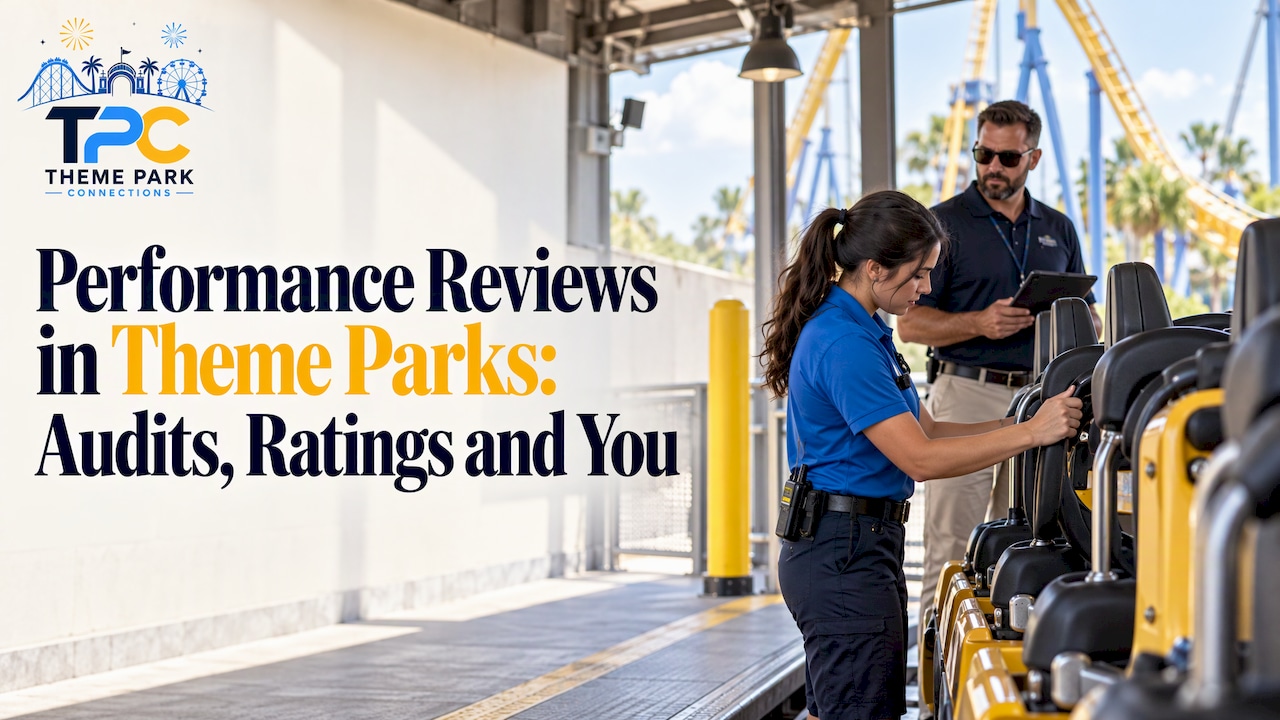
Performance Reviews in Theme Parks: Audits, Ratings and You

In theme parks, “performance review” means three different things: an operations audit of the park, the ratings guests give rides and parks, and the review of your own work as a team member. Each one looks at how well the park runs, and each affects your day-to-day job. This guide explains how all three work and how to use them to build a stronger park career.
TL;DR
- Park audits evaluate the whole operating day, from safety and attractions to food, retail and cleanliness, and they usually end with scored criteria and recommendations.
- Guest ratings are averages of subjective opinions. Score scales, sample sizes and rider experience all change what a number means.
- Guest complaints cluster around wait times, pricing, service and broken attractions, which are the areas frontline teams influence most.
- Your own review goes better when you collect examples through the season and ask for specific feedback before it happens.
- Next step: read the role guides for attractions, guest services and entertainment.
Table of Contents
- Three kinds of performance review in a theme park
- What a park operations audit evaluates
- How guests rate parks and rides
- What guests praise and complain about
- How to get ready for your own performance review
- Turning review feedback into a career move
- Our perspective
- Find your next park role with Theme Park Connections
- FAQ
- Sources
Three kinds of performance review in a theme park
People searching this phrase usually land on ride-rating sites. Those are one piece of the picture. A fuller view has three layers:
- Operational audits. Specialists, or an internal team, observe how the park actually runs and score it.
- Guest reviews and rankings. Visitors rate rides, parks, food and value, and sites turn those opinions into scores.
- Employee performance reviews. Your supervisor assesses your work, usually at set points in a season or year.
They connect more than they seem to. An audit finds a gap in how a ride is dispatched. Guests then write about long waits. Your supervisor later talks to you about dispatch consistency. If you understand all three, you can see why your feedback says what it says and what to do about it.
What a park operations audit evaluates
The whole park, not just rides
One independent park evaluation service describes its audit as covering the whole park, with a focus on safety and guest experience. That includes hazard sweeps, attractions and shows, food and beverage, retail, and cleanliness and wayfinding from the guest’s point of view. The same page describes the audits as on-site from open to close, covering every shift change and every part of the operating day.
For you as an employee, that means the audit sees more than the moment a ride is running smoothly at noon. It sees the opening checks, the handoff between shifts and the late-evening cleanup.
Unannounced observation
A ride-training company describes its ride-operations audits as unannounced, to capture a real-world snapshot of how operators perform. The practical takeaway is simple: the best preparation is doing the procedure the same way every time, with or without an observer.
What happens afterward
The same provider states that after an on-site audit it meets with park management to share results and recommend improvements. It also prepares a written report with scored audit criteria and a narrative summary. Findings usually flow down to teams as retraining, procedure refreshers or changes in how a position is staffed. Treat a refresher session as a normal part of the job, and ask your lead which findings it came from. That question shows you care about the standard.
How guests rate parks and rides
Different sites, different scales
Guest-facing rating sites do not all measure the same thing. Here is how a few published methods differ:
| Approach | How it scores | What it tells you |
|---|---|---|
| Expert coaster rating site | Five categories (coasters, rides, park, food, management), each driven by two criteria scored 0 to 10, then averaged | A reviewer’s experience-based judgment, adjusted by ride type |
| Ride-ranking blog | Four categories: thrill, intensity, theming and an “It” factor | A ranked list built on a consistent personal rubric |
| Survey-based awards | Visitors rate attractions from 1 to 5 across 235,000+ ratings, then responses are averaged | Satisfaction at scale, stronger with more submitted surveys |
Notice that “management” is one of the five categories in the first row. Guests and reviewers do judge how a park is run, even when they cannot see the procedures behind it.
Reading a number honestly
Scores are easier to use when you know what they mean. The coaster rating site says it weighs a ride’s strengths against coasters its reviewers have ridden worldwide. It also describes a 6 or higher as a genuinely solid ride and an 8 as incredibly hard to achieve. A 6 is not a poor result on that scale.
Sample size matters too. The survey-based awards page says accuracy depends on how many post-visit surveys are submitted. Another analysis from the same publisher split survey data into first-timers and returning visitors and compared how each group rated attractions. Who is rating changes the result.
Time matters as well. One writer on ride reviews notes that a review is a snapshot in time: a ride can feel different years later, later the same day or in a different car. A single bad review can reflect one day. A pattern across many reviews says more.
Park-wide reviews versus ride ratings
A ride rating asks, “How good was this attraction?” A park-wide review asks, “How well did the whole day work?” The park-wide view covers arrival and entry, hazards, attractions and shows, food, retail, cleanliness and wayfinding, as the audit description above shows. Many jobs sit in the second category: custodial, food and beverage, retail, guest services and entry. Your work may never appear in a ride ranking, but it can shape the park-wide score.
What guests praise and complain about
Research on visitor reviews gives a useful map of what matters to guests. A study of TripAdvisor postings found that guests wrote positively about rides, the physical environment, food and beverage, and well-managed lines. The same study found they wrote negatively about pricing, wait times, poor service, malfunctioning attractions, lack of variety, low-quality food and lack of updates.
A large study of Disneyland China reviews points the same direction. It reports that visitor satisfaction is highly related to service in the park and the playing feeling. It also found that, over time, reviews can reflect subjective feelings but the rating does not.
Price shapes the whole conversation. A 2026 U.S. visitor survey of 300 people reports that ticket cost was the top decision factor and top dealbreaker, both at 71%. The same report shows value perceptions differ between big operators. So when guests arrive already thinking about what they paid, the experience you create has more work to do.

Where your role fits
The items guests care about map onto jobs you can do something about:
- Well-managed lines: attractions teams, queue hosts and the people dispatching rides. See our guide to attractions and ride operations careers.
- Service quality and recovery: guest services, retail and food teams. Our guest services careers guide covers recovery skills.
- Delight and atmosphere: characters, performers and show crews. Explore entertainment careers.
How to get ready for your own performance review
Your supervisor’s review will probably touch the same themes: safety, consistency, guest interactions and teamwork. Park formats differ, so use your own park’s criteria as the final word. These steps work in almost any role.
Before the season or review period
- Ask what the criteria are. Ask your lead which areas the review covers and whether there is a scoring sheet or checklist.
- Learn the standard procedures cold. Audits often watch for consistency across the whole shift, so the routine you do at 9 a.m. should match the one at closing time.
- Request a mid-season check-in. A short conversation halfway through lets you adjust before the formal review.
During the season
- Keep a simple log. Write down guest compliments, problems you solved, shifts you covered and skills you learned.
- Note the numbers you can. Examples include trained new team members, reduced wait through a new queue approach, or zero missed checklist items over a month, if your park tracks them.
- Save guest feedback you receive. If a guest mentions you by name, tell your lead the same day.
In the review meeting
Come with two or three specific examples and one question about growth. You might say:
“One thing I’m proud of this season is how I handled the dispatch during the evening rush. I’d like to learn more about training roles. What would help me get there?”
That message does three things. It shows you pay attention, it gives your supervisor something concrete to write down, and it turns the conversation toward your next step.
If the feedback is hard to hear
Ask for one example of the behavior and one example of what “good” looks like. Then repeat the plan back in your own words: “So the goal is to complete the full checklist on every cycle, and you’ll check in with me in two weeks. Is that right?” A clear plan is more useful than a vague score, and it shows you are ready to improve.
Turning review feedback into a career move
Performance feedback is the raw material for your next role. A few ways to use it:
- Seasonal-to-returning: Specific examples from your log make a stronger case when you ask to come back next season.
- Cross-department moves: If guest feedback highlights your calm in busy moments, that applies to guest services, attractions and entertainment alike.
- Lead and trainer roles: Ask which behaviors your supervisor would want to see in a lead. Then practice them on shift.
- Updating your resume: Replace “worked at a ride” with specifics: “operated and dispatched a high-capacity attraction, followed safety checklists each cycle, and helped train new team members.”
One conversation with a more experienced team member can also reveal how their park’s review process works. That is where a peer community helps.
Our perspective
Reviews in this industry can feel one-sided, because audits, guest ratings and supervisor feedback often arrive without much explanation. We think they become far more useful when you can see how they connect.
A park audit finds a pattern. Guests describe it as a long line or a slow response. Your supervisor turns it into a coaching point. Once you see that chain, feedback stops feeling personal and starts feeling like a map.
That is why we built Theme Park Connections as more than a job board. Our platform combines job listings with practical guides and a community where current and aspiring team members share what they have learned. We want you to be able to ask a peer how they prepared for a review, how they moved from seasonal to returning, or how they stepped into a lead role.
You do not have to work this out alone, and the people who have been through it are often glad to help.
Mike
Find your next park role with Theme Park Connections
If your review points toward a new role, or you are starting out, Theme Park Connections brings together theme park job listings, career guides and a community of people who work in parks. You can browse roles across operations, entertainment, food and beverage, hospitality, maintenance, guest services, retail and leadership.

Visit Theme Park Connections to explore openings and join the conversation. Employers can also post openings to reach an audience already familiar with park work.
FAQ
What does a theme park performance audit check?
A whole-park audit can cover safety hazards, attractions and shows, food and beverage, retail, cleanliness and wayfinding. One provider describes on-site evaluations from open to close. Ride-operations audits may be unannounced and end with a written report of scored criteria.
How are theme park rides rated by visitors?
It depends on the site. Some use category scores from 0 to 10, and some ask visitors for 1 to 5 satisfaction ratings and average them. Both are subjective, and more responses generally make an average more reliable.
What do guests complain about most in theme park reviews?
An academic analysis of TripAdvisor postings found that wait times, pricing, poor service and malfunctioning attractions were frequent complaints. Many of these areas are shaped by frontline teams.
How can I prepare for my own review as a park employee?
Ask your lead what the criteria are, keep a simple log of examples through the season, and request a mid-season check-in. In the meeting, bring two or three specific examples and ask what would help you grow into your next role.
Should I trust a single bad review of a park or ride?
Treat one review as a snapshot. A ride can feel different on another day or in a different car. Patterns across many reviews tell you more than any one opinion.
Sources
- Park Operations Performance Evaluation (POPE)
- Operations Performance Auditing, International Ride Training
- Rating Evaluation, ParkRating
- The Definitive Ranking of Universal Orlando Coasters, TouringPlans
- 2025 Awards: Best Attractions at Disney World, TouringPlans
- Veterans vs. First-Timers, TouringPlans
- Making the grade with ride reviews, Arthur Levine
- Exploring thematic influences on theme park visitors’ satisfaction
- Customer delight and outrage in theme parks
- The 2026 TPDB VIBE report