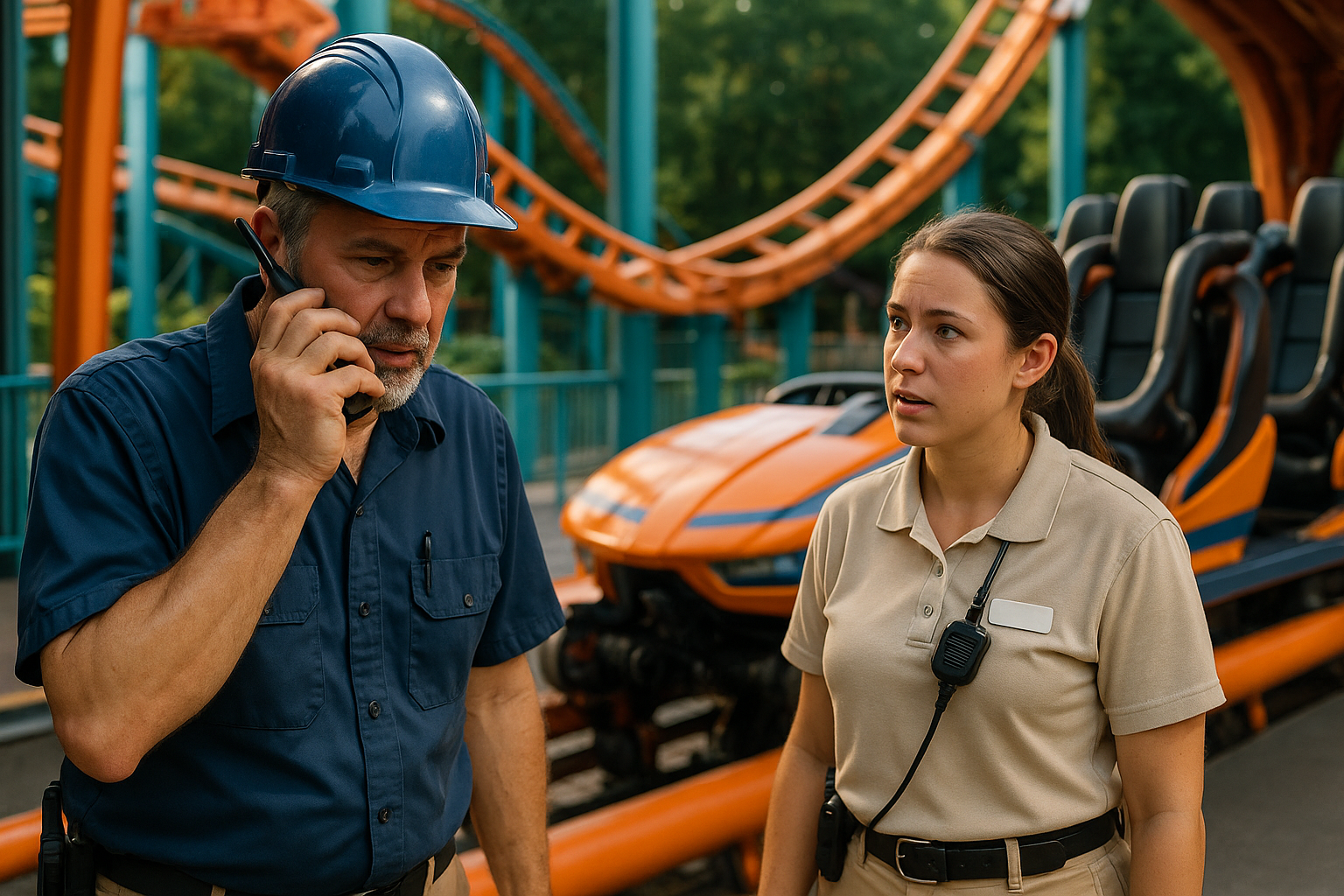
Better Downtime Calls: The Information Ride Technicians Need from Operators
When an attraction goes down, the first few minutes can shape everything that follows. Operators are focused on guests, communication, and maintaining a safe environment. Maintenance and engineering teams are trying to understand what happened, where it happened, and whether the attraction can return to service. A clear downtime call helps both departments move quickly. A vague or incomplete call can send technicians in the wrong direction, delay troubleshooting, and make an already stressful situation more difficult.
Strong communication during attraction downtime is not just a technical skill. It is an operational skill that affects guest experience, team confidence, and the speed of recovery. Operators do not need to diagnose a mechanical or electrical problem, but they do need to provide useful observations.
Why the First Report Matters
A technician may arrive at an attraction knowing only that it is “down.” That description is rarely enough. Many different situations can produce the same result: a ride stops, a restraint warning appears, a sensor does not confirm, or a system prevents the attraction from cycling.
The operator’s initial report gives the technician a starting point. It can help answer questions such as:
- Did the attraction stop during dispatch, movement, or unloading?
- Was the stop part of a normal operational sequence or an unexpected interruption?
- Did the system display a message, alarm, or indicator?
- Were there unusual sounds, smells, movements, or guest reports?
- Did the issue affect one vehicle, one position, or the entire attraction?
Even when the issue appears minor, accurate details can prevent unnecessary resets, repeated calls, or delays caused by searching the wrong area.
What Operators Should Include in a Downtime Call
1. Identify the attraction and exact location
Start with the attraction name and the specific area involved. If the attraction has multiple stations, lifts, load platforms, unload zones, control points, or show scenes, identify the relevant location as clearly as possible.
“The attraction is down” gives a technician very little to work with. “The vehicle stopped just before the unload position” is far more useful. If an attraction has multiple tracks or operating zones, include that information as well.
2. Explain what the attraction was doing
Describe the operating phase when the issue occurred. For example, the attraction may have stopped while:
- A vehicle was entering the station
- Guests were being dispatched
- A lift or conveyor was moving
- A vehicle was traveling through the course
- A restraint was being checked
- The unload process was taking place
This context helps maintenance narrow down which systems may be involved. It also gives the arriving technician a clearer picture of the event rather than only its final condition.
3. Report what you observed, not what you assume
Operators should focus on facts they personally saw, heard, or were told through an established communication channel. There is a significant difference between saying, “The restraint sensor failed,” and saying, “The restraint indicator did not change after the restraint was checked.” The first statement is a diagnosis. The second is an observation.
Useful details may include:
- A warning light or message on the operating panel
- A vehicle stopping in a specific position
- A repeated sound that was not present earlier
- A gate, door, or restraint that did not indicate its expected status
- A guest reporting unusual movement or noise
- An unexpected stop following a normal operation
Sticking to observable information protects the accuracy of the call and allows the technician to evaluate the situation without being influenced by an unsupported conclusion.
4. Mention whether the issue repeated
One isolated event and three similar events may require very different troubleshooting approaches. If the attraction experienced the same warning during multiple dispatches, tell the technician. If the issue occurred only once and the attraction operated normally afterward, include that detail too.
A simple timeline can be helpful: “The first cycle completed normally. On the second cycle, the vehicle stopped near the station entrance. After the attraction was reset according to procedure, the warning returned during the next dispatch.”
5. Share relevant guest or employee information
If a guest reported a sensation, sound, or unusual movement, pass along the information accurately. Avoid exaggerating or dismissing the report. Details such as the row, seat, vehicle, or approximate location may be important.
Employee observations matter as well. An operator, attendant, trainer, or supervisor may notice a difference in sound, timing, or movement. Make sure those observations are communicated through the appropriate channel so the technician does not have to collect the same information repeatedly.
Information That Can Slow Down Troubleshooting
Downtime is often stressful, especially when guests are waiting and leaders are requesting updates. That pressure can lead to communication habits that make troubleshooting harder.
Speculation presented as fact
Operators may have experience with similar issues and recognize a possible pattern. That knowledge can be useful, but it should be clearly labeled as a possibility. “We have seen a similar warning before” is more helpful than “It is definitely the same problem.”
Too much unrelated detail
A complete report does not need to include every event from the shift. Focus on information connected to the downtime. If the technician needs additional context, they can ask follow-up questions.
Changing the story under pressure
When several people ask what happened, details can become inconsistent. If you are unsure about something, say so. It is better to state, “I did not see the vehicle stop, but I was told it stopped near the station exit,” than to present secondhand information as something you personally witnessed.
Using unclear location terms
Words such as “over there,” “the back,” or “the other side” may be obvious to one employee and confusing to another. Use established attraction terminology whenever possible. If you are new, ask a trainer or supervisor to help you learn the location names used by your department.
A Simple Structure for Clear Communication
Operators can organize a downtime call using a basic sequence:
- Where: Identify the attraction and exact location.
- When: Explain when the issue occurred in the operating cycle.
- What: Describe the warning, stop, sound, movement, or condition observed.
- Repeat: State whether the issue happened once or multiple times.
- Impact: Mention whether guests or employees were affected and whether the attraction is currently in a safe, stable condition according to established procedures.
This structure is not a replacement for department-specific communication protocols. It is a way to make sure the most useful information is included before the technician begins asking questions.
Building Better Operator-Technician Relationships
Effective downtime communication improves when operators and technicians understand each other’s responsibilities. Operators are not expected to repair equipment or bypass required controls. Technicians are not expected to know exactly what the operator saw unless it is communicated clearly.
After a downtime event, take a moment to learn from the interaction. Ask appropriate questions when operations have stabilized:
- Was the information provided useful?
- Was there a detail the technician needed but did not receive?
- Are there location names or system terms the team should review?
- Would a written handoff help if the issue continues across shifts?
These conversations should be focused on improving future communication, not assigning blame. A respectful relationship between operations and maintenance makes it easier for employees to speak up about unusual conditions before they become recurring problems.
Why This Skill Helps Your Career
Clear downtime reporting demonstrates situational awareness, professionalism, and respect for safety boundaries. It also shows that you understand how your role affects other departments.
Those skills are valuable for operators, leads, trainers, supervisors, dispatchers, technicians, and managers. Employees who communicate accurately during difficult situations often become trusted points of contact during busy operations, special events, and complex troubleshooting efforts.
You do not need to be the loudest person on the radio or know every technical term. You need to be precise, calm, observant, and honest about what you know. In a theme park environment, that kind of communication can save time and help the entire team return to normal operations more effectively.
Connect with More Attractions Industry Professionals
Downtime communication is one example of how different theme park departments depend on one another. At ThemeParkConnections.com, people working throughout the attractions industry can connect with other professionals, expand their networks, share experiences, and learn how different departments operate.
Whether you work in attractions, maintenance, operations leadership, hospitality, entertainment, food and beverage, retail, or guest services, Theme Park Connections can help you discover career opportunities and build relationships throughout the industry.