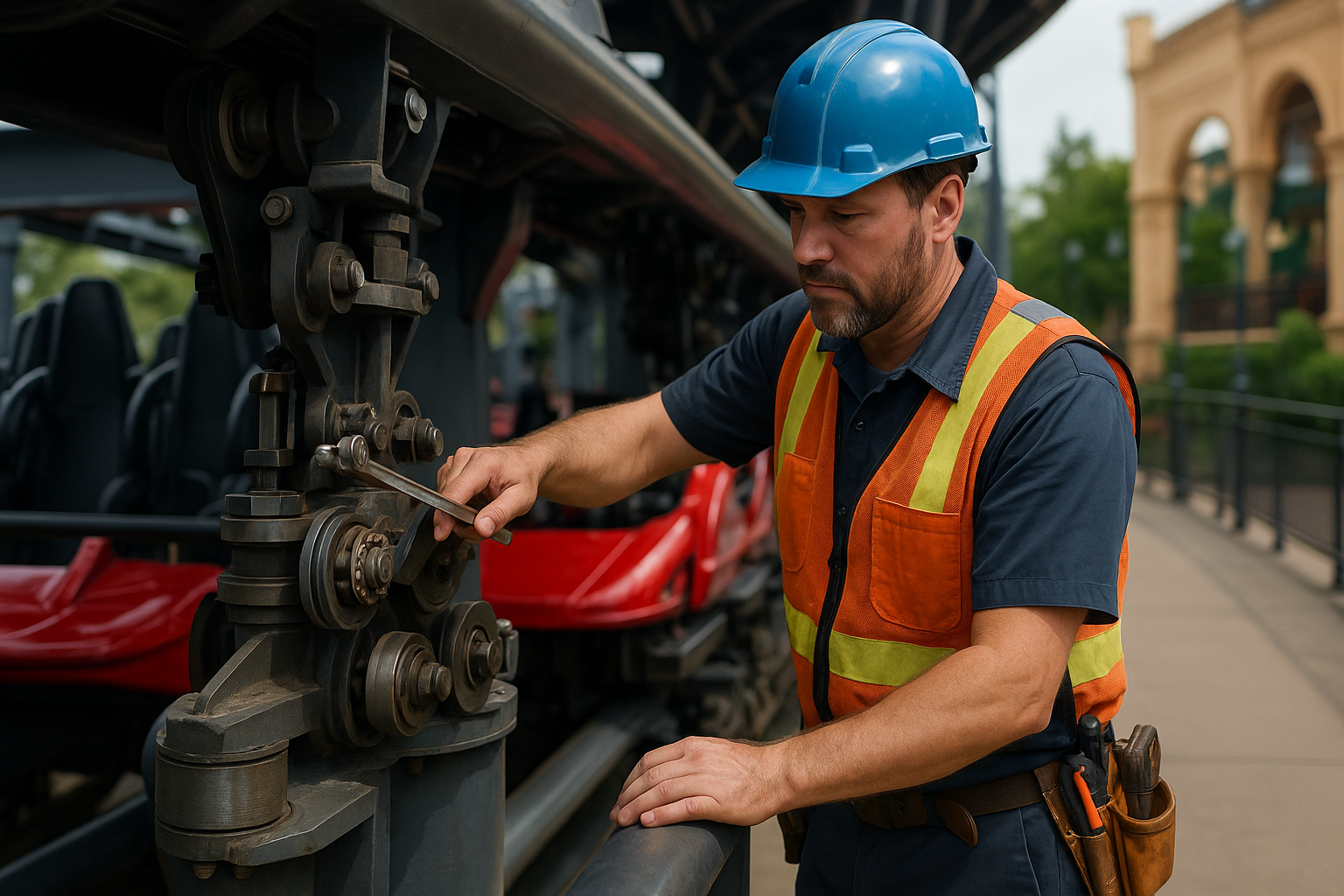
From Guest Report to Ride Return: How Theme Park Maintenance Teams Prioritize Repairs
When a guest reports a strange noise, a malfunctioning light, or a problem with a queue gate, the issue may appear simple from the outside. Behind the scenes, however, that report enters a larger process involving operations employees, maintenance technicians, supervisors, safety teams, and sometimes several departments at once.
For theme park maintenance employees, the challenge is not only repairing equipment. It is determining what needs attention first, what information is missing, and when an attraction or facility is ready to return to service. Understanding that process can help new maintenance employees work more effectively and help employees in other departments communicate better with technical teams.
Why Maintenance Priorities Are Not Always Obvious
A theme park can have hundreds of moving parts operating at the same time. A non-functioning decorative light, a leaking sink, an unusual vibration, and a ride stoppage may all be reported during the same shift. They cannot necessarily be handled in the order they were received.
Maintenance teams typically consider several factors when evaluating a work request:
- Whether the issue creates a safety concern
- Whether the problem affects guests, employees, or both
- Whether the equipment is essential to attraction operation
- Whether the condition is getting worse
- Whether the issue affects accessibility or emergency access
- Whether the repair can be completed while the area remains open
- Whether specialized tools, parts, or additional personnel are needed
A broken display may be visible and frustrating, but a small fluid leak near moving equipment may require more immediate attention. Maintenance prioritization depends on risk and operational impact, not just visibility.
The Quality of the Initial Report Matters
One of the most useful skills a maintenance employee can develop is learning how to get clear information from the person who reported a problem. A vague report such as “the ride sounds wrong” may be an accurate observation, but it does not give a technician enough detail to begin troubleshooting efficiently.
Useful questions to ask
- What exactly did you observe?
- Where did the issue occur?
- When did it begin?
- Did it happen once or repeatedly?
- Was the equipment operating at the time?
- Did anyone notice a change in sound, smell, movement, temperature, or appearance?
- Did the issue occur under a particular condition?
- Was anyone injured or placed at risk?
For example, “the gate is broken” could mean several different things. It might not latch, it might drag against the ground, it might have a damaged hinge, or it might simply be difficult for guests to open. Each description points the technician toward a different starting point.
Employees who work in attractions, custodial operations, food and beverage, entertainment, or guest services can make maintenance responses faster by reporting observations instead of conclusions. Say what you saw, heard, smelled, or experienced rather than attempting to diagnose the cause.
Safety Concerns Usually Change the Entire Response
Some issues can wait for a scheduled repair window. Others require immediate communication and evaluation. A loose handrail, exposed wiring, a damaged walking surface, smoke, an unusual mechanical sound, or a door that will not secure properly may affect how an area is operated until the problem is assessed.
Employees should follow their employer’s reporting and escalation procedures rather than improvising. Depending on the situation, that may involve notifying a supervisor, contacting a maintenance or facilities team, restricting access, pausing an operation, or documenting the condition.
Maintenance employees should also be prepared for incomplete information. A report may arrive during a busy operating period, after a guest interaction, or through a radio transmission where details are difficult to hear. Clarifying the report is not being difficult; it is part of preventing assumptions from entering a safety-related decision.
Diagnosing the Problem Without Creating a New One
Once a technician arrives, the first task is not always to replace a part. It may be to confirm the reported condition, inspect the surrounding area, review recent work, or determine whether the symptom is caused by another component.
This is where disciplined troubleshooting becomes valuable. Experienced technicians avoid changing multiple variables at once. They observe the condition, identify possible causes, test within approved limits, and document what they find. Replacing a part without understanding the underlying problem can result in repeat failures or make the original issue more difficult to diagnose.
A strong maintenance mindset includes questions such as:
- Is the reported symptom still present?
- Could another system be causing the issue?
- Has this equipment experienced a similar problem recently?
- Are environmental conditions contributing to the failure?
- Does the repair address the cause or only the visible symptom?
- What testing is needed before the equipment is returned to operation?
For employees building a career in maintenance, this way of thinking is often more valuable than simply memorizing a list of repairs. Technical knowledge matters, but so do observation, patience, documentation, and the ability to make careful decisions under pressure.
Temporary Fixes Require Clear Communication
Not every issue can be fully repaired immediately. A replacement part may need to be ordered, a specialized technician may not be available, or a permanent repair may require the attraction or facility to remain closed for an extended period.
In those situations, the maintenance team may determine that a temporary measure is appropriate, or the area may need to remain unavailable until a complete repair can be made. The key concern is that temporary conditions must be understood by the employees responsible for operating or monitoring the area.
A successful handoff should communicate:
- What was found
- What action was taken
- What remains unresolved
- What conditions require additional reporting
- Whether follow-up work is scheduled or still pending
Maintenance employees should avoid assuming that everyone involved knows the status of an issue. An operations team may change during a shift, and a new employee may not have heard the earlier conversation. Clear notes and direct handoffs help prevent the same problem from being reported repeatedly—or, worse, overlooked because someone assumes it has already been resolved.
Returning Equipment to Service
A repair is not necessarily complete when the replacement part is installed or the visible problem disappears. The equipment must be evaluated according to the applicable procedures, and the appropriate operational or technical personnel must understand that the work is finished.
The return-to-service conversation should be specific. Instead of saying “it should be good now,” communicate what was repaired, what was tested, and whether any follow-up observation is needed. If the issue could reappear under certain conditions, that information should be included in the handoff.
This is especially important for attractions and other guest-facing systems where employees may notice subtle changes during operation. Operators, attendants, and supervisors can provide useful feedback after a repair, but they need to know what to watch for and whom to contact if the condition returns.
Building Trust Between Maintenance and Operations
Strong relationships between technical and operating teams do not require everyone to understand every part of the other department’s job. They do require mutual respect.
Operations employees should understand that a technician may need time to inspect a problem rather than immediately reset or replace something. Maintenance employees should remember that operators are often the first people to notice changes because they work with the equipment throughout the day.
Trust grows when both departments:
- Report conditions accurately
- Avoid blaming individuals for equipment failures
- Share relevant information during handoffs
- Respect required boundaries and procedures
- Follow up when a recurring issue is identified
- Recognize the value of the other team’s experience
For employees hoping to advance into lead, planner, supervisor, or technical specialist roles, this cross-department communication is a major professional skill. The best maintenance employees are not only capable with tools and systems; they can explain technical information clearly to people who do not work in maintenance.
What New Maintenance Employees Can Practice
New employees can begin developing strong habits before they are responsible for complex repairs. Keep reports factual, take useful notes, ask questions when instructions are unclear, and learn how your department documents completed work.
Pay attention to patterns. A recurring issue may reveal a larger need for preventive maintenance, training, environmental control, or equipment redesign. You may not be responsible for solving the larger problem yet, but recognizing the pattern and communicating it can make a meaningful contribution.
In theme parks, a successful repair is measured by more than how quickly a problem disappears. It is measured by whether the issue was evaluated carefully, communicated accurately, documented properly, and resolved in a way that supports safe and reliable operation.
Theme Park Connections gives professionals across maintenance, attractions, operations, hospitality, entertainment, food and beverage, retail, and guest services a place to connect with other industry professionals. By sharing experiences, learning about different departments, discovering career opportunities, and expanding your professional network, you can better understand how the entire attractions industry works—and where your own skills may lead next.