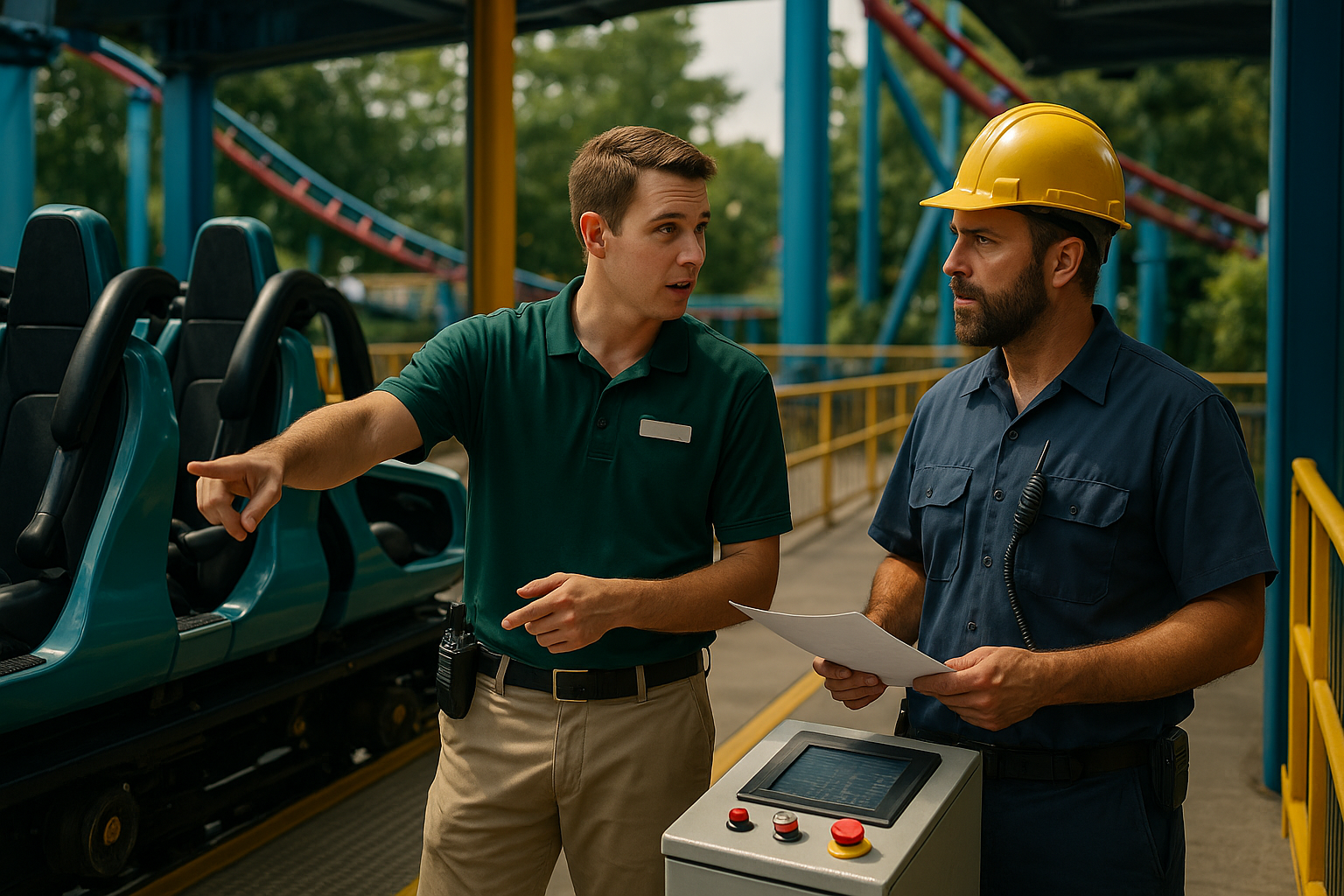
When a Ride Goes Down: Building Better Communication Between Operations and Maintenance
Ride downtime is part of working in the attractions industry. Even with careful inspections, strong training, and well-maintained equipment, an attraction may occasionally stop operating because of a technical issue, an unusual sound, a sensor reading, or a condition that requires investigation.
What happens next often depends on the quality of communication between the ride operations and maintenance teams. A clear, useful report can help technicians identify the problem faster. A vague or incomplete handoff can lead to repeated questions, longer downtime, and frustration for both employees and guests.
Good downtime communication is not about assigning blame. It is about creating an accurate picture of what happened so the right people can respond safely and efficiently.
Why the First Report Matters
Ride operators are often the first employees to notice that something is different. They may hear an unfamiliar noise, observe an unexpected stop, notice a change in vehicle movement, or receive a guest report about unusual behavior. Maintenance technicians then rely on that information when beginning their assessment.
The initial report can provide important clues, including:
- What happened immediately before the ride stopped
- Which train, vehicle, or operating position was involved
- Whether the issue occurred during dispatch, movement, braking, unloading, or another part of the cycle
- Any unusual sounds, smells, vibrations, or visual conditions
- Whether the issue occurred once or more than once
- What actions were already taken by the operations team
A report such as “the ride stopped” may be accurate, but it does not give a technician much to work with. A stronger report might explain that the second vehicle stopped approaching a particular section, the operator heard a repeated clicking sound, and the same sound had been noticed during the previous cycle.
Specific observations are more helpful than conclusions. An operator may believe a sensor failed, but the most useful information is what the operator actually saw or heard.
Describe What You Observed, Not What You Assume
One of the most common communication problems during downtime is confusing an observation with a diagnosis. Operations employees should not be expected to determine the technical cause of a problem unless that responsibility is part of their training. Their role is to communicate what they experienced clearly.
Less useful descriptions
- “The computer is broken.”
- “The brakes failed.”
- “The train was acting weird.”
- “It is probably the sensor again.”
More useful descriptions
- “The ride stopped after the vehicle passed the first set of brakes.”
- “The operator noticed a sharp metallic sound during the final portion of the cycle.”
- “The same fault message appeared twice during dispatch.”
- “The vehicle paused longer than usual before continuing.”
This distinction helps maintenance technicians investigate without being anchored to an incorrect assumption. It also creates a more accurate record for employees who may become involved later in the response.
The Information Maintenance Teams Need
Every park has its own communication tools and procedures, but the basic information needed during a downtime event is broadly similar. Before contacting maintenance, an operations employee should gather as much accurate information as the situation allows.
Useful details may include:
- The attraction name and exact operating location
- The approximate time the issue occurred
- The vehicle, train, theater, lift, platform, or operating position involved
- The ride cycle or sequence during which the issue occurred
- Any visible indication, alarm, message, or status change
- Whether guests or employees reported an unusual condition
- Whether the condition is still present
- Whether the attraction experienced a similar issue earlier in the shift
Employees should follow their department’s established communication process rather than creating their own. In some locations, that may involve a radio call, a digital log, a phone call, or a combination of methods. The key is to make sure the information reaches the appropriate person and is recorded according to local expectations.
Radio Communication During a Downtime Event
Radio traffic can become busy quickly when an attraction is unavailable. Operations may be coordinating guests, communicating with leadership, and managing nearby positions while maintenance is trying to understand the problem. Clear radio habits help everyone focus on the information that matters.
A strong radio message is brief, calm, and organized. It should identify the attraction, state the current condition, and summarize the important observation.
For example:
“Maintenance, this is Operations at the east-side coaster. The attraction is stopped with the train clear of the station. The operator heard a repeated clicking sound near the rear of the train during the last cycle. No visible damage was observed.”
This message gives the responding team a starting point without overwhelming the radio channel. Additional details can be shared when the technician arrives or when the appropriate person asks follow-up questions.
Employees should avoid discussing speculation, personal opinions, or unnecessary details over a shared channel. If information is sensitive or too complex for the radio, follow the department’s process for communicating it privately.
Creating a Useful Shift Handoff
Downtime may continue beyond the shift of the employee who first observed the issue. A proper handoff prevents the next team from having to reconstruct the event from memory.
A good handoff should explain:
- What occurred and when
- What symptoms were observed
- Who was notified
- What response or assessment has already taken place
- Whether the attraction is operating, closed, or operating with specific restrictions
- What information still needs to be monitored
For example, telling the incoming operator, “Maintenance checked it and it is fine,” leaves too many unanswered questions. A better handoff would identify what maintenance inspected, what the current operating status is, and whether the team was asked to watch for a particular sound, message, or movement.
Handoffs should remain factual. Avoid exaggerating an incident or minimizing it because the attraction returned to operation. An issue that was resolved still needs to be communicated accurately so recurring patterns can be recognized.
Respecting the Difference Between Urgency and Panic
Some downtime situations require immediate escalation. Others involve a minor irregularity that can be assessed through the normal process. Employees need to understand the difference without treating either situation casually.
Urgent communication should clearly identify conditions such as an injury, smoke, fire, fluid leak, unusual mechanical movement, guest evacuation concern, or anything that may present an immediate safety risk. Employees should follow their training and local emergency procedures in those situations.
For non-emergency issues, calm communication is still essential. A louder voice or repeated radio calls do not make a technician arrive faster. Providing precise information, staying available for questions, and helping manage the attraction’s operational needs are usually more productive.
Skills That Make Employees Better Communicators
Strong downtime communication is a professional skill that applies across the attractions industry. Employees can improve by practicing a few habits:
- Pay attention to sequence. Notice what happened immediately before the issue.
- Use neutral language. Report facts without assigning blame.
- Remember details. Time, location, vehicle, and repeated symptoms can all matter.
- Ask clarifying questions. Confirm information rather than guessing.
- Listen to technical teams. Maintenance may explain what employees should monitor after the attraction returns to operation.
- Document according to procedure. A written record can reveal patterns that are not obvious during one shift.
These habits can help employees become more effective operators, trainers, leads, and supervisors. They also demonstrate that an employee understands the broader operation rather than focusing only on one position.
Downtime Is a Team Effort
Attractions operate best when operations and maintenance view downtime as a shared responsibility. Operations employees provide frontline observations and help manage the guest experience. Maintenance employees investigate technical conditions and determine what work is necessary. Leadership helps coordinate communication, staffing, and reopening decisions.
Each team sees a different part of the same event. When those perspectives are communicated clearly, the response becomes more organized and professional. The result may be faster troubleshooting, better documentation, and a safer return to operation.
For professionals building careers in the attractions industry, learning to communicate during downtime is valuable experience. It shows reliability under pressure, respect for technical expertise, and an understanding that safe operations depend on accurate information.
ThemeParkConnections.com gives people working throughout the theme park and attractions industry a place to connect with other professionals, share experiences, learn about different departments, discover career opportunities, and expand their networks. Conversations about operational communication, maintenance partnerships, and everyday challenges can help employees better understand the many roles that keep attractions running.