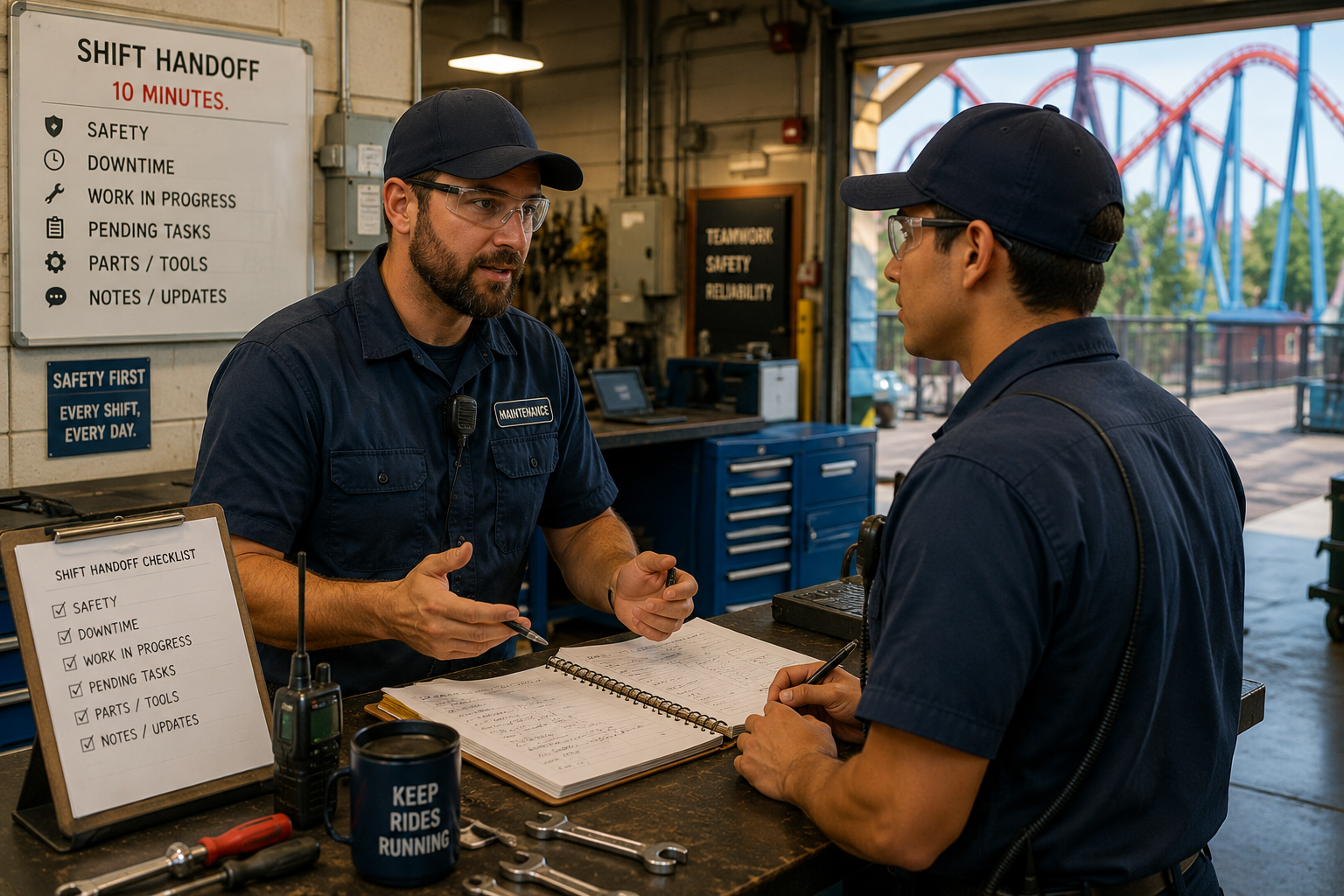
The 10-Minute Handoff: What Theme Park Maintenance Teams Need to Pass Between Shifts
A maintenance shift does not truly end when the next team clocks in. In a theme park, unfinished work, temporary fixes, unusual equipment behavior, and environmental conditions can carry directly from one crew to the next. A clear shift handoff helps the incoming team understand what happened, what still needs attention, and what risks should be monitored.
Poor handoffs create avoidable confusion. A technician may repeat an inspection that was already completed, overlook a developing issue, or assume that another person is handling a repair. Strong handoffs protect employees, support reliable operations, and help other departments make better decisions throughout the day.
Why Maintenance Handoffs Matter
Theme park maintenance teams often work around attractions, resort facilities, food service equipment, utilities, landscaping systems, and guest areas. Many issues develop gradually rather than failing all at once. A pump may be running louder than usual. A door may close inconsistently. A lighting circuit may be resetting intermittently. A ride component may pass an inspection but still require observation.
The outgoing technician may have the most useful context because they saw the issue develop. If that information does not reach the next shift, the team loses valuable operational knowledge.
A useful handoff should answer four basic questions:
- What happened?
- What was checked or repaired?
- What remains unresolved?
- What should the next team watch, complete, or communicate?
The goal is not to provide a long narrative. The goal is to give the incoming employee enough accurate information to make safe, informed decisions.
What to Include in a Theme Park Maintenance Shift Handoff
1. Equipment or Location
Start with the exact asset, area, or system involved. “Water issue near the back” is not specific enough for someone entering a large park or resort property. Identify the attraction, building, room, utility area, kitchen line, guest pathway, or equipment tag when applicable.
Clear location details reduce the time spent searching and prevent work from being performed on the wrong asset. If several pieces of equipment are similar, use the identifying information available through the organization’s normal work-order or asset-tracking process.
2. The Original Problem
Describe the initial complaint or observed condition in plain language. Include who reported it when that context is useful, such as an attraction operator noticing an unusual sound or a food-and-beverage employee reporting that a refrigeration unit was warming.
Do not replace the original symptom with a guess. “Fan was cycling on and off” is more useful than “bad motor” if the motor has not been confirmed as the cause.
3. Actions Already Taken
Explain what the outgoing shift inspected, adjusted, repaired, isolated, or documented. This prevents duplicate work and gives the incoming technician a starting point.
Depending on the situation, the handoff may include:
- Inspections completed
- Parts replaced or requested
- Temporary adjustments made
- Areas cleaned, dried, cleared, or secured
- Readings or observations recorded
- Work orders opened or updated
- Other departments notified
Be precise about what was completed and what was not. “Checked” can mean several different things. If the distinction matters, say whether the team performed a visual inspection, tested operation, reviewed a control panel, or completed another approved troubleshooting step.
4. Current Status
The next team needs to know whether the issue is fully resolved, temporarily controlled, awaiting parts, under observation, or unable to be reproduced.
Useful status descriptions include:
- Operating normally after repair
- Operating with continued monitoring recommended
- Temporarily restored pending a permanent repair
- Removed from service or isolated according to established procedures
- Issue not reproduced during the inspection
- Waiting for a part, vendor, specialist, or additional authorization
Avoid vague phrases such as “looks good” or “should be fine.” Those statements do not tell the incoming employee what was verified or what uncertainty remains.
Separate Facts From Assumptions
One of the most valuable maintenance communication skills is knowing the difference between an observation and a conclusion.
For example:
- Observation: A breaker reset twice during testing.
- Assumption: The breaker is defective.
The first statement can be documented confidently. The second may require further testing by an appropriately qualified employee. A handoff should preserve facts without presenting an unconfirmed diagnosis as settled information.
This distinction is especially important when several departments rely on the update. Operations leaders, facilities teams, guest services, or event staff may make decisions based on maintenance information. Accurate uncertainty is more useful than false confidence.
Communicate Operational Impact
Maintenance work rarely affects only the maintenance department. A repair may influence attraction availability, a restaurant’s equipment capacity, a hotel room’s readiness, backstage access, guest pathways, or the timing of an event setup.
The handoff should identify operational impact when appropriate. The incoming team may need to know that:
- An attraction is operating under additional observation
- A work area requires coordination before access
- A guest-facing space needs a follow-up inspection
- A temporary condition may affect another department’s schedule
- A repair could become more difficult during a parade, event, or peak operating period
This does not mean maintenance employees should make decisions outside their authority. It means they should ensure the right people have the information needed to make those decisions.
Use a Consistent Handoff Structure
Every team develops its own communication habits, but consistency makes handoffs easier to understand. A simple structure might follow this order:
- Location or asset
- Reported condition
- Work completed
- Current status
- Next action
- People or departments already notified
For example, an outgoing technician might explain that a service-area door was reported as sticking, the hinges and closer were inspected, the issue improved after an adjustment, and the door should be checked again during the next operating period. That handoff gives the incoming employee a clear task without exaggerating the repair’s success.
Written records and verbal communication should support each other. If the official work-order system contains the technical details, the verbal handoff can focus on the information most important for the next few hours. If the issue is complex or safety-sensitive, do not rely on memory or an informal conversation alone.
Common Handoff Mistakes
Passing Along Too Little
“It’s on the list” does not tell the next shift whether the issue is urgent, stable, or already being handled. Include enough context for the incoming employee to prioritize correctly.
Overloading the Handoff With Irrelevant Detail
A long story can hide the most important information. Lead with the asset, status, and next action. Add background details only when they help the incoming team understand the situation.
Failing to Mention Temporary Fixes
A temporary adjustment may restore operation without eliminating the underlying problem. Make that distinction obvious so the next technician does not treat a short-term solution as a permanent repair.
Assuming Everyone Has the Same Knowledge
The employee receiving the handoff may be new to the area, covering a different assignment, or unfamiliar with the equipment. Use clear language and explain abbreviations when there is any chance of confusion.
Not Confirming Understanding
A handoff is a two-way conversation. The incoming employee should be able to ask questions, repeat back the next step, or clarify what still needs to be monitored. A brief confirmation can prevent an entire shift of misunderstanding.
Build Handoff Skills That Support Career Growth
Strong technical ability matters, but communication often determines how effectively that ability is used. Employees who provide organized, accurate handoffs become trusted sources of information for their coworkers and leaders.
These skills can support future opportunities such as:
- Training new technicians
- Coordinating work across departments
- Serving as a lead or subject-matter resource
- Supporting preventive maintenance planning
- Participating in operational readiness meetings
- Communicating with vendors or specialty contractors
The best handoff is not the most detailed one. It is the one that gives the next team a reliable understanding of the situation, the remaining uncertainty, and the next responsible action.
Keep the Next Shift Moving
A well-run theme park depends on hundreds of decisions made throughout the day. Maintenance shift handoffs help preserve the information behind those decisions. When employees clearly communicate what they observed, what they completed, and what still needs attention, the entire operation benefits.
For professionals working in maintenance, engineering, facilities, or any department that depends on technical support, communication is part of the job—not an extra task after the real work is finished.
Theme Park Connections gives people throughout the theme park and attractions industry a place to connect with other professionals, share experiences, learn about different departments, discover career opportunities, and build relationships across the industry. Those connections can provide valuable perspective on operational practices, career paths, and the skills that help employees grow.